Alon naval drills in the South China Sea. Philippines, Australia, and Canada project deterrence
The Philippine Armed Forces confirmed the completion of large-scale joint naval exercises east of Scarborough Shoal in the South China Sea, conducted together with Australia and Canada. According to the U.S. Naval Institute (USNI), the operation represented the largest military deployment in Southeast Asia since the 1999 East Timor crisis.
security navy worldwide news29 august 2025 | 21:42 | Source: Gazeta Morska | Prepared by: Kamil Kusier | Print
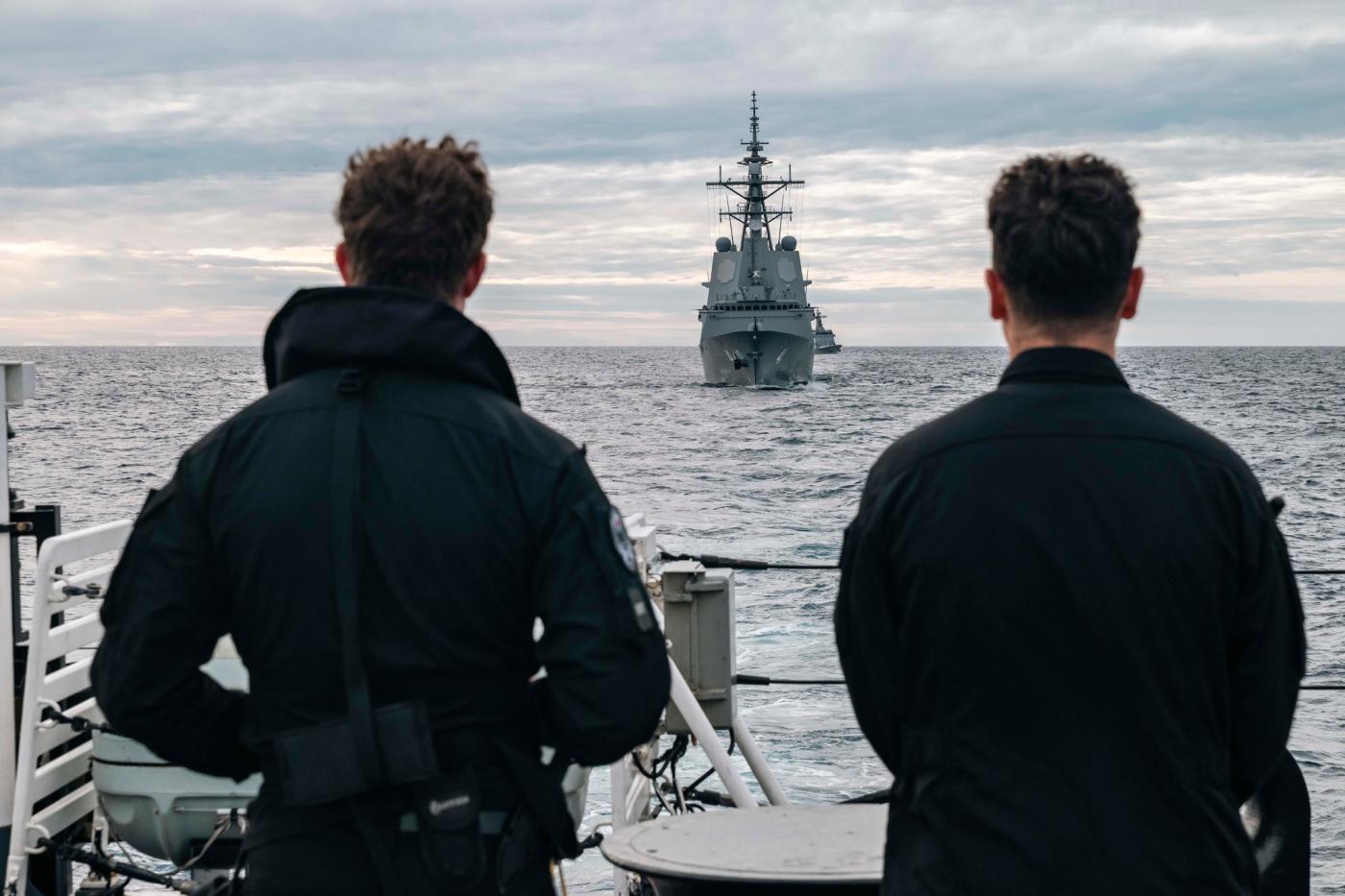
fot. cpl Brendan Gamache
Codenamed exercise Alon, the drills carried a strong strategic message – a coordinated show of presence and deterrence aimed at Beijing, which continues to assert unilateral claims over disputed waters.
Assets and participants
Each nation committed key surface and air assets to the exercise:
- Philippines – missile frigate BRP Jose Rizal, seven infantry divisions, tanks, helicopters (S-70i Black Hawk, T-129 ATAK, AW109), and A-29 Super Tucano attack aircraft,
- Australia – destroyer HMAS Brisbane, F/A-18F Super Hornet and EA-18G Growler jets, C-130J Hercules transports, and a P-8A Poseidon patrol aircraft,
- Canada – frigate HMCS Ville de Québec with embarked CH-148 Cyclone helicopter.
In total, over 3,600 sailors and troops took part. Training scenarios included air defense against simulated strikes, amphibious landings, beach assaults, anti-submarine warfare, and integrated fighter and rotary-wing operations.
Strategic importance
Scarborough Shoal lies roughly 240 km from the Philippine coast and 900 km from mainland China. Situated along one of Asia’s most critical maritime trade routes, the area has been a flashpoint since Beijing asserted control in 2012, barring Filipino fishermen and triggering repeated stand-offs at sea.
Notably, during exercise Alon no Chinese naval or air assets appeared in the vicinity, a fact highlighted by the Philippine Armed Forces as allowing the full scope of operations without risk of escalation.
Implications
Alon underlines growing security cooperation among regional and extra-regional partners in response to China’s expanding maritime posture. For the Philippine Navy, participation in such a comprehensive, high-intensity drill marks a significant step toward enhanced operational readiness and interoperability with allied forces.
Buy us a coffee, and we’ll invest in great maritime journalism! Support Gazeta Morska and help us sail forward – click here!
Kamil Kusier
redaktor naczelny
comments
Add the first comment
see also
Strait of Hormuz at a strategic crossroads: sinking of IRIS Dena and implications for maritime transport
The submarine contract of the decade? Canada weighs South Korea against Germany
When two powers clash, Poland must be ready to act. Military security must be the priority
Commodore Przemysław Karaś appointed deputy commander of the Maritime Operations Centre - Naval Component Command
Radmor hosts delegation from the Republic of Turkey. Advancing maritime security cooperation
French Navy expands global operations from the Pacific to the Red Sea
"Let everyone know we will prevail". Poland’s armed forces set strategic course for 2026-2039
“Army 500” and strategic transformation: Poland sets the course for long-term deterrence and allied readiness
Medical evacuation from offshore vessel in the Baltic. Rescue 511 helicopter and m/s Huragan deployed
Karol Nawrocki: “The strength of the republic lies in its armed forces”. Security requires national unity
ADVERTISEMENT
ADVERTISEMENT