









Maersk christens dual-fuel container ship "Adrian Mærsk" in Rotterdam - a step towards sustainable shipping
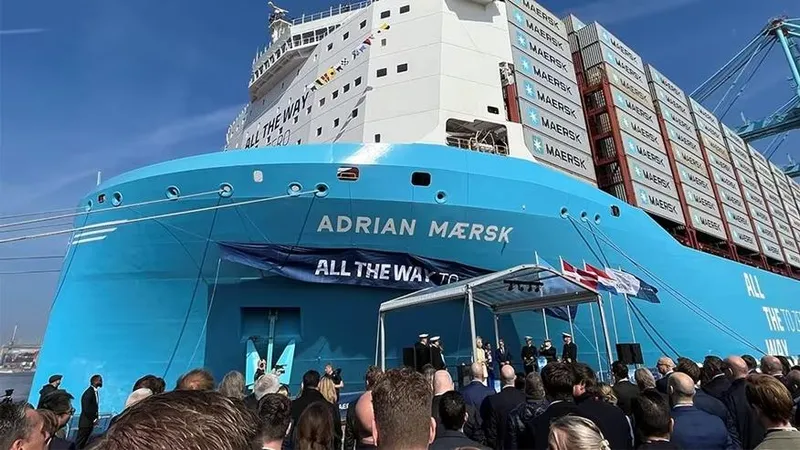
Maersk has officially christened the modern dual-fuel container vessel ‘Adrian Mærsk’ at the APM Terminals Maasvlakte II in Rotterdam. The vessel, with a capacity exceeding 16,000 TEU (twenty-foot equivalent unit), is a crucial part of Maersk’s decarbonization strategy for maritime transport. Stephanie Pullings Hart, executive vice president and chief operations officer (COO) of Nestlé, one of Maersk’s key partners in sustainable shipping, was named the ship’s godmother.
In brief
Maersk has christened the dual-fuel container ship Adrian Mærsk at the APM Terminals Maasvlakte II terminal in Rotterdam. Adrian Mærsk has a capacity exceeding 16,000 TEU, and Stephanie Pullings Hart, chief operating officer of Nestlé, served as godmother. Nestlé ships 100 percent of its cargo with Maersk under the ECO Delivery Ocean programme, cutting greenhouse gas emissions by more than 80 percent compared with conventional fuels. After its maiden voyage Adrian Mærsk will join the Asia to Mediterranean route in Maersk's East-West network, which targets schedule reliability above 90 percent.
Dual-fuel technology and sustainable maritime transport
Nestlé, in line with its carbon reduction goals, ships 100% of its cargo via Maersk under the ECO Delivery Ocean program. This initiative utilizes alternative fuels, reducing greenhouse gas (GHG) emissions by over 80% compared to conventional fossil-based fuels.
- Dual-fuel vessels demonstrate that the technology for the energy transition in shipping is already available. The key now is the decisions to be made by the International Maritime Organization (IMO) in London next month. We urgently need regulations that support the adoption of fuels that significantly cut GHG emissions. At the same time, ambitious customers like Nestlé play a pivotal role in driving the green transformation of the shipping and logistics sectors, said Karsten Kildahl, chief commercial officer (CCO) of Maersk.
Following its maiden voyage from Rotterdam, ‘Adrian Mærsk’ will serve the Asia-Mediterranean trade route. It will be integrated into Maersk’s new east-west network, which aims to achieve schedule reliability above 90%.
Nestlé and Maersk – a partnership for zero-emission logistics
- At Nestlé, we recognize climate change as one of the greatest challenges of our time. As a global leader in the food and beverage industry, we are committed to taking decisive action to combat it. We have already achieved a 20% reduction in greenhouse gas emissions by 2024, ahead of our 2025 target, and our ambition is to reach net zero by 2050. Our green logistics efforts, including our partnership with Maersk, demonstrate our commitment to a sustainable future, emphasized Stephanie Pullings Hart, COO of Nestlé.
Bio- and e-methanol – the future of green shipping
Dual-fuel vessels are a central component of Maersk’s decarbonization roadmap. The use of bio- and e-methanol can reduce greenhouse gas emissions by 65-90%, depending on feedstock and production processes. Additionally, Maersk is set to deploy dual-fuel liquefied methane (LNG) vessels, with the aim of transitioning to bio- or e-methane as soon as feasible.
The future of maritime shipping lies in zero-emission technologies and sustainable fuel alternatives. Maersk, in collaboration with partners like Nestlé, is playing a leading role in this transformation, pushing the industry towards climate neutrality.
Source: Gazeta Morska · Compiled by: Kamil Kusier
Related articles
 Energy and offshore Equinor takes over Bałtyk 2 and 3 O&M base in Łeba. Port to serve 1.44 GW of offshore wind for 30 years
 Navy and defence Port Gdański Eksploatacja secures NATO NCAGE code. Gdańsk port company lines up for defence tenders
 Shipbuilding industry Ex-Enterprise towed to Mobile under $418.5m contract. Test case for Nimitz-class disposal begins
 Energy and offshore Energa renames Gdańsk gas plant company as foundations for 6,000-tonne turbine and boiler are laid
 Equipment and technology WB Group takes Polish drones from Tokyo to SOFEX in Jordan in a single week
 Ports and logistics PGE books Gdańsk’s T5 terminal for the long haul: Baltica 2 first, then more offshore wind farms
Comments (0)
The discussion is moderated by the editors: a comment appears after review. Your e-mail address is not published.
Nobody has commented on this article yet.