









Infrastructure modernisation at PGZ Naval Shipyard in Gdynia
In recent years, PGZ Stocznia Wojenna has undergone one of the most extensive infrastructure modernisation programmes in its history. The investment programme included the construction of new production and warehouse facilities, administrative buildings, and the redevelopment of internal transport infrastructure across the shipyard.
In brief
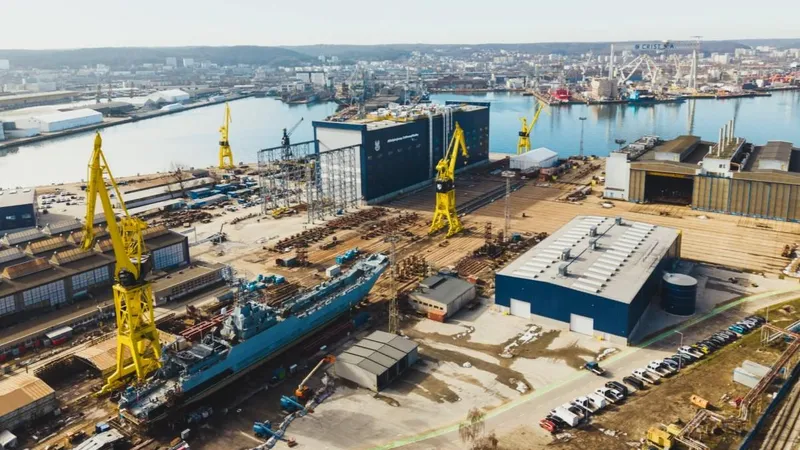
PGZ Stocznia Wojenna in Gdynia completed an expansion including a new hull hall around 46 metres high, one of the tallest structures of this type in Europe. The hull hall of PGZ Stocznia Wojenna received large-format technological gates and overhead cranes with a lifting capacity of up to 100 tonnes, and next to it a production hall of nearly 5 thousand square metres and a warehouse hall of more than 3,300 square metres were built. More than 50 thousand square metres of new road surfaces and technological yards were laid. The new facilities serve the construction of frigates under the Miecznik programme for the Polish Navy.
The modernisation aims to increase the yard’s production capacity and improve logistical efficiency, supporting the construction of modern naval vessels, including the frigates being developed for the Polish Navy under the Program Miecznik.
The works were carried out by the Polish contractor NDI Group and covered several major projects implemented over a period of three years.
New production halls expand shipyard capabilities
A central element of the investment programme was the construction of two new production facilities: a large hull assembly hall and a production hall dedicated to steel processing and fabrication.
The hull assembly hall, reaching approximately 46 metres in height, is among the largest structures of its type in Europe. The building is equipped with large industrial gates and heavy-duty overhead cranes with a lifting capacity of up to 100 tonnes. This infrastructure enables the assembly of large hull sections and blocks under controlled indoor conditions, which improves production precision and allows work to continue regardless of weather conditions.
The second facility, a production hall with an area of nearly 5,000 m², supports the fabrication and preparation of steel structures and ship components.
March marks three years since demolition works began for the three major investment projects at the shipyard.
- The first facilities to be completed were two key buildings: the Hull Assembly Hall and the Production Hall, which already significantly increase the shipyard’s production and technological capabilities, said Przemysław Młynarczyk, construction manager at NDI Group.
Alongside the new halls, a social and administrative building was also constructed, providing modern office and staff facilities.
Logistics and storage infrastructure
The investment programme also included the construction of a warehouse hall with an area exceeding 3,300 m². The facility provides storage and logistical support for shipbuilding operations.
Extensive site development works were also carried out across the shipyard. These included the expansion and redevelopment of quays, storage yards and internal transport routes. In total, more than 50,000 m² of new surfaces were constructed, significantly improving the internal logistics and operational efficiency of the facility.
The new infrastructure facilitates the movement of large ship sections and heavy components between production halls, storage areas and the waterfront.
Modernisation of existing shipyard facilities
In addition to new construction, several existing buildings within the shipyard were modernised and adapted to current technological requirements.
Part of the A-11 hall was converted into a logistics centre and extended with a new annex housing a tracing workshop. This specialised space allows ship components designed in technical drawings to be transferred at full scale onto steel plates before fabrication begins.
Another building, A-9, also underwent refurbishment to accommodate modern production needs. Both facilities were equipped with new sanitary, electrical and telecommunications systems, as well as the necessary technological equipment.
The project presented additional challenges due to the historical nature of some of the structures, with parts of the facility dating back to 1938. Construction work had to be carefully coordinated because the buildings remained in use throughout the modernisation process.
- Thanks to this project, the shipyard has gained a significant amount of modern office space. During construction we faced numerous challenges, not only structural but also organisational, as we were working in a facility whose origins date back to 1938. Shipyard employees remained in the building throughout the works, so construction activities had to be carried out without disrupting their daily operations, Przemysław Młynarczyk added.
Strengthening Poland’s naval shipbuilding capacity
The completed investments significantly enhance the production infrastructure of PGZ Naval Shipyard and support the implementation of complex naval construction programmes.
New production halls, logistics facilities and upgraded internal transport infrastructure improve the organisation of shipbuilding processes and increase the yard’s ability to handle large-scale naval projects.
The modernisation forms part of a broader effort to strengthen the industrial base supporting Poland’s naval modernisation and to expand domestic capabilities in naval shipbuilding.
Source: Gazeta Morska · Compiled by: Kamil Kusier
Related articles
 Shipbuilding industry Poland christens ro-pax ferry Bursztyn Unity in Szczecin on Independence Day. Ystad service starts 18 November
 Energy and offshore Orlen Neptun deploys V-LiDAR buoys at Baltic West ahead of Poland's 2027 offshore wind auction
 Energy and offshore Equinor takes over Bałtyk 2 and 3 O&M base in Łeba. Port to serve 1.44 GW of offshore wind for 30 years
 Navy and defence Port Gdański Eksploatacja secures NATO NCAGE code. Gdańsk port company lines up for defence tenders
 Shipbuilding industry Ex-Enterprise towed to Mobile under $418.5m contract. Test case for Nimitz-class disposal begins
 Energy and offshore Energa renames Gdańsk gas plant company as foundations for 6,000-tonne turbine and boiler are laid
Comments (0)
The discussion is moderated by the editors: a comment appears after review. Your e-mail address is not published.
Nobody has commented on this article yet.