









Grain export season in full swing - Port of Gdańsk supports Polish agri-food exports
Poland ranks among the top European food producers, maintaining a strong export position in products such as apples, poultry, and grain. At the heart of this export engine is the Port of Gdańsk – the country’s largest commercial port – which plays a key role in ensuring the safe and efficient transport of agricultural goods to global markets.
In brief
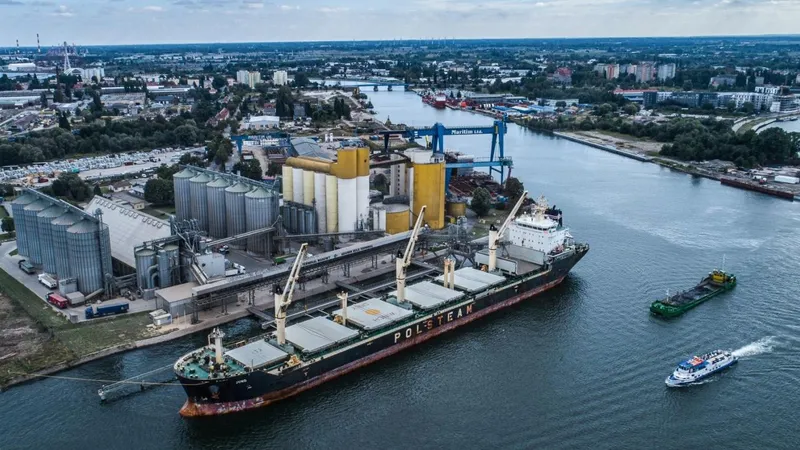
The Port of Gdańsk handled more than 1.1 million tonnes of grain from January to June 2025, compared with 1.5 million tonnes a year earlier, loaded onto 212 ships. Around 39 thousand trucks and 380 rail wagons with grain were also handled, and cargo operations are carried out by 9 terminals at the Bytomskie, Szczecińskie, Wiślane, Oliwskie, Zbożowe and Przemysłowe quays. Bartosz Bloch, commercial director of Zarząd Morskiego Portu Gdańsk SA, pointed to handling capacity utilisation of around 50 percent and ongoing investments. Port Gdański Eksploatacja is building the Gdański Agro Terminal, as described by the company's CEO Andrzej Kuźmicz.
Grain, second only to energy commodities in cargo volumes at the Port of Gdańsk, holds strategic significance for the national economy. Unlike coal or oil, grain is primarily exported, making the seamless operation of grain terminals critical for supporting Polish agriculture and exports.
Bulk carriers loaded with Polish grain – including wheat, corn, rye, barley, rapeseed, and meal – regularly depart from Gdańsk to ports in Spain, the Netherlands, the UK, as well as destinations in North and West Africa, India, and China.
Port infrastructure ready for peak agro cargo season
The summer harvest season traditionally marks a surge in agro-related logistics. For Polish producers and exporters, the Port of Gdańsk is a vital link in the export supply chain, operating year-round to ensure continuity in food exports.
Although grain terminals operated at about 50% capacity in the first half of 2025, the Port of Gdańsk continues to maintain operational momentum, says Bartosz Bloch, commercial director at the Port of Gdańsk Authority. We’re investing in expanded handling capacities so that, in addition to Polish grain, we can support large export volumes from neighboring countries as well.
Between January and June 2025, the port handled just over 1.1 million tonnes of grain (compared to 1.5 million tonnes in the same period of 2024), shipped via 212 vessels. On the landside, approximately 39,000 trucks and 380 rail wagons with grain were processed.
Grain operations are handled by nine terminals located across the Bytomskie, Szczecińskie, Wiślane, Oliwskie, Zbożowe, and Przemysłowe quays. These facilities offer modern handling systems, high operational efficiency, and dedicated cargo services – key factors that contribute to Poland’s global competitiveness in food exports.
Smart solutions for road logistics
To streamline land transport within the port area, the Port of Gdańsk is implementing the Vehicle Traffic Notification System (SARP) – a digital tool aimed at reducing truck waiting times, eliminating congestion, and optimizing infrastructure usage.
Additionally, truck buffer zones have been prepared in several key locations across the port – including Budowniczych Portu Północnego, Ku Ujściu, Załogowa, Śnieżna, Wielopole, and Wiślna streets – offering a combined capacity of approximately 1,000 parking spaces for inbound trucks.
New investments to future-proof grain handling capacity
One of the most notable infrastructure projects currently underway is the Gdańsk Agro Terminal, developed by Port Gdański Eksploatacja – a key cargo-handling operator in the Inner Port.
The grain market today is extremely volatile – shifting volumes and changing export directions are the new norm, influenced by geopolitical pressures and climate change, explains Andrzej Kuźmicz, CEO of Port Gdański Eksploatacja. Our investment in the Gdańsk Agro Terminal will not only boost capacity but also strengthen the port’s resilience to fluctuating demand and supply in the agri-food sector.
We want to be a reliable and predictable logistics partner for farmers and exporters, supporting not only seasonal peaks but also long-term strategies for the development of Polish food exports.
A strategic node for food security and global supply chains
In the face of ongoing geopolitical tensions and climate-related risks, food security is becoming an increasingly critical part of both national and international policy. As a modern logistics hub, the Port of Gdańsk is actively responding to these challenges – playing a pivotal role in stabilizing supply chains and securing the export flow of essential agricultural goods.
Source: Gazeta Morska · Compiled by: Oskar Wojciechowski
Related articles
 Energy and offshore Equinor takes over Bałtyk 2 and 3 O&M base in Łeba. Port to serve 1.44 GW of offshore wind for 30 years
 Navy and defence Port Gdański Eksploatacja secures NATO NCAGE code. Gdańsk port company lines up for defence tenders
 Shipbuilding industry Ex-Enterprise towed to Mobile under $418.5m contract. Test case for Nimitz-class disposal begins
 Energy and offshore Energa renames Gdańsk gas plant company as foundations for 6,000-tonne turbine and boiler are laid
 Equipment and technology WB Group takes Polish drones from Tokyo to SOFEX in Jordan in a single week
 Ports and logistics PGE books Gdańsk’s T5 terminal for the long haul: Baltica 2 first, then more offshore wind farms
Comments (0)
The discussion is moderated by the editors: a comment appears after review. Your e-mail address is not published.
Nobody has commented on this article yet.