









Gdańsk to launch Baltic Sea monitoring center
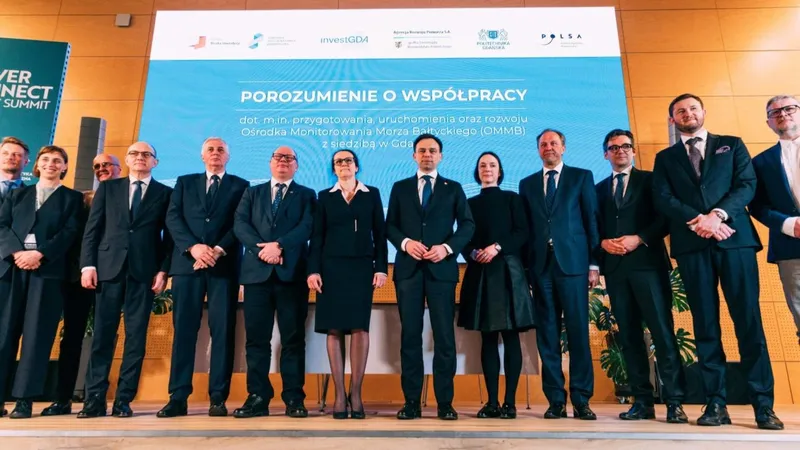
At the end of March 2026, a strategic step was taken to strengthen Poland’s capabilities in space and satellite technologies: the Baltic Sea Monitoring Center (OMMB) is set to be established in Gdańsk. The initiative aims to integrate satellite and other data sources to support environmental monitoring, infrastructure oversight, and maritime security. The agreement was signed during the PowerConnect 2026 energy fair at AmberExpo.
In brief
An agreement on establishing the Baltic Sea Monitoring Centre was signed at the end of March 2026 in Gdańsk during the PowerConnect 2026 trade fair at AmberExpo. The initiative has been joined by the Polish Space Agency, Gdańsk University of Technology, the Pomeranian Special Economic Zone, the Pomerania Development Agency and the Gdańsk Economic Development Agency. The Baltic Sea Monitoring Centre is to integrate satellite data to detect environmental and infrastructure threats and to support high-tech companies.
Key partners and roles
The project brings together leading institutions from science, public administration, and business:
- Polish Space Agency (POLSA) – coordinating space sector activities and satellite technology development
- Gdańsk University of Technology – providing research infrastructure and technological expertise
- Pomeranian Special Economic Zone (PSSE), Pomeranian Development Agency, and InvestGDA – supporting investment, startups, and commercialization of innovative solutions
Each partner contributes complementary competencies, creating a regional hub for innovation and applied research.
- Satellite technologies are now a cornerstone of national security and the modern economy. They allow us to monitor developments, respond quickly to threats, and develop new services, said Andrzej Domański, Poland’s minister of finance and economy.
Strategic importance of the Baltic
The Baltic Sea remains a critical area for Poland, both economically and strategically. The OMMB will provide rapid detection of environmental and infrastructure threats and facilitate the growth of local high-tech enterprises.
- Our goal is to create a facility that leverages satellite data for the Polish economy and citizen safety. The Baltic Sea has strategic significance, and we need modern tools to monitor it, said Mirosław Kamiński, CEO of PSSE.
Opportunities for science and business
OMMB will serve as a platform for collaboration between academia, government, and industry. Gdańsk University of Technology brings research capabilities, while regional agencies support startups and companies implementing innovative solutions. Educational and training programs in IT, artificial intelligence, and cybersecurity are also planned.
Piotr Ciechowicz, vice president of the Pomeranian Development Agency, emphasized that the cooperation opens access to EU funding and strengthens the space-tech sector in the region.
Poland in the European context
The initiative aligns with broader European trends in maritime monitoring and environmental management. Baltic countries increasingly rely on satellite data for managing ports, ecosystems, and maritime infrastructure. The OMMB positions Poland among the leading Baltic Sea monitoring hubs in Europe.
Ultimately, the center aims to become a research, innovation, and applied technology hub, bridging the needs of the state, industry, and academia. Gdańsk is set to set a new benchmark for integrated Baltic Sea monitoring in the region.
Source: Gazeta Morska · Compiled by: Kamil Kusier
Related articles
 Energy and offshore Equinor takes over Bałtyk 2 and 3 O&M base in Łeba. Port to serve 1.44 GW of offshore wind for 30 years
 Navy and defence Port Gdański Eksploatacja secures NATO NCAGE code. Gdańsk port company lines up for defence tenders
 Shipbuilding industry Ex-Enterprise towed to Mobile under $418.5m contract. Test case for Nimitz-class disposal begins
 Energy and offshore Energa renames Gdańsk gas plant company as foundations for 6,000-tonne turbine and boiler are laid
 Equipment and technology WB Group takes Polish drones from Tokyo to SOFEX in Jordan in a single week
 Ports and logistics PGE books Gdańsk’s T5 terminal for the long haul: Baltica 2 first, then more offshore wind farms
Comments (0)
The discussion is moderated by the editors: a comment appears after review. Your e-mail address is not published.
Nobody has commented on this article yet.