









Gdańsk and New York sign a letter of intent. US trade is growing, a direct service is missing
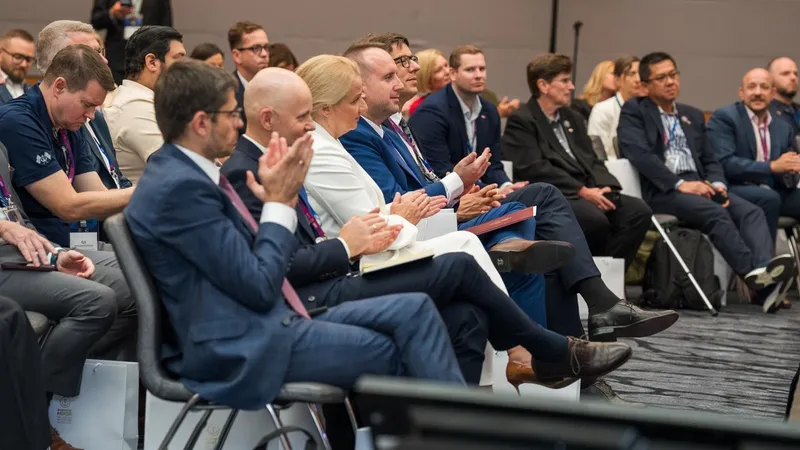
The Port of Gdańsk Authority and the Port Authority of New York and New Jersey signed a letter of intent on cooperation during this year's Business Mixer, held for the first time in the United States. The agreement is to support trade, the development of transport links and closer business relations between Poland and the US.
In brief
Containerised trade between the USA and Poland reached nearly 169 thousand TEU in 2025, and the ports of Gdańsk and New York-New Jersey concluded a letter of intent on cooperation. The agreement was signed at the Port of Gdańsk Business Mixer, the port's fifth business mission and the first outside Asia. Business Mixer participants pointed to the lack of a direct shipping line, which makes transhipment at a European hub extend transport by a week or even ten days. Trade between Poland and the USA was worth about 33 billion dollars in 2025.
The background is measurable. According to US Customs and Border Protection, containerised trade between the United States and Poland reached close to 169,000 TEU in 2025, almost 20 per cent more than a year earlier. For years much of that trade passed through Western European ports. That model is changing, and the volume handled in Gdańsk is growing steadily.
A gateway to a hundred million consumers
Dorota Pyć, president of the Port of Gdańsk Authority, presented those figures at the opening.
- Port Gdańsk, together with its network of partners, can be a gateway for American businesses not only to Poland but to the whole of Central and Eastern Europe - said Dorota Pyć.
The port's ambition is to serve a market of around one hundred million consumers, including Ukraine, the Czech Republic, Slovakia, Hungary and the Baltic Sea states. Direct sea links are to shorten transit times, cut overland transport costs in Europe and create value through logistics, warehousing and distribution carried out in Poland.
Total Poland–US trade reached around 33 billion dollars in 2025, of which 13 billion was Polish exports. In a letter to participants, read out by Paweł Krężel, director of the maritime economy department at the Ministry of Infrastructure, deputy minister Arkadiusz Marchewka noted that cooperation now spans industrial goods, advanced technology, pharmaceuticals, food, aviation and energy.
Two ports with the same problems
Bethann Rooney, director of the Port Authority of New York and New Jersey, pointed to growing cargo volumes from Eastern Europe and to American importers increasingly seeking alternative sources of supply as they reduce dependence on China. Gdańsk, given its location and links to the Czech and Slovak markets, could be among the ports to benefit.
She stressed, however, that the relationship should not be reduced to volumes. Gdańsk and New York-New Jersey face similar challenges: limited room for expansion, the energy transition and the need to keep modernising infrastructure. The letter of intent is meant to open space for sharing experience in those areas.
A week, even ten days, of difference
The main topic was a direct sea service between Poland and the United States. Jan Van Mossevelde, chief executive of Baltic Hub, recalled that the opening of the T3 terminal increased capacity, and that American companies including Amazon, Colgate-Palmolive, eBay, Dell, 3M and PepsiCo already use the terminal. Growth in the region, investments such as the nuclear plant and the prospect of Ukraine's reconstruction are expected to raise demand for transport through Gdańsk.
Logistics operators showed what the absence of such a line costs. Rafał Michalski of Langowski Logistics noted that for American customers time can matter more than price, and that transhipment at a European hub adds a week or even ten days. Marcin Jasiński of Polsteam USA, a subsidiary of Polska Żegluga Morska, described a shipment from Gdańsk to New York that required additional overland transport via Chicago or a complicated transhipment in Europe.
The transatlantic link is not only about containers. Polsteam is expanding its fleet of Lakemax bulk carriers moving steel and specialised cargo between Europe and North America, while flagging the question of alternative fuels: ships may be ready for methanol, but bunkering infrastructure in ports has to develop at a similar pace.
Energy as a source of project cargo
A separate panel dealt with project cargo linked to the energy transition. Bartosz Folusiak of the Polish Embassy in Washington recalled that over the past 35 years Poland has been the second fastest growing economy in the world after China, and that the move away from Russian fossil fuels accelerated energy investment: the expansion of Naftoport, the floating LNG terminal in the Port of Gdańsk and the nuclear plant in Pomerania using American technology.
- It is a symbol of strong Polish-American relations, because the chosen technology is American and comes from Westinghouse - said Bartosz Folusiak, adding that Bechtel will build the plant, which is to be fully operational with three reactors by 2039.
Andrew Sentyz, president of Delaware River Stevedores, noted that preparing a port for project cargo begins with quays strong enough for the loads, but roads, bridges and overpasses along the route matter just as much, and planning must anticipate ever larger components, as some US ports proved unable to handle growing offshore wind parts. Gdańsk already handles such operations: DSV has carried out more than 55,000 cargo operations in the port, with goods moving on by road and river.
An example of an American investor in the port is Lyten, a producer of energy storage systems, which runs one of Europe's largest plants of its kind in Gdańsk along with a research centre. Keith Norman of Lyten announced further expansion, first deliveries to South America and a modular data centre in the port to meet industry's demand for computing power.
Customs as in Rotterdam, security as on the eastern flank
The final panel set out to dispel American concerns about customs clearance in Poland. Grzegorz Korcz of the Gdańsk tax administration recalled that Poland is part of the EU customs union and that procedures in Gdańsk are essentially the same as in Rotterdam or Hamburg. Problems arise from incomplete documentation, and AEO status offers facilitations similar to the US CTPAT programme. David W. Kleinman of US Customs and Border Protection added that inspections are based on risk analysis and data supplied by businesses, so the quality of documents translates directly into the speed of clearance. Sanctions on Russia and Belarus and the monitoring of goods bound for third countries were also discussed.
Alan Aleksandrowicz, vice president of the Port of Gdańsk Authority, spoke about security on NATO's eastern flank: surveillance systems, protection against unauthorised drone flights and measures ensuring continuity of operations during GPS disruption. He also announced a port development strategy to 2050, with expansion of access infrastructure from sea and land.
The fifth mission, the first across the Atlantic
The second day was devoted to direct meetings between more than a hundred businesses. In this format the port acts not only as an infrastructure manager but as an economic intermediary and ambassador for the Polish market.
It was the fifth edition of the port's trade missions and the first outside Asia, after Singapore, South Korea, Vietnam and Japan. The choice of destination is deliberate: Gdańsk can receive the largest ocean-going ships in direct service with the US West Coast, and the discussions showed that what is missing on both sides of the Atlantic is not interest, but a shipping line.
Source: Gazeta Morska · Compiled by: Kamil Kusier
Related articles
 Energy and offshore Equinor takes over Bałtyk 2 and 3 O&M base in Łeba. Port to serve 1.44 GW of offshore wind for 30 years
 Navy and defence Port Gdański Eksploatacja secures NATO NCAGE code. Gdańsk port company lines up for defence tenders
 Shipbuilding industry Ex-Enterprise towed to Mobile under $418.5m contract. Test case for Nimitz-class disposal begins
 Energy and offshore Energa renames Gdańsk gas plant company as foundations for 6,000-tonne turbine and boiler are laid
 Equipment and technology WB Group takes Polish drones from Tokyo to SOFEX in Jordan in a single week
 Ports and logistics PGE books Gdańsk’s T5 terminal for the long haul: Baltica 2 first, then more offshore wind farms
Comments (0)
The discussion is moderated by the editors: a comment appears after review. Your e-mail address is not published.
Nobody has commented on this article yet.