









From one million to 38.6 million tonnes. Naftoport turns 35 and builds a berth for the largest tankers
Naftoport marks 35 years as an independent company this year. In that time the Gdańsk oil terminal has grown from around one million tonnes of throughput in the early 1990s to 38.65 million tonnes of crude oil and petroleum products in 2025, with crude alone, at 37.4 million tonnes, setting the highest figure in its history.
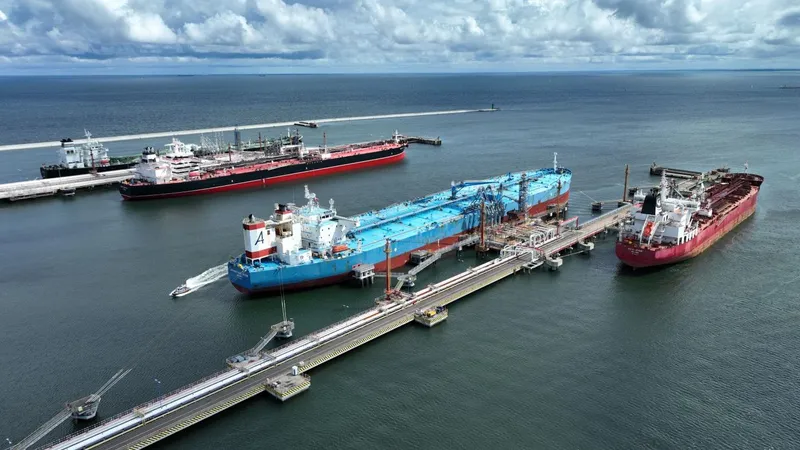
In brief
The Gdańsk terminal Naftoport handled 38.65 million tonnes of crude oil and petroleum products in 2025, including 37.4 million tonnes of crude, the highest in its history. Naftoport is marking 35 years as an independent company and handled 463 ships in 2025. Naftoport and the Port of Gdańsk Authority are building a sixth handling berth capable of serving VLCC-class tankers. PERN president Daniel Świętochowski said the new infrastructure will raise the terminal's handling capacity by about 9 million tonnes a year.
The scale of that change is the shortest possible history of Poland's energy security. A terminal built to supplement pipeline supplies from the east is today the main gateway for crude from around the world.
2025 in figures
Last year Naftoport handled 463 ships: 379 carrying crude oil and 84 carrying petroleum products. Of the 38.65 million tonnes, 37.4 million were crude and 1.25 million were products.
The growth of recent years has been steep. In 2021 the terminal handled around 18 million tonnes, in 2022 around 25 million, in 2023 around 37 million and in 2024 around 39 million. The break coincides precisely with Poland's move away from Russian oil, when seaborne supply went from supplementary to primary.
The trend continues this year. From January to the end of August 2026 liquid fuels remained the largest cargo group at the Port of Gdańsk, at around 26 million tonnes, and in August alone their volume reached 3.9 million tonnes, 5 per cent more than a year earlier.
From the Zawrat to VLCCs
The terminal's operational history begins in 1975, when the tanker Zawrat called at the Northern Port with more than 100,000 tonnes of crude. Naftoport has operated as an independent company since 1991, and a year later throughput reached around one million tonnes.
Today the company is part of the PERN Capital Group and one of the key links in its logistics system. The connection between the terminal and PERN's network of pipelines and depots allows crude to be received from different parts of the world and moved on to refineries in Poland and two refineries in Germany.
- 35 years of Naftoport is a history of consistent development: of infrastructure, competencies and the scale of operations - says Daniel Betke, president of the management board of Naftoport.
Behind the result, he adds, are people and their responsibility for the safe execution of every operation, and the company's task is not only to maintain its position but to develop its potential further in response to the needs of the Polish market and energy system.
The sixth berth
The anniversary falls during another stage of expansion. Together with the Port of Gdańsk Authority, Naftoport is building a sixth handling berth, designed to accommodate large VLCC-class tankers.
- The new infrastructure will increase the terminal's nominal handling capacity by around 9 million tonnes a year - says Daniel Świętochowski, president of the management board of PERN.
More important than raw capacity, in his view, is the additional operational reserve, which raises the technical safety and resilience of the whole supply system. The expansion of Naftoport is part of wider efforts by the PERN Group to strengthen logistics infrastructure and increase the flexibility of crude supplies to Poland.
Why the reserve matters more than the record
A terminal that handled around 39 million tonnes in 2024 is operating close to its limits. Any berth failure, a storm closing the port or a delayed tanker then feeds directly into refinery stocks. The sixth berth is therefore not only about handling more, but about keeping the system running when one of the other berths is out of service.
The ability to receive VLCCs has a second dimension. The largest tankers lower freight costs per tonne and open up sources from which delivery in smaller vessels would not pay. For a country that has given up a pipeline and moved to the sea, access to that tonnage is a condition of competitive crude prices.
After 35 years Naftoport remains one of the most important elements of Poland's energy infrastructure. Its role has changed along with the supply system: from a terminal supplementing traditional routes to the strategic gateway for crude from around the world.
Source: Gazeta Morska · Compiled by: Kamil Kusier
Related articles
 Energy and offshore Equinor takes over Bałtyk 2 and 3 O&M base in Łeba. Port to serve 1.44 GW of offshore wind for 30 years
 Navy and defence Port Gdański Eksploatacja secures NATO NCAGE code. Gdańsk port company lines up for defence tenders
 Shipbuilding industry Ex-Enterprise towed to Mobile under $418.5m contract. Test case for Nimitz-class disposal begins
 Energy and offshore Energa renames Gdańsk gas plant company as foundations for 6,000-tonne turbine and boiler are laid
 Equipment and technology WB Group takes Polish drones from Tokyo to SOFEX in Jordan in a single week
 Ports and logistics PGE books Gdańsk’s T5 terminal for the long haul: Baltica 2 first, then more offshore wind farms
Comments (0)
The discussion is moderated by the editors: a comment appears after review. Your e-mail address is not published.
Nobody has commented on this article yet.