









First multi hull design vessel delivered from Gdańsk to Norway for outfitting
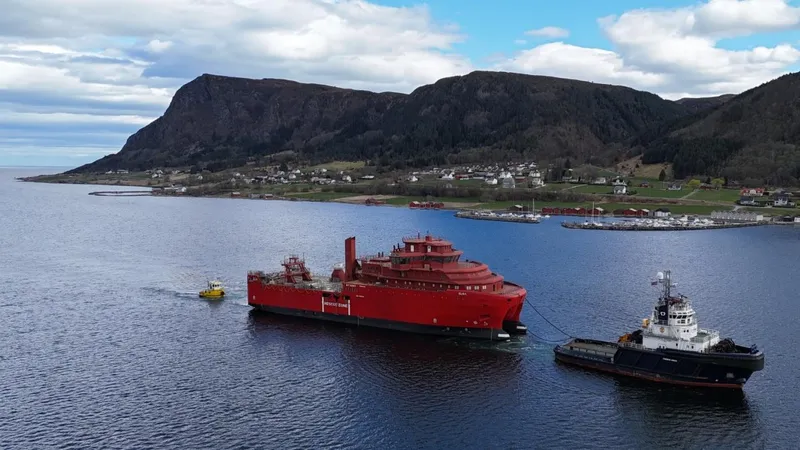
The first vessel based on the multi hull design (MHD) concept developed by Marin Teknikk has been launched at Montex Shipyard and transported to Green Yard Kleven for outfitting and final completion. The vessel, designated MT6067 “ELISA”, is being built for OMV Petrom.
In brief
The first vessel built to the Multi Hull Design concept of the Marin Teknikk design office, designated MT6067 ELISA, has been launched at Montex Shipyard in Gdańsk and transported to Green Yard Kleven for the outfitting stage. The ship is being built for OMV Petrom, and the concept was validated in model tests at SINTEF Ocean. A passive motion compensation system is to enable walk-to-work operations in sea states up to Hs of 4.5 metres, and ROV work from the side of the roughly 70-metre-long vessel up to Hs of 6 metres. The design provides for propulsion with four azimuth thrusters.
The project marks the transition of the MHD concept from development to physical implementation. According to the designer, the solution has been refined over several years and validated through model testing conducted by SINTEF Ocean.
Focus on motion reduction
The MHD concept introduces an alternative hull architecture aimed at reducing vessel motions in offshore conditions. A central element is the passive motion compensating system (MCS), which operates without external energy input.
Based on available data, the design enables walk-to-work operations in sea states up to Hs 4.5 m. For ROV operations conducted over the side of a vessel of approximately 70 m length, operability is expected to extend to Hs 6 m, supported by reduced vertical heave velocity.
This reduction in motion is intended to improve operational uptime, extend weather windows, and enhance safety and working conditions offshore.
Market context and applications
The development of MHD aligns with increasing demand for higher operability in offshore sectors, particularly offshore wind and subsea operations. Reducing weather-related downtime remains a key driver for vessel design innovation.
The concept is positioned as a potential alternative to conventional monohull offshore vessels, as well as more complex multi-hull solutions such as SWATH designs, offering a balance between motion performance and technical simplicity.
Marin Teknikk is currently developing a range of MHD-based vessel concepts, including:
- walk-to-work and offshore support vessels
- subsea, IMR, and ROV support vessels
- cable and pipeline installation vessels
- heavy-lift vessels
- offshore wind feeder vessels
Propulsion and design features
The design incorporates a “4 prop drive” configuration, with four azimuth thrusters positioned at each corner of the vessel. This setup is intended to optimize thrust distribution and deliver high bollard pull relative to installed power.
Polish yard’s role in offshore supply chain
The construction of the hull in Gdańsk highlights the continued role of Polish shipyards in the European offshore supply chain. Facilities such as Montex Shipyard specialize in hull fabrication and steel structures, with vessels often completed and outfitted in Norway.
The completion and operational deployment of “ELISA” will serve as a key reference point for assessing the real-world performance and commercial viability of the MHD concept in offshore operations.
Source: Gazeta Morska · Compiled by: Kamil Kusier
Related articles
 Energy and offshore Equinor takes over Bałtyk 2 and 3 O&M base in Łeba. Port to serve 1.44 GW of offshore wind for 30 years
 Navy and defence Port Gdański Eksploatacja secures NATO NCAGE code. Gdańsk port company lines up for defence tenders
 Shipbuilding industry Ex-Enterprise towed to Mobile under $418.5m contract. Test case for Nimitz-class disposal begins
 Energy and offshore Energa renames Gdańsk gas plant company as foundations for 6,000-tonne turbine and boiler are laid
 Equipment and technology WB Group takes Polish drones from Tokyo to SOFEX in Jordan in a single week
 Ports and logistics PGE books Gdańsk’s T5 terminal for the long haul: Baltica 2 first, then more offshore wind farms
Comments (0)
The discussion is moderated by the editors: a comment appears after review. Your e-mail address is not published.
Nobody has commented on this article yet.