









First container ship from Ningbo embarks on Arctic Express Route to Europe
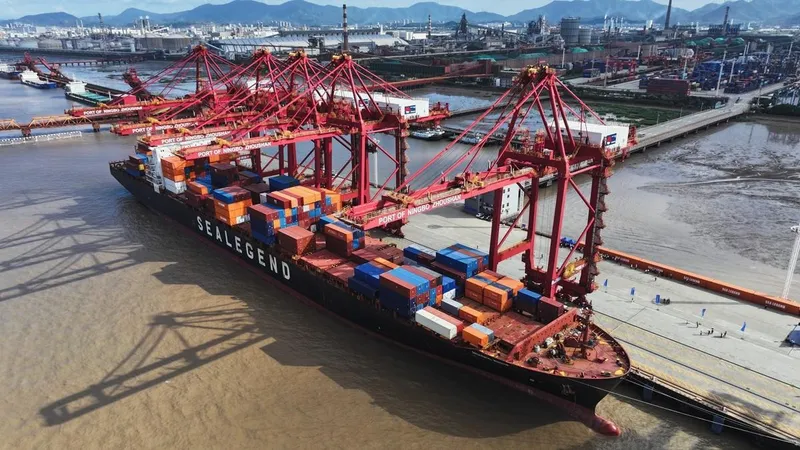
The port of Ningbo-Zhoushan on China’s east coast has dispatched its first container vessel on a new express service to Europe via the Northern Sea Route. The voyage, part of the “Polar Silk Road” initiative, is being hailed in Chinese industry circles as a milestone in global shipping.
In brief
The first container ship on the new express route through the Northeast Passage has sailed from the port of Ningbo-Zhoushan in China to Felixstowe in the United Kingdom. The voyage is expected to take 18 days, compared with an average of 25 days by rail from China to Europe, about 40 days via the Suez Canal and up to 50 days around the Cape of Good Hope. Sun Xuejun, chairman of Zhejiang Seaport Logistics Group, said the solution was developed for cross-border e-commerce and high-value cargo. The Arctic route links Ningbo, Shanghai, Qingdao and Dalian with the ports of Felixstowe, Rotterdam, Hamburg and Gdańsk.
The vessel is bound for the Port of Felixstowe in the UK, with an estimated transit time of just 18 days. This represents a dramatic improvement compared with traditional routes: around 25 days by rail, approximately 40 days via the Suez Canal, and up to 50 days on routes rounding the Cape of Good Hope.
Running along Russia’s Arctic coastline through the Northeast Passage, the route provides the shortest maritime link between East Asia and Europe. Its advantages extend beyond speed. As the Global Times emphasized, the passage avoids piracy-prone waters and politically unstable regions, offering carriers greater security and predictability.
“This route was designed specifically for cross-border e-commerce and high-value cargoes,” noted Sun Xuejun, president of Zhejiang Seaport Logistics Group, the operator behind the service.
The European Union remains Ningbo’s largest trading partner. According to local customs data, trade with the EU in the first eight months of this year reached RMB 330.74 billion (approx. USD 46.5 billion), accounting for 18 percent of the port’s total foreign trade.
The Arctic link connects China’s leading gateways — Ningbo, Shanghai, Qingdao and Dalian — with Europe’s major hubs, including Felixstowe, Rotterdam, Hamburg and Gdańsk. Analysts believe the route could, in time, reshape global shipping networks by offering a viable northern alternative to traditional southern sea lanes.
Source: Gazeta Morska / PAP · Compiled by: Krzysztof Pawliszak
Related articles
 Energy and offshore Equinor takes over Bałtyk 2 and 3 O&M base in Łeba. Port to serve 1.44 GW of offshore wind for 30 years
 Navy and defence Port Gdański Eksploatacja secures NATO NCAGE code. Gdańsk port company lines up for defence tenders
 Shipbuilding industry Ex-Enterprise towed to Mobile under $418.5m contract. Test case for Nimitz-class disposal begins
 Energy and offshore Energa renames Gdańsk gas plant company as foundations for 6,000-tonne turbine and boiler are laid
 Equipment and technology WB Group takes Polish drones from Tokyo to SOFEX in Jordan in a single week
 Ports and logistics PGE books Gdańsk’s T5 terminal for the long haul: Baltica 2 first, then more offshore wind farms
Comments (0)
The discussion is moderated by the editors: a comment appears after review. Your e-mail address is not published.
Nobody has commented on this article yet.