









Ferrari Hypersail hull completed as Maranello reveals flight control technology
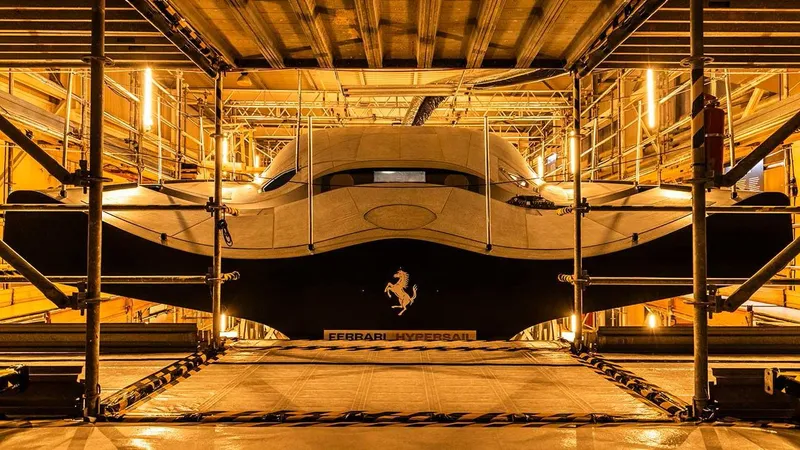
Construction of Ferrari Hypersail, the 100-foot ocean monohull designed to sail fully foiling, has entered its final phase. The hull is fully painted, the livery is complete and the appendages that generate lift and govern the boat's flight are now in the shipyard. On 16 October Ferrari described in detail for the first time the technology that will lift the boat above the waves: foils, keel and rudder working with the automated flight management system, Flight Control.
In brief
Ferrari Hypersail, a 100-foot ocean monohull flying on foils, has a fully painted hull and is entering the final phase of construction. Ferrari described on 16 October the layout of foils, keel and rudder linked to the automatic Flight Control system, which corrects the yacht's trim in flight in real time. The yacht is 30 m long with a 40-metre mast and is being built at Ferrari's plant in Pisa, with the project already yielding more than 20 patents. Ferrari Hypersail is scheduled for launch at the end of 2026, with Livorno as the team's base.
30 metres long, a 40-metre mast and a Maranello livery
Hypersail is 30 m long and 20 m wide, with a 40 m mast. The hull was designed by Guillaume Verdier's studio, one of the best-known names in foiling race yacht design, and the boat is being built by Ferrari in its own facility in Pisa rather than at an outside yard. The project is led by Enrico Voltolini, with Italian ocean sailor Giovanni Soldini as its figurehead.
Ferrari unveiled the livery in April at Milan Design Week. The carbon fibre hull wears a new grey shade, Grigio Hypersail, while the cabin, foils and hull lines are picked out in Giallo Fly yellow, echoing the colour split of the classic 512 BB. Solar panels are integrated into the deck and hull sides, as the boat is designed to be fully energy self-sufficient.
Three points of support: foils, keel and rudder
The boat's flight relies on three appendages that together create three support and control points. The side wing foils generate the upward lift that raises the hull above the surface, reducing drag and allowing the boat to reach its target speeds.
The keel is the project's signature innovation. It integrates a foil with its own movable flap, which contributes to flight management and creates a third support point for stability. The rudder also does more than steer: a small movable flap on its vertical section makes continuous micro-adjustments to hold the target heading.
Flight Control: the electronic brain on board
Flight Control is the electronic system Ferrari describes as the boat's central nervous system, drawing on Maranello's know-how in automotive electronics and dynamic control. It continuously analyses wind, waves, speed and heel angle and adjusts the boat's trim in real time during foil-borne sailing.
The system works in three stages. A network of sensors measures sea state and hull movements, an onboard computer analyses the data and calculates corrections, and actuators, mechanical arms and pistons, move the components that set the angle of the foils and appendages. Ferrari stresses that the crew remains central: automation handles what can be optimised, leaving sailors free to read the sea, make strategic decisions and push for maximum performance.
Carbon fibre and titanium borrowed from sports cars
Precise flight control demands an extremely stiff structure. The hull is built from multiple layers of carbon fibre, preventing deformation under heavy ocean loads and allowing the appendages to respond precisely to commands. In the most heavily loaded areas, such as the foil arms and the mainsheet traveller, a sandwich construction combines carbon fibre and titanium, a material pairing taken directly from Ferrari's sports cars.
More than 20 patents from Maranello
Building the boat entirely in-house has already produced more than 20 patents. They include Winch by Wire, extended-range wind turbines and a medium and high voltage system for integrating renewable energy, presented in July together with the energy self-sufficiency concept. They are complemented by a rotating mast fitted with winglets and a double-skin mainsail for better sail control.
Ferrari draws a direct parallel between a sports car and a flying monohull: both need maximum aerodynamic efficiency and electronics that detect and correct the vehicle's responses. Computer simulation, airflow analysis and the software that stabilises Ferrari's cars are therefore key tools in making the boat fly, while data from the trials will feed back into Maranello's engineering knowledge.
A Livorno base and launch by the end of the year
In early October the team announced Livorno as its base for shore and offshore operations, within Azimut Yachts' premises. ABB has joined as technology partner for electrification. Launch is planned for the end of 2026, followed by sea trials ahead of a racing programme aimed at ocean records.
Source: Gazeta Morska · Compiled by: Kamil Kusier
Related articles
 Energy and offshore Equinor takes over Bałtyk 2 and 3 O&M base in Łeba. Port to serve 1.44 GW of offshore wind for 30 years
 Navy and defence Port Gdański Eksploatacja secures NATO NCAGE code. Gdańsk port company lines up for defence tenders
 Shipbuilding industry Ex-Enterprise towed to Mobile under $418.5m contract. Test case for Nimitz-class disposal begins
 Energy and offshore Energa renames Gdańsk gas plant company as foundations for 6,000-tonne turbine and boiler are laid
 Equipment and technology WB Group takes Polish drones from Tokyo to SOFEX in Jordan in a single week
 Ports and logistics PGE books Gdańsk’s T5 terminal for the long haul: Baltica 2 first, then more offshore wind farms
Comments (0)
The discussion is moderated by the editors: a comment appears after review. Your e-mail address is not published.
Nobody has commented on this article yet.