









Dęblin to train FlyEye operators. Polish Air Force University accredited by WB Group
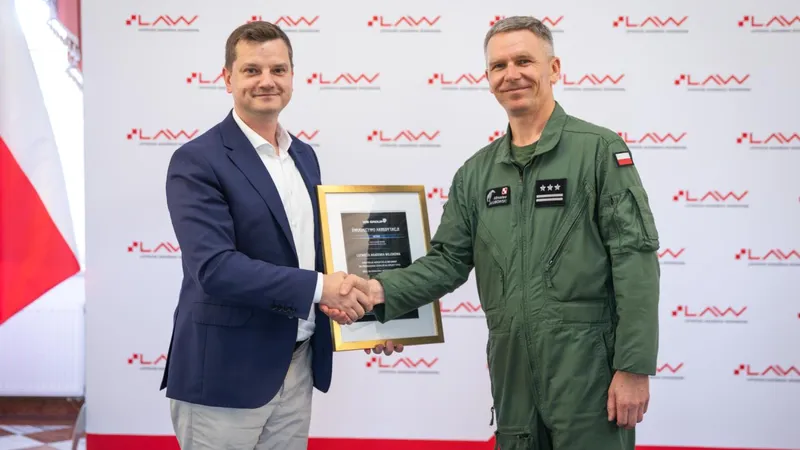
The Unmanned Aerial Vehicle Personnel Training Centre of the Polish Air Force University (Lotnicza Akademia Wojskowa, LAW) in Dęblin has been accredited by WB Group. The certificate confirms that the centre meets the manufacturer's standards for unmanned systems and is qualified to deliver specialist training for operators of FlyEye, one of the most widely used Polish reconnaissance systems.
In brief
Grupa WB has accredited the Unmanned Aircraft Systems Personnel Training Centre of the Polish Air Force University in Dęblin to conduct training for operators of the FlyEye system. The procedure covered the training programme, teaching organisation, infrastructure, technical equipment and instructor qualifications. The FlyEye system, developed by Flytronic, has served for sixteen years in the Polish Armed Forces and with foreign users. Jarosław Czajka, director of the unmanned systems programme at Grupa WB, called the certification an important step in strengthening national training competences.
An audit covering everything from curriculum to instructors
The accreditation was preceded by a comprehensive verification process covering the training programme, the organisation of teaching, infrastructure, technical equipment and the qualifications of the centre's instructor staff. The successful completion of the procedure confirmed that the Dęblin facility is prepared to conduct specialist training in line with WB Group standards.
Speaking at the accreditation ceremony, Jarosław Czajka, director of WB Group's unmanned systems programme, welcomed the certification of the Polish Air Force University, describing it as an important step in strengthening national training competencies and preparing operators of one of the most proven Polish reconnaissance systems.
Sixteen years of FlyEye in service
The FlyEye unmanned system was developed by engineers at Flytronic, WB Group's competence centre for aerial systems. It has been in service with the Polish Armed Forces and foreign users for sixteen years. Experience gained during its operational use feeds not only into the further development of the system itself, but also into the refinement of operator training - and it is precisely the quality of that training that determines how effectively unmanned reconnaissance systems are employed.
Manufacturer and university join forces
The accreditation marks another stage in the cooperation between WB Group and the Polish Air Force University, confirming both parties' commitment to developing a modern training system for unmanned systems personnel. Combining the manufacturer's experience with the university's teaching potential strengthens Poland's national competencies in the operation and use of aerial unmanned vehicles.
The move reflects a broader trend. As the number of unmanned systems in the Polish military grows, the bottleneck is increasingly not the equipment but trained operators. A certified academic centre working to the manufacturer's standards shortens the path from procurement to genuine operational capability - and builds competencies that stay in the country.
Source: Gazeta Morska · Compiled by: Kamil Kusier
Related articles
 Energy and offshore Equinor takes over Bałtyk 2 and 3 O&M base in Łeba. Port to serve 1.44 GW of offshore wind for 30 years
 Navy and defence Port Gdański Eksploatacja secures NATO NCAGE code. Gdańsk port company lines up for defence tenders
 Shipbuilding industry Ex-Enterprise towed to Mobile under $418.5m contract. Test case for Nimitz-class disposal begins
 Energy and offshore Energa renames Gdańsk gas plant company as foundations for 6,000-tonne turbine and boiler are laid
 Equipment and technology WB Group takes Polish drones from Tokyo to SOFEX in Jordan in a single week
 Ports and logistics PGE books Gdańsk’s T5 terminal for the long haul: Baltica 2 first, then more offshore wind farms
Comments (0)
The discussion is moderated by the editors: a comment appears after review. Your e-mail address is not published.
Nobody has commented on this article yet.