Onshore section of the FSRU project reaches halfway point. Gdańsk-Gustorzyn gas pipeline progresses steadily
The construction of the Gdańsk–Gustorzyn gas pipeline, forming the key onshore component of Poland’s floating storage regasification unit (FSRU) programme, has now passed the halfway mark. The investment, implemented by GAZ-SYSTEM and co-financed through the National Recovery and Resilience Plan (KPO), will significantly enhance Poland’s energy security by creating a new gas entry point into the national transmission network.
business power engineering investments pomerania news06 november 2025 | 08:04 | Source: Gazeta Morska | Prepared by: Kamil Kusier | Print
fot. Gaz-System
Gdańsk – the gateway to a new energy corridor
In the Gulf of Gdańsk, preparatory works are underway for the construction of a mooring jetty and subsea pipeline connecting the FSRU terminal to the national gas grid. Simultaneously, advanced onshore construction is ongoing along the 250-kilometre Gdańsk–Gustorzyn pipeline, divided into three main sections:
- Kolnik – Gdańsk (34 km)
- Gardeja – Kolnik (88 km)
- Gustorzyn – Gardeja (128 km)
- After less than a year of work, we are already beyond the halfway point on the route between Gdańsk and Gustorzyn. The pipelines under construction will transport gas from the FSRU terminal in the Gulf of Gdańsk to central Poland. The works are progressing on schedule, with Polish companies accounting for 90 percent of the project’s contractors and suppliers. Orders worth around PLN 1.8 billion have already been placed with domestic firms, says Robert Parafianowicz, director of GAZ-SYSTEM’s Gdańsk branch.
Advanced construction phase
The onshore section of the FSRU programme has reached an advanced stage of implementation. Pipe laying and welding operations are well underway, with more than half of the linear works already completed. On the Gustorzyn–Gardeja segment, land restitution to property owners is expected to begin in 2025.
Completion of the entire onshore section is scheduled for Q4 2026.
- The gas pipeline construction is a complex enterprise that requires technical precision and agile management. The experience of the contractor – the ROMGOS Group consortium – plays a crucial role in maintaining progress in changing field and community conditions,
notes Mirosław Papież, project manager for the Gustorzyn–Gardeja section.
Strategic facilities and innovative technology
A total of 15 above-ground facilities are being constructed as part of the project, including two of strategic importance to Poland’s gas transmission system:
- The gas metering station in Gdańsk (Górki Zachodnie) – one of the largest in Poland, with a throughput of 1.5 million m³/h,
- The gas distribution node in Kolnik (Pszczółki municipality) – built on a 5-hectare site, featuring gas cleaning and metering installations of the same capacity.
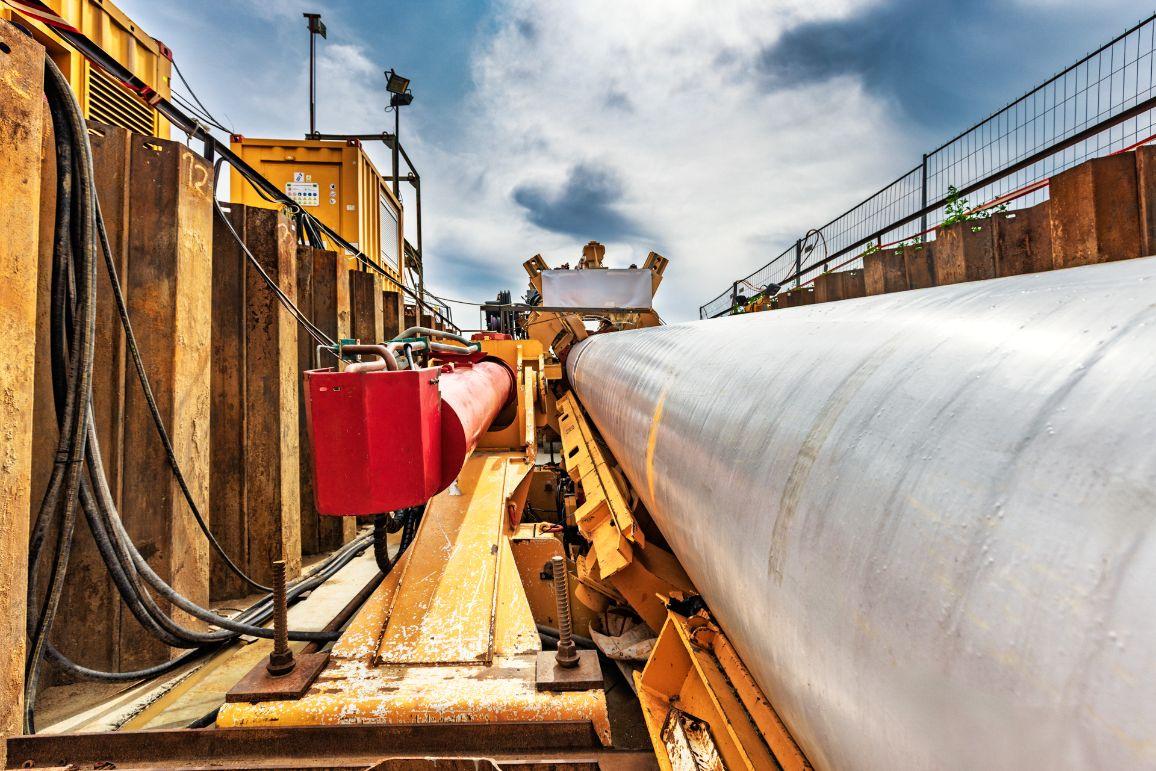
The project also includes 193 trenchless crossings under rivers, roads, and railways. The Direct Pipe technology used in these works combines the advantages of microtunnelling and horizontal directional drilling (HDD), allowing simultaneous drilling and installation of the pipeline with minimal environmental impact.
The longest crossings include Martwa Wisła River (1,042 m), Vistula River (1,010 m and 670 m), Drwęca River (536 m), and the S7 expressway (633 m).
Strong presence of Polish companies
Construction and supervision of the onshore section are carried out almost entirely by Polish companies:
- The Gustorzyn–Gardeja segment is being built by a consortium comprising ROMGOS Gwiazdowscy Sp. z o.o. and ROMGOS Engineering Sp. z o.o.,
- The Gardeja–Kolnik segment is delivered by Stalprofil S.A. of Dąbrowa Górnicza.
- Each section poses unique technical and organisational challenges – including trenchless crossings under rivers, the A1 motorway and protected natural areas. We have already trained over 600 workers in occupational safety, with a strong focus on safety culture and accountability. Over 750 professionals are currently involved in the 250-kilometre project, says Łukasz Kowalczyk, project manager at ROMGOS Group.
The participating companies bring extensive experience, robust technical resources, and financial stability, ensuring high quality and timely delivery of works.
Local benefits and long-term impact
The FSRU programme will also bring measurable benefits to local communities. Upon completion, GAZ-SYSTEM will pay an annual property tax of 2 percent of the infrastructure value located within each municipality, providing a steady revenue stream for local development, infrastructure, and quality-of-life improvements.
FSRU – a pillar of Poland’s energy independence
The FSRU programme is a strategic initiative encompassing the construction of a floating LNG terminal in the Gulf of Gdańsk and a 250 km onshore transmission network connecting it with central Poland. Once operational, the FSRU terminal will create a new gas entry point to the national grid, diversifying supply sources and strengthening the country’s energy independence.
Financing through the National Recovery Plan
On 13 June 2025, GAZ-SYSTEM signed a financing agreement with the Bank Gospodarstwa Krajowego (BGK) for the onshore section of the FSRU programme. The PLN 2.2 billion loan, financed through the National Recovery and Resilience Plan, supports the expansion of Poland’s gas infrastructure, enhances national energy security, and contributes to post-pandemic economic resilience.
Buy us a coffee, and we’ll invest in great maritime journalism! Support Gazeta Morska and help us sail forward – click here!
Kamil Kusier
redaktor naczelny
comments
Add the first comment
see also
Navantia and Fincantieri deepen cooperation on the european patrol corvette programme
Galeon Yachts and Meyer Shank Racing: merging luxury yachts with motorsport expertise
Unmanned systems and naval firepower modules. WB Group showcases integrated capabilities at Enforce Tac 2026
Swedish ports record lowest ship calls in 18 years. Implications for the maritime sector
February in Szczecin’s shiprepair sector. Ice, overhauls and North Sea expansion
Advanced ROV trials conducted at CTO to validate subsea technologies for offshore applications
University of Gdańsk and PGZ Naval Shipyard join forces for innovation and security
Stadt Naval to deliver electric propulsion system for Polish rescue vessel Ratownik
Gdańsk port’s Basen Górniczy to gain modern port infrastructure
First month of Jantar Unity operations. Polsca ferry paves the way for Batory program units
ADVERTISEMENT
ADVERTISEMENT