CORSICA linea Launches LNG-Powered E-Flexer Ferry CAPU ROSSU: A New Era for Marseille-Corsica Route
The Chinese shipyard CMI Jinling in Weihai marked a significant milestone with the launching of CAPU ROSSU, the first LNG-powered E-Flexer ro-pax vessel for CORSICA linea. Built under the supervision of Stena RoRo, this state-of-the-art ferry is set to enter service on the Marseille–Corsica route in June 2026, promising enhanced environmental performance and passenger comfort.
business maritime economy worldwide ports shipbuilding industry transport and forwarding marine tourism and recreation news03 july 2025 | 08:07 | Source: Gazeta Morska | Prepared by: Oskar Wojciechowski | Print
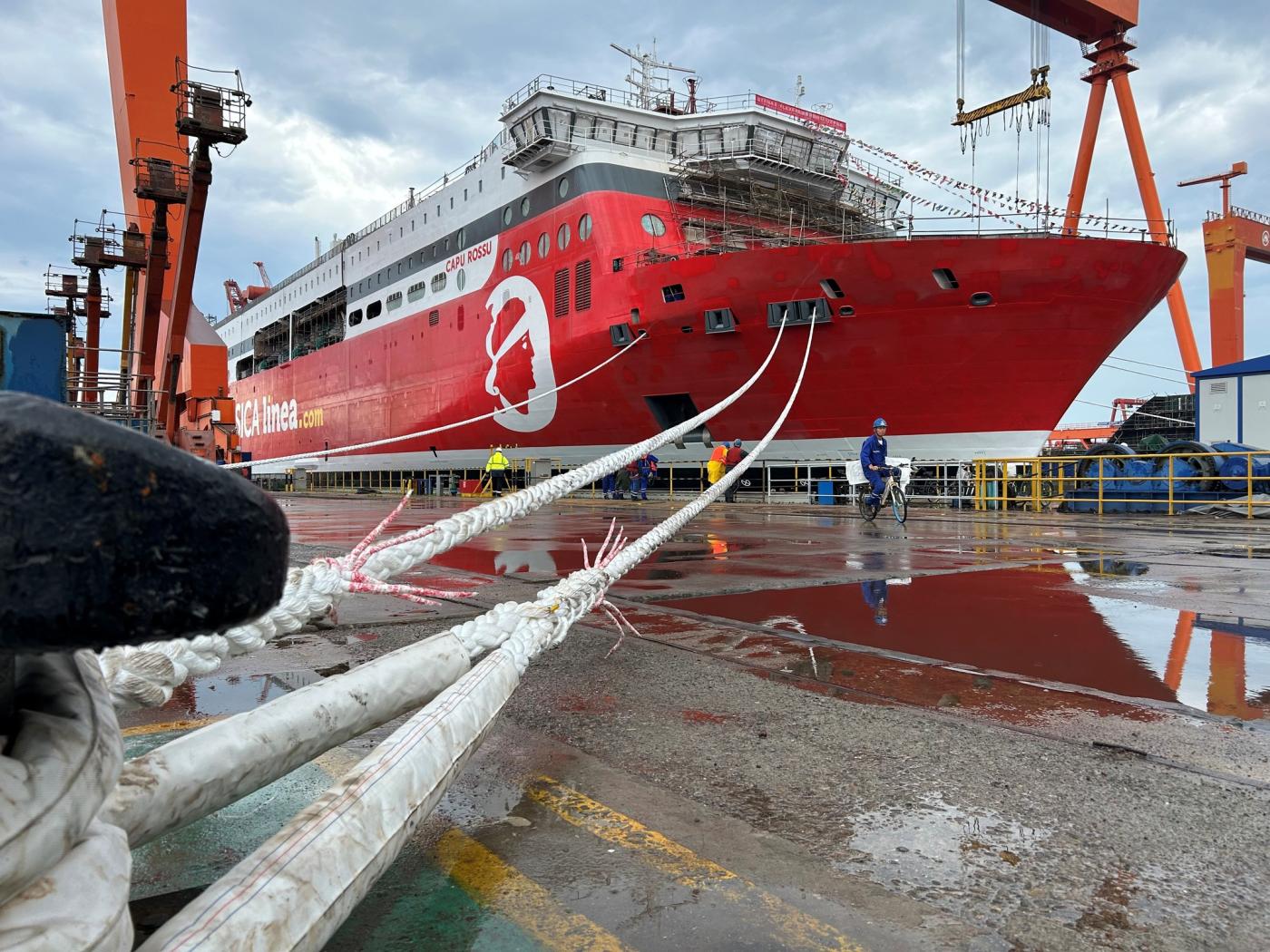
fot. Corsica linea
Next-Generation Ro-Pax Ferry
CAPU ROSSU represents the 13th vessel in the successful Stena E-Flexer series, widely recognized as one of Europe’s most versatile and eco-friendly ferry platforms. The vessel is constructed based on a proven design by Finnish naval architects Deltamarin, and tailored to meet the specific operational requirements of the Mediterranean market.
Measuring 202.90 m in length and 27.80 m in beam, with a draught of 6.60 m, the ferry is propelled by two Wärtsilä 12V46DF dual-fuel engines delivering a combined output of 27,480 kW. Powered primarily by liquefied natural gas (LNG), the engines can also operate on marine gas oil (MGO) and biodiesel blends, enabling a top speed of 23 knots.
Sustainability and Future-Readiness
The introduction of CAPU ROSSU aligns with CORSICA linea’s strategic commitment to reducing the environmental footprint of its fleet. The LNG propulsion system delivers:
- A 20–25% reduction in CO₂ emissions,
- Up to 85% reduction in NOₓ,
- Over 99% reduction in SOₓ and particulate matter,
compared to conventional marine fuels.
Furthermore, the ferry has been classified as Battery Power Ready, allowing integration of battery storage systems in the future and facilitating the transition toward fully zero-emission operations.
Capacity and Onboard Comfort
Designed with passenger experience in mind, CAPU ROSSU accommodates up to 1,035 passengers in 234 cabins spread over 10 decks. Onboard amenities include:
- A main restaurant with 318 seats,
- A bar area with 321 seats,
- A snack bar with 172 seats,
- A Pullman lounge with 76 seats offering a premium travel environment.
Cargo capacity is optimized with 2,500 lane meters, supporting the carriage of 120 trailers and 180 cars, thereby strengthening the ferry’s role in freight transport across the Mediterranean.
Industry Impact
For CORSICA linea, the arrival of CAPU ROSSU marks a major step in fleet modernization and environmental stewardship. Following the LNG-powered ferry A Galeotta, CAPU ROSSU further reinforces the operator’s position as a regional leader in sustainable maritime transport.
As the first E-Flexer built specifically for Mediterranean service, the vessel combines proven Northern European technology with adaptations to the unique conditions of southern Europe’s shipping lanes and port infrastructure.
Construction Timeline
- September 2024: First steel cut
- February 2025: Keel laying
- June 30, 2025: Launching ceremony (completion of 140 days assembly involving 318 steel blocks weighing over 16,000 tonnes)
- February 2026: Sea trials
- March 2026: Delivery
- May 2026: Christening ceremony
- June 2026: Entry into commercial service
About CORSICA linea
CORSICA linea continues to invest heavily in greener shipping solutions to meet ambitious climate targets, aiming for a 40% reduction in CO₂ emissions by 2030 (compared to 2022) and carbon neutrality by 2040. The introduction of CAPU ROSSU is a key milestone in this strategic plan, improving both passenger and freight services while advancing decarbonization in the Mediterranean maritime sector.
CAPU ROSSU stands not only as a new ferry but as a symbol of transformation in European ro-pax shipping — merging sustainability, operational flexibility, and passenger comfort. This state-of-the-art LNG-powered vessel reflects CORSICA linea’s vision for a greener, more efficient future of maritime transport in one of Europe’s busiest passenger and freight corridors.
Buy us a coffee, and we’ll invest in great maritime journalism! Support Gazeta Morska and help us sail forward – click here!
Oskar Wojciechowski
redaktor
comments
Add the first comment
see also
Navantia and Fincantieri deepen cooperation on the european patrol corvette programme
Galeon Yachts and Meyer Shank Racing: merging luxury yachts with motorsport expertise
Unmanned systems and naval firepower modules. WB Group showcases integrated capabilities at Enforce Tac 2026
Swedish ports record lowest ship calls in 18 years. Implications for the maritime sector
February in Szczecin’s shiprepair sector. Ice, overhauls and North Sea expansion
Advanced ROV trials conducted at CTO to validate subsea technologies for offshore applications
University of Gdańsk and PGZ Naval Shipyard join forces for innovation and security
Stadt Naval to deliver electric propulsion system for Polish rescue vessel Ratownik
Gdańsk port’s Basen Górniczy to gain modern port infrastructure
First month of Jantar Unity operations. Polsca ferry paves the way for Batory program units
ADVERTISEMENT
ADVERTISEMENT