









Continents at your fingertips. Diving in Iceland’s purest waters
There are many extraordinary diving spots worldwide, but only one allows you to literally touch two continents underwater. Silfra Fissure, located in the heart of Iceland’s Þingvellir National Park, is a place where nature, geology, and adrenaline blend into one absolutely unique experience. It’s no surprise that divers from all over the world consider this spot one of the most breathtaking and extraordinary locations on our planet.
In brief
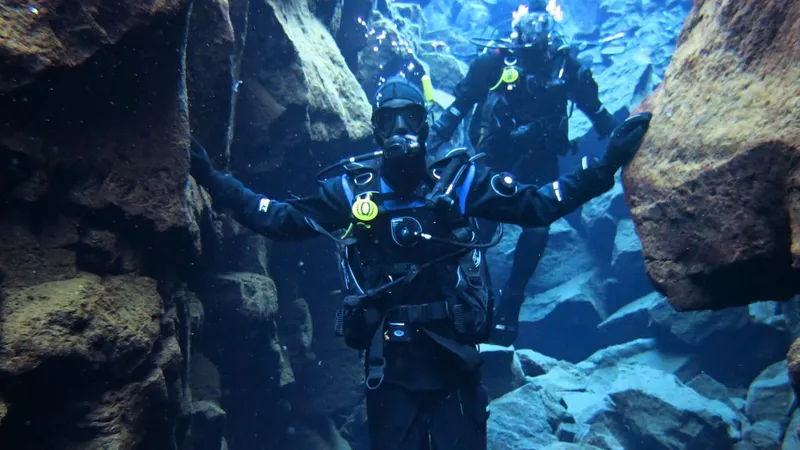
The Silfra fissure in Iceland's Thingvellir National Park allows divers to touch the Eurasian and North American plates at the same time at a spot called Silfra Big Crack. The tectonic plates are moving apart at a rate of around 2 centimetres per year, and water visibility in Silfra reaches up to 100 metres. Water from the Langjökull glacier filters through porous lava rock for 30 to 100 years, and its temperature is 2 to 4 degrees Celsius all year round. The drive from Reykjavik to Thingvellir National Park takes around 45 minutes.
Slifra geologiczny cud na wyciągnięcie ręki | fot. Wikicommons
Silfra – a continental boundary and geological wonder
Silfra is nothing less than an ever-widening fissure between two massive tectonic plates: the Eurasian and the North American. These colossal land masses drift apart at a rate of about 2 cm per year, with glacial meltwater filling the space left behind. The result is not only one of Earth’s most spectacular geological formations but also a paradise for underwater exploration enthusiasts.
The world’s purest water – visibility up to 100 meters
One of Silfra’s greatest assets is its astonishing water clarity, reaching up to 100 meters. This is due to an incredibly long filtration process—meltwater from Iceland’s Langjökull glacier takes between 30 and 100 years to percolate through porous lava rocks before entering the fissure. As a result, the water is not only crystal clear but also rich in minerals, giving it a slightly bluish, almost magical hue.
Diving into these waters feels like floating in zero gravity—no turbulence, no sediment, just incredible transparency and a surreal landscape of tectonic rock formations.
Diving and snorkeling in Silfra – extreme thrills in cold waters
Silfra attracts not only experienced divers but also snorkeling enthusiasts. Although the water temperature remains between 2–4°C year-round, modern drysuits allow for comfortable exploration without the risk of hypothermia. Diving here is an unparalleled experience—especially in the narrowest section known as Silfra Big Crack, where you can touch both continents simultaneously.
Silfra Big Crack, Silfra Cathedral, and Lagoon – Iceland’s underwater wonders
Silfra consists of several sections, each offering a unique experience. In addition to Silfra Big Crack, divers can navigate through Silfra Hall, a wide passage with towering rock walls, before reaching Silfra Cathedral—the most monumental part of the fissure, where the clarity and underwater formations create the sensation of being inside a submerged cathedral. The journey ends at Silfra Lagoon, a calm area where divers can pause and marvel at the unparalleled clarity of the water.
Is Silfra worth visiting? Practical information
Without a doubt! Silfra is a must-see, or better yet, a must-experience destination. It’s ideal for diving enthusiasts, geology lovers, and anyone looking to immerse themselves in one of the world’s purest aquatic environments. Iceland itself captivates with its raw beauty, and Silfra stands out as one of its most fascinating treasures.
A surreal encounter with two continental plates, pristine waters, and the sensation of floating among glacial rock formations—this is an experience that lingers in memory for a lifetime. If you’ve ever dreamed of diving in a place that is literally a border between two worlds, Silfra should be at the top of your travel bucket list.
How to get to Silfra? Transport and logistics
To reach Iceland from Poland, travelers can take direct flights to Reykjavik (Keflavík International Airport – KEF). Airlines offer connections from cities such as Gdańsk and Szczecin, though the best range of routes is available from Warsaw and Kraków. Alternatively, adventurers can reach Iceland by sea—ferries operate from Denmark (Hirtshals) to Seyðisfjörður on Iceland’s east coast, making it a great option for those who want to bring their own vehicle.
Upon arrival in Reykjavik, visitors can reach Þingvellir National Park, home to Silfra, by renting a car or joining one of the many guided tours offered by local travel agencies. The drive from Reykjavik takes about 45 minutes and passes through Iceland’s stunning landscapes. No matter how you choose to travel, a trip to Silfra is an unforgettable adventure worth planning well in advance.
We are on Google News! Join us and follow Gazeta Morska. Get daily updates straight from the sea. Follow us at gazetamorska.pl!
Source: Gazeta Morska · Compiled by: Kamil Kusier
Related articles
 Sailing and water sports GB1's America's Cup AC75 reaches Naples, swapping cyclors for batteries
 Safety and rescue From lightships to solar power: 160 years of the Grundkallen light station
 Shipbuilding industry Lionel Messi orders a Sunreef catamaran. The Ultima 88 is being built at the Gdańsk firm’s UAE yard
 Investments A Szczecin firm is to design the world's tallest Christ statue. A 207-metre core in 40 days
 Sailing and water sports A century-old Inga Lisa and Czarny Diament after 32 years at sea. Over 30 classic yachts in Gdynia
 Sailing and water sports Eleven years of trying and metres at the finish. Witold Karałow's Scamp 4 wins the 75th Blue Ribbon
Comments (0)
The discussion is moderated by the editors: a comment appears after review. Your e-mail address is not published.
Nobody has commented on this article yet.