









Construction of third Miecznik-class frigate begins as ORP Huragan enters production
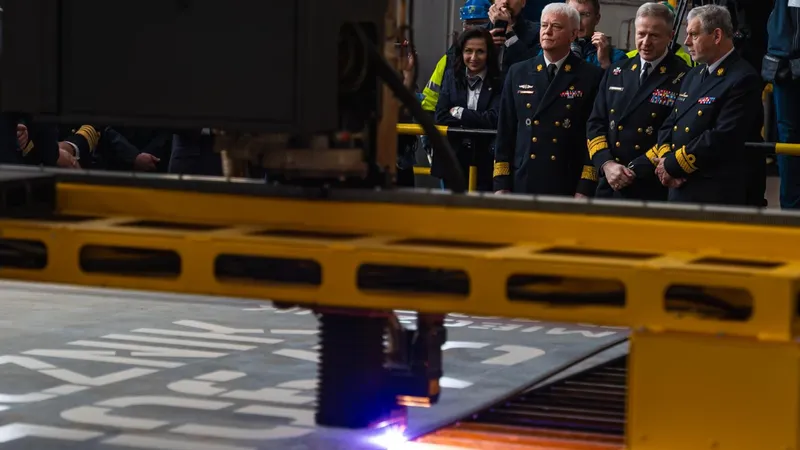
On 28 April 2026, PGZ Stocznia Wojenna in Gdynia officially launched construction of the third and final multi-role frigate under Poland’s Miecznik naval modernisation programme. The ceremonial steel cutting for ORP Huragan marked the beginning of hull prefabrication for the last of three Project 106 frigates being built for the Polish Navy.
In brief
PGZ Stocznia Wojenna in Gdynia cut the first steel on 28 April 2026 for the frigate ORP Huragan, the third and last project 106 vessel in the Miecznik programme. The frigates, based on the British Arrowhead 140 design, are about 138 metres long, with a full displacement of about 7,000 tonnes, a range of about 8,000 nautical miles and a top speed of 28 knots. PGZ Stocznia Wojenna chief executive Marcin Ryngwelski said the launch of ORP Wicher is planned for August 2026, while ORP Burza is at the hull section construction stage. Completion of the programme is scheduled for the end of 2031.
The event, held at PGZ Stocznia Wojenna’s facilities in Gdynia, formally initiated production of the final unit in what is currently Poland’s largest naval shipbuilding and defence industrial programme. With ORP Huragan now entering construction, all three Miecznik-class frigates are officially in production.
The ceremony was attended by senior representatives of the Polish government, armed forces and defence industry, including Paweł Bejda, Secretary of State at the Ministry of National Defence; Konrad Gołota, Undersecretary of State at the Ministry of State Assets; representatives of the National Security Bureau, Polish Navy command structures, the Armament Agency, and international industrial partners.
In a letter addressed to ceremony participants, Deputy Prime Minister and Minister of National Defence Władysław Kosiniak-Kamysz underlined the strategic significance of the programme:
- Today’s steel cutting ceremony for ORP Huragan – the third and final multi-role frigate under the MIECZNIK programme – is an important moment for the Polish Navy, the national defence industry and the security of our state. Following the start of construction of Wicher and Burza, today’s ceremony confirms the consistency in implementing one of the most important modernisation programmes of the Polish Armed Forces.
Speaking during the ceremony, Paweł Bejda highlighted the broader industrial implications of the programme:
- Today we are beginning construction of the third frigate in the Miecznik programme. However, this is not the end of the tasks we are setting for the Polish defence industry - MIECZNIK is an important step, but we are moving forward, consistently developing competencies and building capabilities that strengthen Poland’s security.
Marcin Ryngwelski, President of the Management Board of PGZ Stocznia Wojenna, emphasised both programme progress and shipyard development:
- By starting construction of Huragan, we are entering another stage in the implementation of the Miecznik programme. This is a special moment – Wicher is approaching its launch scheduled for August this year, Burza is currently in the hull section construction phase, and today we are initiating the third unit. PGZ Stocznia Wojenna is executing this programme in accordance with schedule, systematically developing its competencies and utilising modern infrastructure expanded specifically for this project.
He added:
- This is the third steel cutting ceremony within the Miecznik programme, but not the last steel cutting at PGZ Stocznia Wojenna.
Poland’s key naval modernisation programme
The Miecznik programme remains the flagship surface combatant acquisition effort for the Polish Navy and a cornerstone project for Poland’s domestic naval-industrial base.
The frigates are based on the British Arrowhead 140 design developed by Babcock International, itself derived from the Danish Iver Huitfeldt-class platform. The vessels are intended to provide the Polish Navy with significantly expanded capabilities in:
- area air defence,
- anti-surface warfare,
- anti-submarine warfare,
- land attack and littoral strike operations,
- maritime infrastructure and sea line protection,
- NATO and national operational deployments.
Basic platform parameters include:
- overall length: approx. 138 m,
- maximum beam: approx. 20 m,
- full displacement: approx. 7,000 tonnes,
- range: approx. 8,000 nautical miles,
- maximum speed: 28 knots,
- propulsion: CODAD arrangement with four diesel engines and two controllable pitch propellers,
- core crew: 120 personnel,
- additional accommodation: up to 60 mission or support personnel.
Construction activities are centred at the dedicated Miecznik Hull Assembly Hall at PGZ Stocznia Wojenna, currently the tallest ship assembly hall in Poland. Bow sections are also being manufactured in cooperation with CRIST S.A. in Gdynia.
Programme timeline
The first vessel, ORP Wicher, is currently in an advanced hull assembly phase. According to PGZ Stocznia Wojenna, launch is planned for August 2026, with delivery to the Polish Navy scheduled for 2029.
The second frigate, ORP Burza, completed steel cutting in May 2025 and keel laying in December 2025. The vessel is currently undergoing construction of successive hull sections.
With ORP Huragan now entering production, the programme has transitioned into simultaneous execution of all three vessels. Completion of the Miecznik programme, including delivery of the third unit to the Polish Navy, is planned by the end of 2031.
Beyond fleet recapitalisation, the programme is expected to strengthen national shipbuilding competencies in warship design integration, production, maintenance and lifecycle support. For the Polish Navy, Miecznik represents the first comprehensive restoration of major surface combatant capability in decades.
Source: Gazeta Morska · Compiled by: Kamil Kusier
Related articles
 Energy and offshore Equinor takes over Bałtyk 2 and 3 O&M base in Łeba. Port to serve 1.44 GW of offshore wind for 30 years
 Navy and defence Port Gdański Eksploatacja secures NATO NCAGE code. Gdańsk port company lines up for defence tenders
 Shipbuilding industry Ex-Enterprise towed to Mobile under $418.5m contract. Test case for Nimitz-class disposal begins
 Energy and offshore Energa renames Gdańsk gas plant company as foundations for 6,000-tonne turbine and boiler are laid
 Equipment and technology WB Group takes Polish drones from Tokyo to SOFEX in Jordan in a single week
 Ports and logistics PGE books Gdańsk’s T5 terminal for the long haul: Baltica 2 first, then more offshore wind farms
Comments (0)
The discussion is moderated by the editors: a comment appears after review. Your e-mail address is not published.
Nobody has commented on this article yet.