









Chinese firms now control over a third of Africa’s ports - raising fears of Beijing’s expanding global reach
Chinese companies are now involved in more than a third of all African ports – a staggering presence unmatched anywhere else in the world, according to a new report.
In brief
Chinese state-owned enterprises are shareholders, builders, financiers or operators of about 78 ports in 32 African countries, out of 231 ports on the continent, according to a report by the Africa Center for Strategic Studies. West Africa accounts for the largest number of Chinese port investments, 35, compared with 17 in East Africa, 15 in Southern Africa and 11 in North Africa. The expansion of the port of Abidjan was valued at 934 million dollars, and China financed 85 percent of the cost with a loan. The Pentagon assesses that China has the world's largest navy, numbering 355 warships.
State-owned Chinese firms have a stake in around 78 of Africa’s 231 ports, spread across 32 countries. Whether as builders, financiers, or operators, China’s grip on African ports is strongest in the West of the continent, with 35 port projects – far more than in East Africa (17), Southern Africa (15), or North Africa (11). That’s the finding from the Africa Center for Strategic Studies, a US Department of Defense think tank.
By comparison, China is only involved in 10 ports across Latin America and the Caribbean, and 24 in Asian countries.
In West Africa, Chinese influence stretches from Mauritania and Senegal, through Cape Verde, Guinea, Sierra Leone, Liberia, Côte d'Ivoire, and all the way to Nigeria.
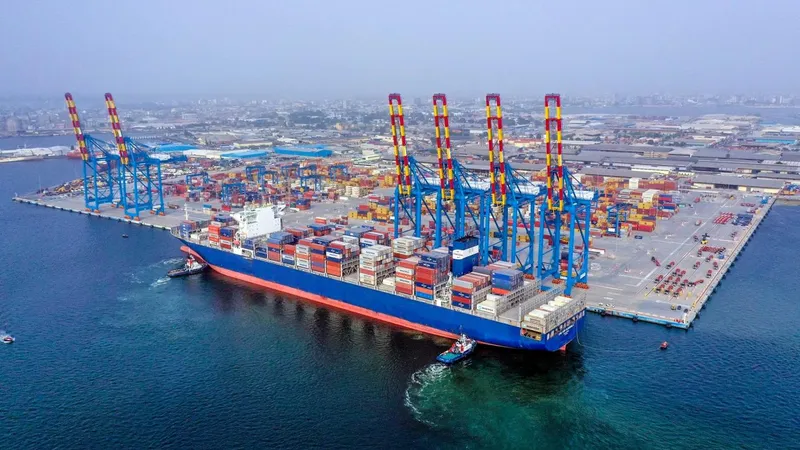
One of the most important ports on this list is in Abidjan, Côte d’Ivoire – a major hub handling 80% of the country’s exports and employing 60,000 people. China funded 85% of the $934 million port expansion, making it Beijing’s biggest port infrastructure investment in Africa to date. When construction wrapped up in 2023, Chinese naval ships began docking there. Since then, the country has increasingly relied on Chinese weapons and military support.
In many African ports, Chinese state companies control nearly every aspect – from funding and building to operations and ownership. The infamous Hambantota port deal in Sri Lanka is often cited as a cautionary tale. Unable to repay its Chinese debt, Sri Lanka handed the port over to a Chinese firm on a 99-year lease.
Similar concerns are now being raised in Africa. Take the Lekki Port in Nigeria – one of West Africa’s largest. It was designed and built by China Harbor Engineering Co., which now owns 54% of the project and manages it under a 16-year lease.
But China’s interests go beyond trade. Some of these ports are being eyed as future military bases. That’s already happened in Djibouti, where China established its first overseas military base in 2017 – right next to a Chinese-built port. The base is close to military outposts run by the US, UK, France, Germany, Italy, Saudi Arabia, Japan, and Spain.
There are also growing fears that “smart” Chinese-built port equipment may be doubling as spying tools. In 2023, the Pentagon raised alarms over cranes made by a Shanghai firm, widely used in ports around the world. These cranes, equipped with high-tech sensors, could reportedly track shipments – including sensitive military cargo.
The warning comes as China continues to flex its naval muscles. The Pentagon now estimates that Beijing has the world’s largest navy, with 355 warships and dozens of fast-attack missile boats.
Source: PAP / Gazeta Morska · Compiled by: Tadeusz Brzozowski / PAP
Related articles
 Energy and offshore Equinor takes over Bałtyk 2 and 3 O&M base in Łeba. Port to serve 1.44 GW of offshore wind for 30 years
 Navy and defence Port Gdański Eksploatacja secures NATO NCAGE code. Gdańsk port company lines up for defence tenders
 Shipbuilding industry Ex-Enterprise towed to Mobile under $418.5m contract. Test case for Nimitz-class disposal begins
 Energy and offshore Energa renames Gdańsk gas plant company as foundations for 6,000-tonne turbine and boiler are laid
 Equipment and technology WB Group takes Polish drones from Tokyo to SOFEX in Jordan in a single week
 Ports and logistics PGE books Gdańsk’s T5 terminal for the long haul: Baltica 2 first, then more offshore wind farms
Comments (0)
The discussion is moderated by the editors: a comment appears after review. Your e-mail address is not published.
Nobody has commented on this article yet.