









Bałtyk 2 and 3 offshore wind farms: foundation work reaches the halfway mark
The Bałtyk 2 and Bałtyk 3 offshore wind farms, built jointly by Equinor and Polenergia, have reached the halfway point of foundation installation. More than 50 monopiles, together with their transition pieces, have already been placed in the bed of the Baltic Sea, and installation of the foundations for the offshore substations is due to begin soon.
In brief
The Bałtyk 2 and Bałtyk 3 offshore wind farms, built by Equinor and Polenergia, have reached the halfway point of foundation installation, with more than 50 monopiles with transition pieces set into the seabed. The two farms will consist of 100 turbines of 14.4 MW each with a combined capacity of up to 1.44 GW, and towers 260 metres high will be erected next year. The vessel Thialf, more than 200 m long and 88 m wide, is carrying out the installation, and installation of foundations for offshore substations stepping voltage up from 66 to 220 kV will begin this summer. Power generation is due to start in 2027, with full commissioning planned for 2028.
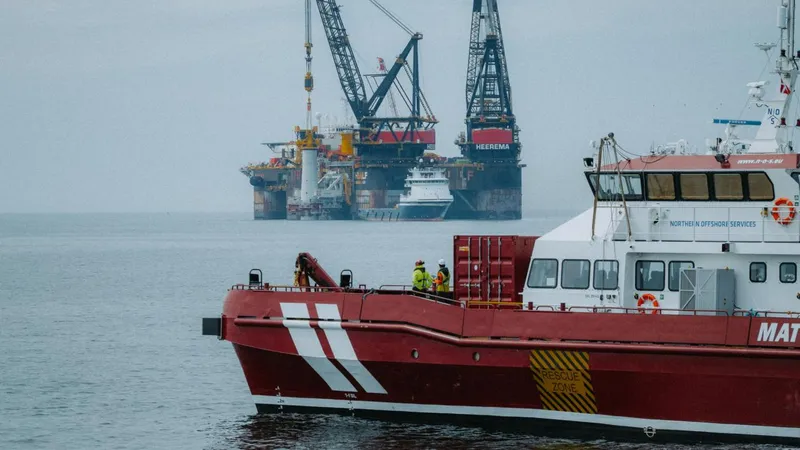
Together the two farms will comprise 100 turbines of 14.4 MW each, with a combined capacity of up to 1.44 GW. Foundation installation began in May. The monopiles seated in the seabed are joined to transition pieces, recognisable by the distinctive yellow tops visible above the water. It is on these that the 260-metre turbine towers will be mounted next year.
Adam Purwin, CEO of Polenergia, said that each foundation installed brings the project closer to the moment when energy from farms with a combined capacity of up to 1.44 GW begins to genuinely power the national grid and strengthen Poland's energy security. He described this complex engineering and logistics operation, behind one of Poland's largest offshore projects, as proceeding smoothly and on schedule.
Michał Jerzy Kołodziejczyk, CEO of Equinor Poland, stressed that foundation work is one of the most demanding stages of building an offshore wind farm, one in which offshore experience, the safety of operations and tight coordination between teams at sea and on land are decisive.
From Bałtyk 2 to Bałtyk 3
Monopiles and transition pieces were first installed at Bałtyk 2, which lies 37 kilometres from shore. At Bałtyk 3, 22 kilometres from the coastline, seabed work was carried out in parallel, including rock placement to protect the underwater infrastructure, and foundation work is now moving there as well. Still this summer, installation is to begin of the jacket support structures, the foundations for the offshore substations. These stations will receive electricity from the turbines, step the voltage up from 66 to 220 kV and transmit the power to shore.
Foundation installation is being carried out by Thialf, one of the largest installation vessels in the world, more than 200 metres long and 88 metres wide, supported by more than a dozen other vessels, including those delivering components.
Power for two million households
Bałtyk 2 and 3 are a joint investment by Equinor, which originates in Norway, and Polenergia, the largest privately owned Polish energy group. Power generation is due to begin as early as 2027, with full commissioning planned for 2028. The electricity from the two farms will be enough to cover the needs of two million households in Poland.
Source: Gazeta Morska · Compiled by: Kamil Kusier
Related articles
 Energy and offshore Equinor takes over Bałtyk 2 and 3 O&M base in Łeba. Port to serve 1.44 GW of offshore wind for 30 years
 Navy and defence Port Gdański Eksploatacja secures NATO NCAGE code. Gdańsk port company lines up for defence tenders
 Shipbuilding industry Ex-Enterprise towed to Mobile under $418.5m contract. Test case for Nimitz-class disposal begins
 Energy and offshore Energa renames Gdańsk gas plant company as foundations for 6,000-tonne turbine and boiler are laid
 Equipment and technology WB Group takes Polish drones from Tokyo to SOFEX in Jordan in a single week
 Ports and logistics PGE books Gdańsk’s T5 terminal for the long haul: Baltica 2 first, then more offshore wind farms
Comments (0)
The discussion is moderated by the editors: a comment appears after review. Your e-mail address is not published.
Nobody has commented on this article yet.