









Bałtyk 2 and 3: landfall drilling complete, shore ready for export cables
One of the more technically demanding stages of the grid-connection works on the Bałtyk 2 and Bałtyk 3 offshore wind farms is finished, the landfall drilling, at the point where the export cables cross from the marine section onto land. The routes beneath the Baltic shoreline are now ready for the cables to be pulled through, carrying power from both farms into Poland's national grid. For the joint venture of Equinor and Polenergia, with a combined capacity of around 1.44 GW, it is another milestone on the way to first power.
In brief
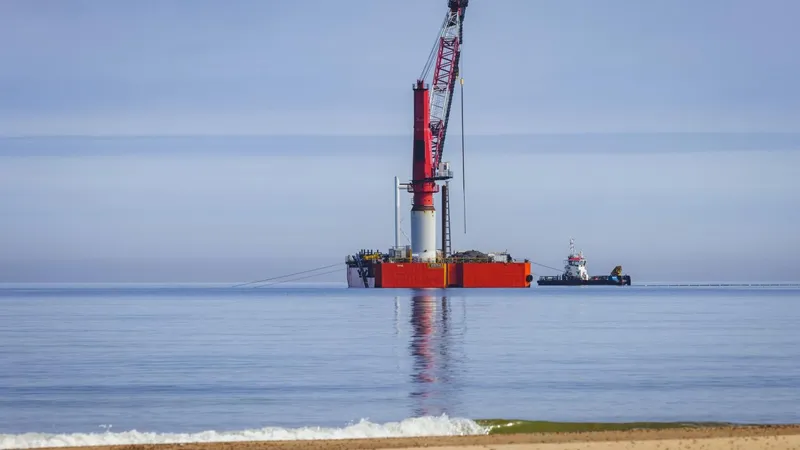
Four HDD bores, each about one kilometre long, have been completed at the landfall of the Bałtyk 2 and Bałtyk 3 offshore wind farms. Casing pipes 71 cm in diameter, into which export cables will be pulled, were laid in the corridors, and the trenchless method made it possible to protect the dunes and the beach. Hanab carried out the drilling, while the Polish company MAG Offshore was responsible for the works from the sea side, towing a pontoon with a 100-tonne crane. The Equinor and Polenergia wind farms are to have 100 turbines 260 metres tall and a capacity of 1.44 GW, with first power in 2027 and full commissioning in 2028.
A kilometre beneath the dunes, without an open trench
The scope covered four bores drilled using HDD (horizontal directional drilling), each roughly one kilometre long. Casing pipes 71 cm in diameter, made of a high-strength material, were laid inside the resulting underground corridors; the export cables that will connect the farms to the onshore transmission network are to be drawn through them.
The key advantage of the trenchless method was routing the crossing beneath the beach and the shoreline without disturbing the surface. That made it possible to protect the dunes and their ecosystem, a particularly sensitive feature along this stretch of coast, and usually one of the hardest to reconcile with construction work. The drilling was carried out by the engineering firm Hanab.
The bore itself, however, is only part of the puzzle. As the investors point out, building the connection infrastructure for offshore wind farms calls for precise planning, technology matched to the local geology, and tight coordination of works running in parallel on land and at sea.
A Polish contractor in a role that barely existed a few years ago
And it is the marine side of the operation that is most interesting here from the point of view of Polish industry. The work from the water was handled by the Polish company MAG Offshore. Its responsibilities included the marine logistics of the kilometre-plus casing pipes, towing the work pontoon fitted with a 100-tonne crane, coordinating several vessels, and supporting the installation works.
The involvement of a Polish contractor in such a demanding task illustrates a process still taking shape in the country, the build-up of a local supply chain for offshore wind and the strengthening of competencies that simply did not exist on the Polish market a few years ago. The first Baltic farms, such as Bałtyk 2 and 3, are becoming the driving force behind an entirely new branch of the maritime industry.
One hundred turbines, 1.44 GW and a 2027 deadline
The Bałtyk 2 and Bałtyk 3 farms, developed jointly by Norway's Equinor and Poland's Polenergia, are to comprise a combined 100 wind turbines standing 260 metres tall. Their capacity is expected to reach 1.44 GW, enough, according to the investors, to match the demand of roughly two million households.
Under the current schedule, the first power from both farms is due to flow into the national grid as early as 2027, with full commercial operation planned for 2028. Bałtyk 2 and 3 form part of a wider Equinor–Polenergia portfolio in the Baltic that also includes the Bałtyk 1 project, with combined capacity approaching 3 GW.
Completing the landfall drilling moves the project a step closer to the point where Polish offshore energy will be discussed not in terms of plans, but of megawatts actually feeding the grid.
Source: Gazeta Morska · Compiled by: Kamil Kusier
Related articles
 Energy and offshore Equinor takes over Bałtyk 2 and 3 O&M base in Łeba. Port to serve 1.44 GW of offshore wind for 30 years
 Navy and defence Port Gdański Eksploatacja secures NATO NCAGE code. Gdańsk port company lines up for defence tenders
 Shipbuilding industry Ex-Enterprise towed to Mobile under $418.5m contract. Test case for Nimitz-class disposal begins
 Energy and offshore Energa renames Gdańsk gas plant company as foundations for 6,000-tonne turbine and boiler are laid
 Equipment and technology WB Group takes Polish drones from Tokyo to SOFEX in Jordan in a single week
 Ports and logistics PGE books Gdańsk’s T5 terminal for the long haul: Baltica 2 first, then more offshore wind farms
Comments (0)
The discussion is moderated by the editors: a comment appears after review. Your e-mail address is not published.
Nobody has commented on this article yet.