









Baltica 2 HDD landfall completed. Offshore wind farm cable route ready for grid connection
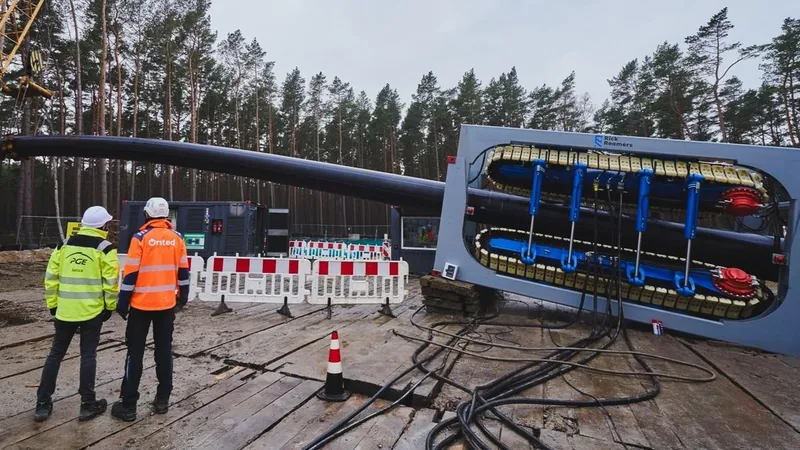
The horizontal directional drilling (HDD) campaign for the landfall section of the Baltica 2 offshore wind project - a joint venture between PGE and Ørsted - has been successfully completed. The milestone enables the trenchless installation of export cables beneath the shoreline, connecting the offshore wind farm to the onshore transmission infrastructure without disturbing beaches or coastal dunes.
In brief
The campaign of horizontal directional drilling from sea to land for the Baltica 2 offshore wind farm has been completed. The works covered four cable ducts with a diameter of 800 mm, welded into strings of around 1,240 metres each, around 5 kilometres of infrastructure in total, and lasted nine months from July 2025, with 42 pipe transports and temperatures ranging from 30 degrees Celsius to minus 20. The Baltica 2 cables will make landfall at Lubiatowo in the Choczewo municipality. Baltica 2, a joint project of PGE and Orsted with a capacity of around 1.5 GW, will supply more than 2.5 million households after commissioning in 2027.
The landfall section represents one of the most technically and environmentally challenging parts of the entire cable route. It is the critical interface where offshore infrastructure meets the onshore grid, making execution methods and environmental safeguards key to the project’s success.
The HDD campaign covered the installation of four cable ducts, each with a diameter of 800 mm. Pipes were assembled on-site using butt fusion welding of 18-metre sections, forming four strings of approximately 1,240 metres each – delivering a total of շուրջ 5 kilometres of तैयार infrastructure for future cable installation.
Works commenced in July 2025 and lasted nine months. Pipe prefabrication alone required 42 deliveries to the construction site. Operations were carried out under highly variable and demanding weather conditions, ranging from +30°C in summer to –20°C in winter, including snow and icing.
Minimising environmental impact at the shoreline
The application of HDD technology allowed the project to significantly reduce its impact on sensitive coastal environments, including beaches and dune systems, while maintaining public access throughout the construction phase.
All works were performed below ground level, eliminating the need for open trenching across the الساحل. Designated pedestrian routes remained operational at all times, with construction activities coordinated closely with local authorities.
Commenting on the milestone, Ulrik Lange, Managing Director of the Baltica 2 project at Ørsted, highlighted both technical and organisational achievements:
- The successful installation of the fourth and final HDD section marks a significant step forward in the project’s execution and reflects the excellent coordination and commitment of the entire project team, as well as strong collaboration with our contractors. We are particularly proud of the high safety culture maintained on site during this technically demanding operation and the dedication of everyone involved.
He added that seabed dredging works are scheduled for April to secure the four duct exits, completing preparations for export cable installation and the connection of offshore and onshore cable systems.
Strategic link between offshore generation and the Polish grid
The landfall is located near Lubiatowo, in the Choczewo municipality, where offshore export cables will connect with onshore transmission infrastructure.
Bartosz Fedurek, President of PGE Baltica, emphasised the importance of this interface for national energy transmission:
- Subsea cables transmitting electricity generated by the Baltica 2 offshore wind farm will make landfall near Lubiatowo. There, they will connect with onshore cables running approximately 7 kilometres to our onshore substation. From there, via the PSE Choczewo substation, electricity will be fed into the national grid. We also place great importance on the involvement of Polish contractors, supported by local subcontractors from the Pomerania region.
With a planned capacity of approximately 1.5 GW, Baltica 2 is one of the largest offshore wind projects under development in the Baltic Sea. Installation of foundations, offshore export cables and offshore substations is scheduled to begin later this year. This will be followed by the installation of inter-array cables linking turbines with offshore substations, as well as the commissioning phase of the onshore substation.
Once operational in 2027, Baltica 2 is expected to become Poland’s largest offshore wind farm, supplying renewable energy to more than 2.5 million households and playing a key role in the country’s energy transition.
Source: Gazeta Morska · Compiled by: Kamil Kusier
Related articles
 Energy and offshore Equinor takes over Bałtyk 2 and 3 O&M base in Łeba. Port to serve 1.44 GW of offshore wind for 30 years
 Navy and defence Port Gdański Eksploatacja secures NATO NCAGE code. Gdańsk port company lines up for defence tenders
 Shipbuilding industry Ex-Enterprise towed to Mobile under $418.5m contract. Test case for Nimitz-class disposal begins
 Energy and offshore Energa renames Gdańsk gas plant company as foundations for 6,000-tonne turbine and boiler are laid
 Equipment and technology WB Group takes Polish drones from Tokyo to SOFEX in Jordan in a single week
 Ports and logistics PGE books Gdańsk’s T5 terminal for the long haul: Baltica 2 first, then more offshore wind farms
Comments (0)
The discussion is moderated by the editors: a comment appears after review. Your e-mail address is not published.
Nobody has commented on this article yet.