









Baltic Industrial Group delivers first steel components for Baltica 2 foundations
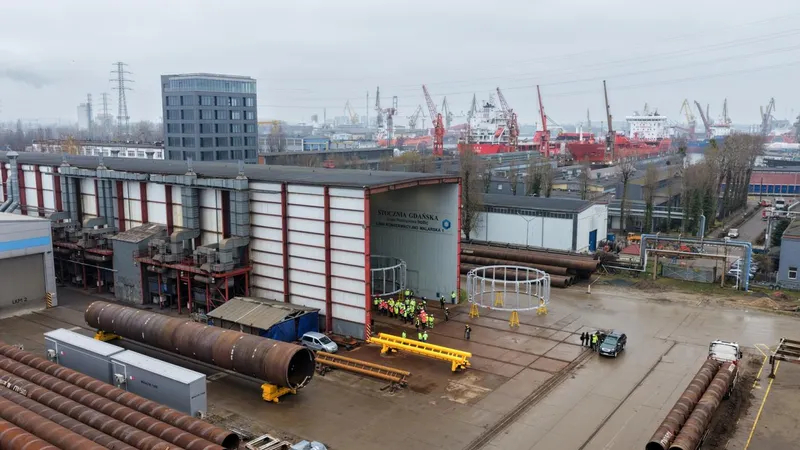
Baltic Industrial Group (GPB) has completed the first secondary steel components for the Baltica 2 offshore wind farm—Poland’s largest offshore project currently under construction, jointly developed by Ørsted and PGE. The initial batch includes anodic cages and a service vessel berthing platform, which play a critical role in corrosion protection and operational access to turbine and substation foundations.
In brief
Grupa Przemysłowa Baltic has delivered the first anode cages and a boat landing platform for service vessels for the foundations of the Baltica 2 offshore wind farm, developed by Ørsted and PGE. The contract covers 111 anode cages and 111 boat landing platforms, of which 4 will go on the foundations of offshore substations and 107 on turbine foundations. Production at Grupa Przemysłowa Baltic's plants in Gdańsk started in July, and completion is scheduled for mid-August 2026. Baltica 2 will reach a capacity of around 1.5 GW after commissioning in 2027.
Key structural elements for long-term offshore resilience
Under the contract, GPB will manufacture and supply 111 anodic cages and 111 service vessel berthing platforms — four for offshore substations and 107 for turbine foundations. These structures ensure safe access for maintenance crews, provide attachment points for safety and firefighting equipment, and safeguard the integrity of the primary steel over decades of exposure at sea.
Production began in late July this year, with completion of the full scope scheduled for mid-August 2026. Manufacturing at GPB’s facilities in Gdańsk strengthens Poland’s offshore supply chain and demonstrates the rapidly expanding capabilities of the national industrial sector.
Milestone demonstrates offshore manufacturing competence
According to Ørsted and PGE representatives, the completion of the first units confirms GPB’s readiness for repeatable, specification-compliant serial production. Precision manufacturing is essential, given the demanding quality standards and environmental conditions offshore structures must withstand.
The developers emphasize that the involvement of Polish companies is not only a strategic element of the energy transition, but also a strong driver for domestic capability-building, workforce development, and long-term supply chain growth.

Quality assurance and safety at the core
The production process includes welding operations, steel cutting, lifting activities, mechanical finishing, and work at height — all performed under rigorous safety and risk management protocols. Each component undergoes a comprehensive inspection and test plan, with full material traceability and daily supervision by the developers’ representatives. Final inspection is conducted prior to shipment to storage.
Safety remains a core pillar of the collaboration between Ørsted, PGE, and GPB throughout the project lifecycle.
Baltica 2 – a flagship offshore wind project for Poland
Once commissioned in 2027, Baltica 2 will deliver approximately 1.5 GW of clean energy, enough to supply around 2.5 million Polish households. It is a cornerstone of Poland’s offshore wind development and the largest offshore wind farm currently being built in the Baltic Sea region.
Source: Gazeta Morska
Related articles
 Energy and offshore Equinor takes over Bałtyk 2 and 3 O&M base in Łeba. Port to serve 1.44 GW of offshore wind for 30 years
 Navy and defence Port Gdański Eksploatacja secures NATO NCAGE code. Gdańsk port company lines up for defence tenders
 Shipbuilding industry Ex-Enterprise towed to Mobile under $418.5m contract. Test case for Nimitz-class disposal begins
 Energy and offshore Energa renames Gdańsk gas plant company as foundations for 6,000-tonne turbine and boiler are laid
 Equipment and technology WB Group takes Polish drones from Tokyo to SOFEX in Jordan in a single week
 Ports and logistics PGE books Gdańsk’s T5 terminal for the long haul: Baltica 2 first, then more offshore wind farms
Comments (0)
The discussion is moderated by the editors: a comment appears after review. Your e-mail address is not published.
Nobody has commented on this article yet.