









Baltic 2 and Baltic 3 move closer to offshore installation as key components reach final preparation stage
The Baltic 2 and Baltic 3 offshore wind farms, developed by Equinor and Polenergia, are entering a decisive phase of preparation ahead of offshore installation works in the Baltic Sea. In Vlissingen, at Smulders’ facilities in the Netherlands, major offshore infrastructure components are now undergoing final outfitting and yard preparation.
In brief
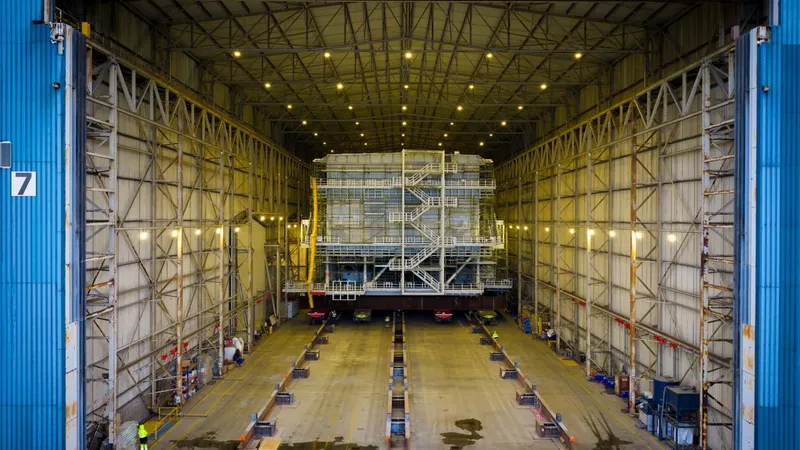
The topside for the Bałtyk 3 offshore wind farm has left the production hall of the Smulders plant in Vlissingen in the Netherlands and now stands in the outdoor yard. The structure, measuring 51 × 38 × 43 metres, weighs about 3,700 tonnes, similar to the Bałtyk 2 topside, and the plant has gathered more than 60 transition pieces about 17 metres high and weighing nearly 400 tonnes each. The Equinor and Polenergia farms will comprise 100 turbines with a capacity of 1,440 MW, with first power in 2027 and full commercial operation in 2028.
A key milestone has been reached with the rollout of the topside structure for the Baltic 3 offshore substation from the production hall to the outdoor yard. The structure measures 51 × 38 × 43 metres, making it comparable in scale to a 15-storey building. The Baltic 2 topside is located adjacent on the same site. Each of the topsides weighs approximately 3,700 tonnes and is currently in the final phase of outfitting and system integration ahead of offshore transport.
In parallel, production and assembly of transition pieces is progressing at scale. These critical interface structures, which connect monopile foundations to wind turbine towers, are among the most technically demanding components of offshore wind infrastructure. More than 60 units have already been staged at the Vlissingen site. Each transition piece stands approximately 17 metres tall and weighs close to 400 tonnes. The first units are expected to be transported shortly to the Baltic Sea, where they will be installed alongside monopile foundations as the initial offshore elements of the projects.
According to project representatives, both topsides and transition pieces are being delivered through a complex international supply chain, with significant participation from Polish industry. Polish companies are supplying steel components, auxiliary systems, and engineering solutions supporting fabrication, outfitting, and integration processes. The local content share remains a key execution pillar for both Baltic 2 and Baltic 3 developments.
Together, the projects will comprise 100 wind turbines with a total installed capacity of 1,440 MW. First power is scheduled for 2027, while full commercial operation is expected in 2028.
The Baltic 2 and Baltic 3 developments represent one of the largest offshore wind build-outs in the Polish sector of the Baltic Sea. The current stage confirms that the projects are transitioning from onshore fabrication and assembly into the offshore installation phase.
Source: Gazeta Morska · Compiled by: Kamil Kusier
Related articles
 Energy and offshore Equinor takes over Bałtyk 2 and 3 O&M base in Łeba. Port to serve 1.44 GW of offshore wind for 30 years
 Navy and defence Port Gdański Eksploatacja secures NATO NCAGE code. Gdańsk port company lines up for defence tenders
 Shipbuilding industry Ex-Enterprise towed to Mobile under $418.5m contract. Test case for Nimitz-class disposal begins
 Energy and offshore Energa renames Gdańsk gas plant company as foundations for 6,000-tonne turbine and boiler are laid
 Equipment and technology WB Group takes Polish drones from Tokyo to SOFEX in Jordan in a single week
 Ports and logistics PGE books Gdańsk’s T5 terminal for the long haul: Baltica 2 first, then more offshore wind farms
Comments (0)
The discussion is moderated by the editors: a comment appears after review. Your e-mail address is not published.
Nobody has commented on this article yet.