









ALFA 4000: a Spanish answer to Sweden’s future surface fleet? Navantia bets on flexibility and partnership
Spanish shipbuilder Navantia is actively positioning its ALFA 4000 frigate design as a contender for Sweden’s next-generation surface combatant programme. The proposal is tied to the ongoing Luleå programme, under which the Swedish Navy plans to acquire four new frigates. Beyond the platforms themselves, the programme is expected to shape long-term industrial cooperation and sustain national defence competencies.
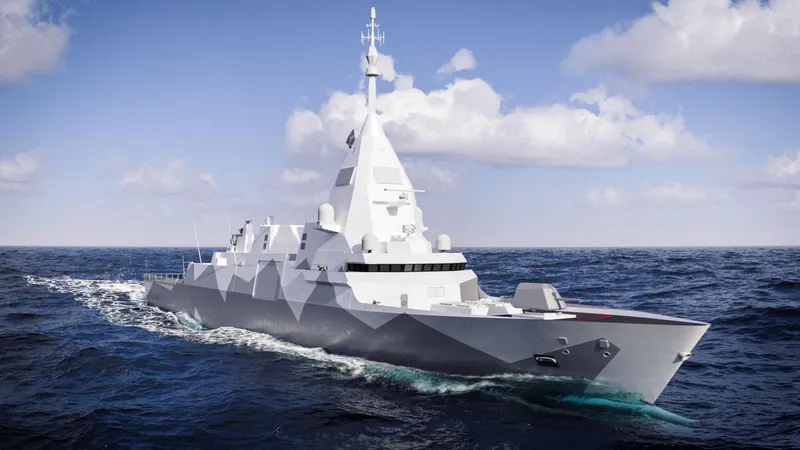
In brief
Navantia is offering Sweden the ALFA 4000 frigate under the Luleå programme covering four surface vessels. The ALFA 4000 design provides for a length of around 120 metres, a full displacement of some 4,300 tonnes, CODAD propulsion with PTO/PTI and a speed exceeding 27 knots, with a flight deck adapted for NH-90 and SH-60 Seahawk helicopters. Navantia declares cooperation with Swedish industry, including Saab, and integration of RBS-15 missiles. The schedule envisages delivery of the first two frigates in 2030 and two more a year later, although the reference ship has not yet been built.
The ALFA 4000 sits firmly within the increasingly prominent segment of medium-sized frigates. This class reflects a broader shift in naval procurement, as rising costs of large blue-water combatants push navies toward more balanced solutions that combine credible combat capability with manageable acquisition and lifecycle costs.
A design built around adaptability
From the outset, the ALFA 4000 has been conceived as a highly configurable platform. With an overall length of approximately 120 metres and a full-load displacement of around 4,300 tonnes, it offers sufficient volume for a full-spectrum combat system while avoiding the complexity and cost associated with larger frigate designs.
The propulsion architecture is based on a CODAD arrangement, supported by a PTO/PTI system that enables electric drive in selected operational profiles. This feature is particularly relevant for anti-submarine warfare, where reduced acoustic signature can significantly enhance detection performance.
The design incorporates a full aviation capability, including a flight deck and hangar sized for helicopters such as the NH-90 helicopter and the SH-60 Seahawk. The inclusion of an automated handling system underlines the intended operational tempo and the importance of the embarked air asset within the overall combat system.
Multi-domain capability as baseline
Modern frigates are expected to operate across all warfare domains, and the ALFA 4000 follows this paradigm. The concept integrates air defence, surface warfare, and anti-submarine warfare within a single platform.
In the air defence role, the design предусматриes a vertical launch system (VLS), with missile selection left open to customer requirements. This approach aligns with current trends toward interoperability and tailored force structures.
For surface warfare, the platform is designed to accommodate anti-ship missiles such as the RBS-15, which is of particular relevance in the Swedish context. A medium-calibre main gun and remotely operated weapon stations provide layered engagement options at shorter ranges.
Anti-submarine warfare represents one of the more demanding aspects of the design. The proposed configuration includes a hull-mounted sonar, a towed array system, lightweight torpedoes, and a fully integrated naval helicopter. The emphasis is placed on the seamless integration of sensors and effectors through the combat management system, enabling a coherent sensor-to-shooter chain.
Industrial dimension tailored to Sweden
A central element of Navantia’s offer is its industrial component. The company highlights its willingness to cooperate closely with Swedish industry, including Saab, a key supplier of combat systems and sensors.
This cooperation would likely extend beyond system integration to include local participation in production and through-life support. Such an approach is consistent with Sweden’s long-standing policy of maintaining a high degree of technological sovereignty in defence procurement.
Navantia also underlines its experience in international programmes and points to potential support from the Spanish Navy in training and operational transition. These elements are presented as factors that could mitigate programme risk.
Ambitious timelines and inherent risks
According to Navantia, the delivery schedule foresees the first two frigates entering service in 2030, followed by the remaining pair in 2031. By current naval procurement standards, this represents an ambitious timeline, particularly given that the ALFA 4000 remains an unbuilt design.
The absence of a reference platform implies that many of the stated performance parameters are still theoretical. This applies not only to propulsion and endurance, but also to the integration of complex combat systems, which is often the most challenging phase of any naval programme.
As a result, claims regarding reduced risk should be viewed in the context of the shipyard’s track record rather than the maturity of the specific design. In practice, programme success will depend on the ability to translate design assumptions into a stable and executable build standard.
Part of a broader market shift
The ALFA 4000 reflects a wider evolution in naval force structure planning. Medium-sized frigates are increasingly seen as a viable alternative to both large, high-end combatants and smaller corvettes with limited endurance. They offer sufficient capability for most regional missions while maintaining a more sustainable cost profile.
For Sweden, whose operational focus is centred on the Baltic Sea, such a platform could provide an effective balance between capability and practicality. The ability to operate in confined and complex littoral environments, while retaining credible multi-domain capability, is likely to be a key consideration in the final selection.
Between proposal and procurement decision
Navantia’s ALFA 4000 clearly addresses several of Sweden’s stated priorities, particularly in terms of industrial cooperation and system flexibility. At the same time, it remains a concept that has yet to be validated through construction and operational service.
The final decision will therefore hinge on a combination of technical evaluation, risk assessment, and industrial considerations. In that context, the ALFA 4000 stands as a competitive and forward-looking proposal, but one that will ultimately need to prove its credibility beyond the design stage.
Source: Gazeta Morska · Compiled by: Kamil Kusier
Related articles
 Energy and offshore Equinor takes over Bałtyk 2 and 3 O&M base in Łeba. Port to serve 1.44 GW of offshore wind for 30 years
 Navy and defence Port Gdański Eksploatacja secures NATO NCAGE code. Gdańsk port company lines up for defence tenders
 Shipbuilding industry Ex-Enterprise towed to Mobile under $418.5m contract. Test case for Nimitz-class disposal begins
 Energy and offshore Energa renames Gdańsk gas plant company as foundations for 6,000-tonne turbine and boiler are laid
 Equipment and technology WB Group takes Polish drones from Tokyo to SOFEX in Jordan in a single week
 Ports and logistics PGE books Gdańsk’s T5 terminal for the long haul: Baltica 2 first, then more offshore wind farms
Comments (0)
The discussion is moderated by the editors: a comment appears after review. Your e-mail address is not published.
Nobody has commented on this article yet.