









A new era of underwater warfare. Saab’s Autonomous Ocean drone
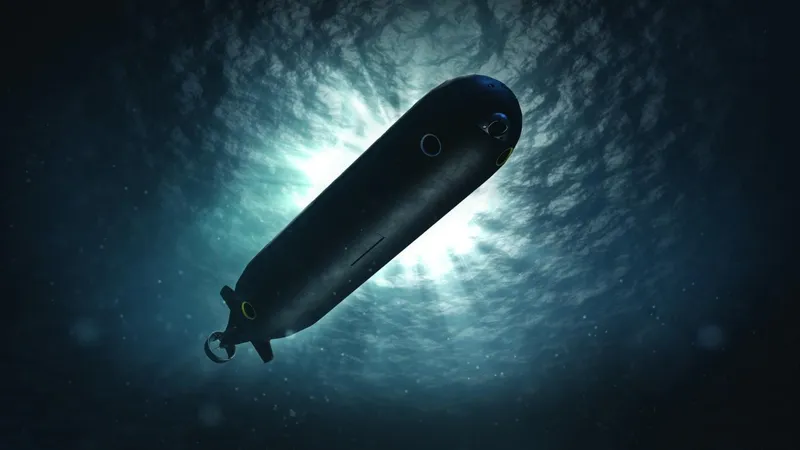
The future of naval defence is moving beneath the surface — and Saab is positioning itself at the forefront of this transformation. The Swedish defence company has unveiled its latest innovation, the Autonomous Ocean Drone, a large uncrewed underwater vehicle (LUUV) designed to redefine intelligence, surveillance, and seabed warfare. Backed by a newly awarded contract worth SEK 60 million (approx. USD 5–6 million) from Sweden’s Defence Materiel Administration (FMV), Saab is accelerating the development of this next-generation platform.
In brief
Saab signed a contract in August 2025 with the Swedish Defence Materiel Administration FMV to develop a concept for a Large Uncrewed Undersea Vehicle class vehicle, worth around SEK 60 million, more than USD 6 million. The first sea trials of the Autonomous Ocean Drone prototype are planned for summer 2026, and the demonstrator is to be around 6.5 m long and around 1.4 m wide, with a speed of up to 14 km/h and an operating depth of up to 500 m. At the heart of the design is the Autonomous Ocean Core, an autonomy system developed by Saab for more than 30 years, handling navigation, sensors and ultimately torpedoes.
From submarines to drones: a century of experience
Saab is not a newcomer to underwater technologies. With more than a hundred years of submarine-building tradition, the company has consistently pushed the limits of what can be achieved in challenging maritime environments. Submarines built for the Baltic Sea have demonstrated long-range endurance without logistical support, modular mid-life upgrades, and resilience in one of the world’s most complex naval theatres.
The Autonomous Ocean Drone inherits this evolutionary design philosophy. Modularity and adaptability lie at its core, enabling rapid integration of new systems and technologies to meet both today’s and tomorrow’s mission profiles.
Versatility in deployment
Unlike traditional underwater platforms, Saab’s LUUV offers flexible deployment methods. The drone can be launched directly pier-side or deployed covertly from compatible submarines, such as the Blekinge-class (A26) equipped with a multi-mission portal. This dual capability provides strategic choice: discreet operations when launched from submarines, or independent missions initiated from ports or surface ships.
ISR and seabed operations
At its current stage of development, the Autonomous Ocean Drone is optimised for intelligence, surveillance, and reconnaissance (ISR) tasks. Equipped with a suite of advanced sensor systems, it can conduct stealth monitoring, deliver objects to the seabed, or install seabed ISR infrastructure such as cables or power sources. The system can also support special forces operations by transporting equipment to hard-to-reach underwater locations.
Saab stresses that this is only the beginning. The platform is designed for scalability, with future capabilities such as torpedo launches already being evaluated as potential mission extensions.
Autonomous Ocean Core – the brain of the system
Central to the concept is Autonomous Ocean Core, Saab’s AI-driven system-of-systems architecture. It provides navigation, electronic warfare support, advanced sensor fusion, and the ability to synchronise with crewed and uncrewed assets. Built for long-term scalability, the core allows integration not only of Saab’s proprietary technologies but also third-party solutions — ensuring sustained relevance as the underwater threat landscape evolves.
Strategic implications
The unveiling of the Autonomous Ocean Drone comes at a time when seabed warfare and the protection of Exclusive Economic Zones (EEZs) and critical national infrastructure (CNI) are rising in importance. The Baltic Sea, with its dense infrastructure and geopolitical sensitivities, underscores the need for stealthy, long-endurance underwater assets.
By blending autonomy, modularity, and proven submarine heritage, Saab’s LUUV positions itself as a future cornerstone of underwater operations. Whether operating as a “water wingman” alongside submarines or conducting independent ISR missions, the platform represents a decisive step in extending the operational reach of modern navies.
Source: Gazeta Morska · Compiled by: Kamil Kusier
Related articles
 Energy and offshore Equinor takes over Bałtyk 2 and 3 O&M base in Łeba. Port to serve 1.44 GW of offshore wind for 30 years
 Navy and defence Port Gdański Eksploatacja secures NATO NCAGE code. Gdańsk port company lines up for defence tenders
 Shipbuilding industry Ex-Enterprise towed to Mobile under $418.5m contract. Test case for Nimitz-class disposal begins
 Energy and offshore Energa renames Gdańsk gas plant company as foundations for 6,000-tonne turbine and boiler are laid
 Equipment and technology WB Group takes Polish drones from Tokyo to SOFEX in Jordan in a single week
 Ports and logistics PGE books Gdańsk’s T5 terminal for the long haul: Baltica 2 first, then more offshore wind farms
Comments (0)
The discussion is moderated by the editors: a comment appears after review. Your e-mail address is not published.
Nobody has commented on this article yet.