









A hundred metres long and 22 metres high. A floating block from Gdynia sails for Saint-Nazaire
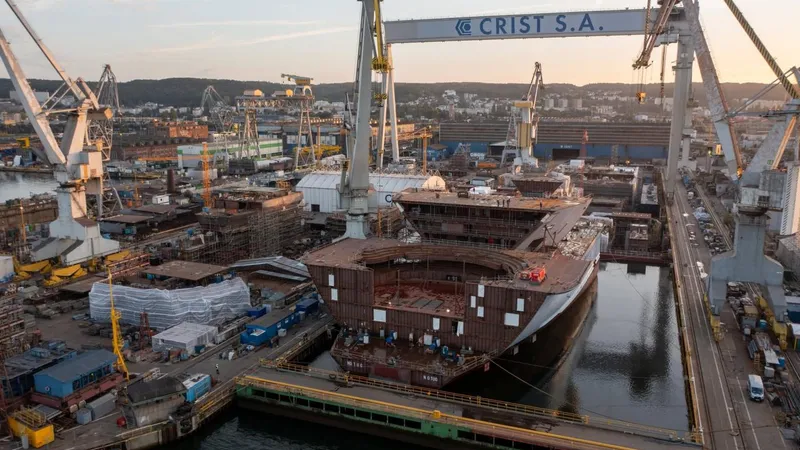
CRIST has completed the floating block B35 for a Royal Caribbean International cruise ship under construction at Chantiers de l'Atlantique in France. The structure left Gdynia on 16 September for Saint-Nazaire. The block measures around 100 metres in length, up to 57 metres in width and 22 metres in height, and carries three additional bow blocks built under the same project on its deck.
In brief
Gdynia shipyard CRIST shipped the B35 block, about 100 metres long and 22 metres high, from Gdynia to Saint-Nazaire on 16 September for a Royal Caribbean International cruise ship. The B35 block for Chantiers de l'Atlantique was partly outfitted and painted, with piping, ventilation and partial cabling installed. Three bow blocks from the same project are being carried on the B35 block. Cooperation between CRIST and Chantiers de l'Atlantique has lasted more than ten years.
Not just steel
The scope of work matters more than the dimensions. The structure has been partly outfitted and painted. Piping and ventilation systems have been installed, along with equipment and electrical systems including partially completed cabling.
That distinction determines the value of the contract. A bare steel hull block is the lowest-priced product in the entire shipbuilding chain. A partly outfitted block, with pipe runs, ventilation and cabling in place, demands design work, coordination between disciplines and quality control at a different level altogether, while shortening assembly time at the receiving yard.
That is why such sections are prepared at a specialist supplier rather than on the building dock, where every week costs more.
More than a decade of cooperation
The delivery of block B35 is another CRIST project for Chantiers de l'Atlantique and confirms more than ten years of continuous cooperation between the two yards.
Chantiers de l'Atlantique is one of the three European yards that dominate large cruise ship construction, alongside Italy's Fincantieri and Germany's Meyer Werft. All three work to a model in which a substantial part of the hull and its sections is built away from the home yard, at trusted subcontractors, while the main yard handles design, integration, interior outfitting and handover to the owner.
Within that arrangement, Gdynia has for years occupied the position of supplier of large, complex structures that must arrive ready to be joined into the hull.
Transport as a task in itself
Moving a structure of these dimensions is an operation in its own right. A block 22 metres high and up to 57 metres wide fits no standard transport formula, and shifting it requires a vessel with sufficient capacity and stability, prepared sea fastenings and a route planned around the weather.
Loading three additional bow blocks onto the same vessel shows that transport is planned to deliver a complete set of sections from a given stage in a single voyage.
What it says about Polish shipbuilding
The contract illustrates the real position of Polish yards in the European value chain. Cruise ships are not built in Poland today, but without companies such as CRIST those ships would not be delivered on schedule.
It also shows the direction worth taking. The more outfitting is completed in Gdynia, the higher the value of the order and the harder the supplier is to replace. A block with systems and cabling is a very different negotiating position from a section of welded plate.
The same pattern appears in another project now under way at the Gdynia yard: hulls for advanced fibre-optic cable-laying vessels for OMS Group, completed afterwards at Ulstein Verft in Norway. The model is identical, and the question for the coming years is how to move one step further along it.
Source: Gazeta Morska · Compiled by: Kamil Kusier
Related articles
 Energy and offshore Equinor takes over Bałtyk 2 and 3 O&M base in Łeba. Port to serve 1.44 GW of offshore wind for 30 years
 Navy and defence Port Gdański Eksploatacja secures NATO NCAGE code. Gdańsk port company lines up for defence tenders
 Shipbuilding industry Ex-Enterprise towed to Mobile under $418.5m contract. Test case for Nimitz-class disposal begins
 Energy and offshore Energa renames Gdańsk gas plant company as foundations for 6,000-tonne turbine and boiler are laid
 Equipment and technology WB Group takes Polish drones from Tokyo to SOFEX in Jordan in a single week
 Ports and logistics PGE books Gdańsk’s T5 terminal for the long haul: Baltica 2 first, then more offshore wind farms
Comments (0)
The discussion is moderated by the editors: a comment appears after review. Your e-mail address is not published.
Nobody has commented on this article yet.