









A Gdańsk HVAC contractor turns up in three Polish Navy programmes at once
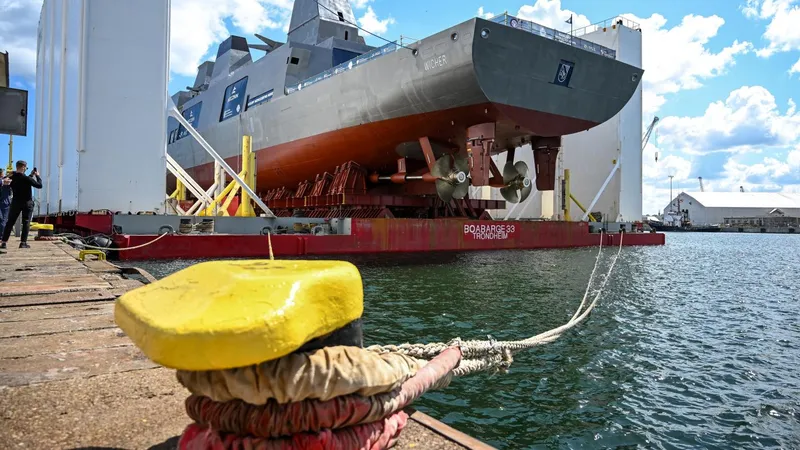
The engineering team of Allrad, a company based in Gdańsk, is supporting the design process for the Miecznik frigate programme, working on HVAC solutions, their coordination and their adaptation to the realities of building a warship. It is the third Polish Navy programme the company works on, alongside Ratownik and Delfin. In parallel it is delivering LNG process ventilation and HVAC for a new Ro-Pax ferry for Polska Żegluga Morska.
In brief
Gdańsk-based Allrad supports HVAC design in the Miecznik programme, the third Polish Navy programme involving the company alongside Ratownik and Delfin. In the Delfin programme Allrad delivers military-standard HVAC and filtered ventilation systems. Allrad is also installing LNG process ventilation and HVAC for a new Ro-Pax ferry of Polska Żegluga Morska. Allrad was founded in 2015 by Bartłomiej Szmagliński, who remains chief executive.
What the company does on Miecznik
Allrad describes its role as support for the design process rather than the supply of a single piece of equipment. The company lists the questions a marine systems designer has to answer: whether the system fits the space available, whether it can be manufactured and installed, whether equipment will be accessible in service and maintenance, whether the solution works with the ship's other systems, and whether the final design can actually be built.
That is an accurate description of work on a frigate. In a hull of limited volume every system competes for space with cabling, piping, structure and weapons, and a change in one discipline forces changes in several others. A design that looks correct on the drawing can prove impossible to install.
What HVAC actually means
HVAC stands for heating, ventilation and air conditioning. In practice it covers everything that moves and treats air in a structure: supply and extraction, ducting, air handling units, chillers, chilled water systems, filters and the control systems that run them. Where refrigeration is included, the sector uses the term HVAC/R.
On a ship the package grows. It takes in ventilation of machinery and bilge spaces, heat rejection from the engine room, ventilation of hazardous zones on gas-fuelled vessels and, on warships, filtration systems that clean incoming air in a contaminated environment. All of it has to work under heel, vibration and salt air, in spaces measured in centimetres.
Three naval programmes and a ferry
The company's order book includes HVAC and military-standard filtration and ventilation systems for the Delfin programme, covering signals intelligence ships for the Polish Navy. It also delivers HVAC systems for vessels built under the Ratownik and Miecznik programmes.
The fourth large maritime project is the LNG process ventilation and HVAC installation for a new Ro-Pax ferry being built for Polska Żegluga Morska. Ventilation on a gas-fuelled ship is a different category of work from air conditioning, as it covers hazardous zones and has to comply with the rules for gaseous fuels.
Outside the maritime market the company also handles industrial projects, including installations for a REHAU Automotive plant in Alabama in the United States, and lists France, Germany, Denmark, Switzerland, Israel and the United States among its markets.
Why HVAC on a warship is a safety system
In a building, ventilation is about comfort. On a warship it is part of the ship's fighting capability and of the crew's survival.
Military-standard filtration and ventilation is designed to let a ship operate in a chemically, biologically or radiologically contaminated environment. Designated zones of the hull have to be kept at positive pressure so that outside air can only enter through filters. Add to that the cooling of compartments packed with electronics, of which a modern frigate carries several times more than a ship designed three decades ago, along with ventilation of machinery spaces, magazines and medical compartments.
Each of these has its own requirements for shock resistance, noise and thermal signature, and all of them have to fit inside the same hull. Competence in warship HVAC design is therefore not something that transfers directly from the construction market.
A company founded in 2015
Allrad was founded in 2015 by Bartłomiej Szmagliński, who remains its CEO. The Gdańsk-based company delivers HVAC systems, piping installations and steel structures for the maritime and onshore sectors, from offshore platforms and vessels to industrial plants, petrochemicals and refineries, and runs its own HVAC design department.
This matters for the picture of the Polish supply chain for naval programmes. Discussions about local content usually focus on shipyards and large combat system suppliers, and far less often on the companies responsible for shipboard installations. Yet it is at that level that it is decided how much of the work stays in the country and which competencies remain in Poland once a programme ends.
Source: Gazeta Morska · Compiled by: Kamil Kusier
Related articles
 Energy and offshore Equinor takes over Bałtyk 2 and 3 O&M base in Łeba. Port to serve 1.44 GW of offshore wind for 30 years
 Navy and defence Port Gdański Eksploatacja secures NATO NCAGE code. Gdańsk port company lines up for defence tenders
 Shipbuilding industry Ex-Enterprise towed to Mobile under $418.5m contract. Test case for Nimitz-class disposal begins
 Energy and offshore Energa renames Gdańsk gas plant company as foundations for 6,000-tonne turbine and boiler are laid
 Equipment and technology WB Group takes Polish drones from Tokyo to SOFEX in Jordan in a single week
 Ports and logistics PGE books Gdańsk’s T5 terminal for the long haul: Baltica 2 first, then more offshore wind farms
Comments (0)
The discussion is moderated by the editors: a comment appears after review. Your e-mail address is not published.
Nobody has commented on this article yet.