









A 1,112-metre pier into the sea at Lubiatowo has its environmental decision. Reactor vessels will arrive by sea
The Regional Director for Environmental Protection in Gdańsk issued on 30 September the environmental decision for MOLF, the marine off-loading facility to be built at Lubiatowo for Poland's first nuclear power plant, and for the technical road linking it to the plant site. It is one of the key stages of preparation: without it there is no siting decision, no water permit and no building permit, and without a pier into the sea there is no way to bring reactor vessels and steam generators to the construction site.
In brief
The Regional Director for Environmental Protection in Gdańsk issued an environmental decision on 30 September for MOLF, the marine off-loading facility near Lubiatowo for Poland's first nuclear power plant. The MOLF pier is to be about 1112 metres long, including about 970 metres at sea, and to receive reactor vessels and steam generators by sea. The Maritime Office in Gdynia announced it will file applications for a location decision and a water permit and is running a tender for the contractor.
The Maritime Office in Gdynia, which is responsible for building MOLF, says it will file applications for the siting decision and the water permit within days, while a tender for the construction contractor is already under way. The decision was issued on a joint application by the office and the company Polskie Elektrownie Jądrowe, because it covers both the structure at sea, built by the office, and the road, built by PEJ.
What exactly is to be built
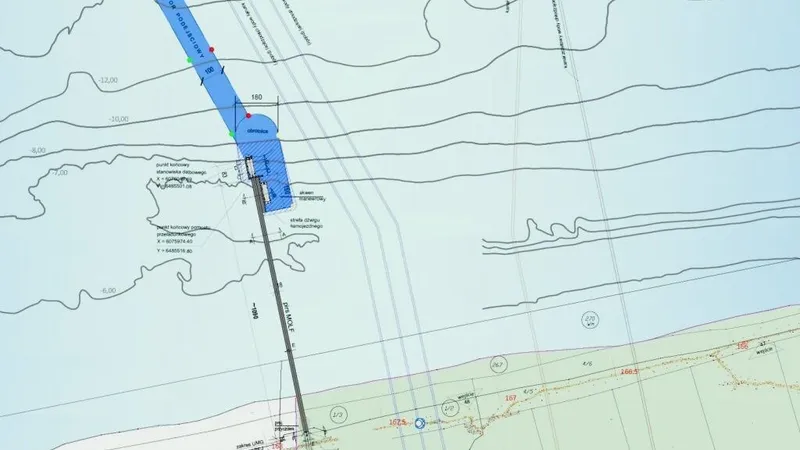
MOLF, Marine Off-Loading Facility, is a permanent pier running out to sea from the beach at Lubiatowo in the municipality of Choczewo, next to the construction site of the plant at the Lubiatowo-Kopalino location. The structure will be around 1,112 metres long in total, of which around 970 metres at sea. It consists of an approach pier from the shore and a wider off-loading pier, from which cargo will be lifted off by cranes, in lo-lo mode, or driven off the ship on platform vehicles, in ro-ro mode. Mooring berths, a manoeuvring basin, a turning circle and an approach channel are part of the scope.
The structure is reinforced concrete on steel piles, and it is open, which matters: it lets bottom sediment move between the supports and limits the facility's effect on natural coastal processes. This is the same problem every breakwater on the Polish coast faces: a solid barrier across a beach traps sand on one side and starves the other. A pier on piles is meant not to do that.
The facility is to receive components that cannot travel by land: reactor pressure vessels, steam generators, modules weighing hundreds of tonnes and of dimensions that fit under no overpass between a port and Lubiatowo. For a nuclear plant on the coast a dedicated off-loading pier is standard, from Hinkley Point C in England to Olkiluoto in Finland.
- Using sea transport to deliver the largest and heaviest components of the plant will make use of the potential of Polish ports and maritime infrastructure. It is another example of how investment in the maritime economy can support strategic state projects - said Arkadiusz Marchewka, secretary of state at the Ministry of Infrastructure.
A shore studied since 1970
The decision was preceded by an environmental impact report and natural inventories covering vegetation, habitats and birds, including their migrations along the coastal strip. Results of earlier marine environmental studies carried out for the plant were also used. In parallel, analyses of hydrodynamic conditions and sediment transport, a navigational analysis and geological surveys were prepared, and the procedure included opinions, agreements and public participation.
Lubiatowo has an advantage no other stretch of the Polish coast has. Since 1970 the Prof. Stanisław Hueckel Coastal Marine Laboratory has operated here, a field station of the Institute of Hydro-Engineering of the Polish Academy of Sciences, studying waves, currents, sediment transport and changes in the seabed, beach and dunes; systematic measurements of the shoreline and the dune foot have been made since 1983. More than half a century of data makes it possible to separate seasonal changes and storm effects from long-term trends, and to check computational models against real observations. For MOLF the institute prepared in 2025 an analysis of hydrodynamics and sediment transport that went into the environmental report. In other words, the pier will be built on a beach about which more is known than about any other in Poland.
The decision sets the conditions under which the structures may be built and operated: protection of habitats and species, organisation of works, noise limits, protection of waters and monitoring of the investment's effect on the environment and the shore.
- We are using our experience in hydro-engineering projects to prepare and carry out the construction of MOLF with due care, taking account of safety and environmental requirements. Timely preparation of the hydro-engineering, road and rail infrastructure is crucial for securing deliveries and starting the next stages of the plant's construction - said Anna Stelmaszyk-Świerczyńska, director of the Maritime Office in Gdynia.
Why the pier is on the critical path
The plant at Lubiatowo-Kopalino is to consist of three Westinghouse AP1000 reactors, built in a consortium with Bechtel, and is to supply more than 12 million households. The first items to reach the site will be steel and concrete, but the moment the reactor vessels and steam generators arrive sets the schedule of the whole project. If the pier is not ready when the first of those components leave the factories, the plant will stand waiting for a delivery route.
That is why the maritime office is not waiting: acceptance of the design documentation is being finalised, the contractor tender is running, and the applications for the siting decision and water permit are going in within days, not months. The building permit is the next step.
- Every administrative decision brings us closer to the start of construction of Poland's first nuclear power plant. The hydro-engineering infrastructure will play an important role in the efficient delivery of the project. It will relieve the road and rail network by allowing sea deliveries of oversized components such as reactor vessels and steam generators - said Michał Olszewski, vice-president of Polskie Elektrownie Jądrowe.
What it means for the ports and the coast
Deputy minister Arkadiusz Marchewka speaks of the potential of Polish ports, and the phrase is not empty. The plant's components will come from abroad, but in one of the Polish ports they have to be transhipped, consolidated and loaded onto vessels able to reach the pier at Lubiatowo, which means contracts for ports, tugs, stevedores and the yards that build barges and pontoons. A ro-ro pier taking cargo on platform vehicles is also a market for contractors who learned to build structures at sea at Baltic Hub and in Świnoujście.
For the coast between Białogóra and Lubiatowo, one of the least built-up stretches of the Polish shore, a pier of more than a kilometre is the first permanent structure in the sea. The environmental decision sets the conditions on which it is to be built and what is to be monitored. Whether those conditions suffice will be shown only by the construction itself, but for the first time in the history of Polish nuclear power it can be checked against data from a laboratory that has stood on that beach for 56 years.
Source: Gazeta Morska · Compiled by: Kamil Kusier
Related articles
 Energy and offshore Equinor takes over Bałtyk 2 and 3 O&M base in Łeba. Port to serve 1.44 GW of offshore wind for 30 years
 Navy and defence Port Gdański Eksploatacja secures NATO NCAGE code. Gdańsk port company lines up for defence tenders
 Shipbuilding industry Ex-Enterprise towed to Mobile under $418.5m contract. Test case for Nimitz-class disposal begins
 Energy and offshore Energa renames Gdańsk gas plant company as foundations for 6,000-tonne turbine and boiler are laid
 Equipment and technology WB Group takes Polish drones from Tokyo to SOFEX in Jordan in a single week
 Ports and logistics PGE books Gdańsk’s T5 terminal for the long haul: Baltica 2 first, then more offshore wind farms
Comments (0)
The discussion is moderated by the editors: a comment appears after review. Your e-mail address is not published.
Nobody has commented on this article yet.