









3D-printed catamaran: robotic manufacturing sets course for the future of small craft
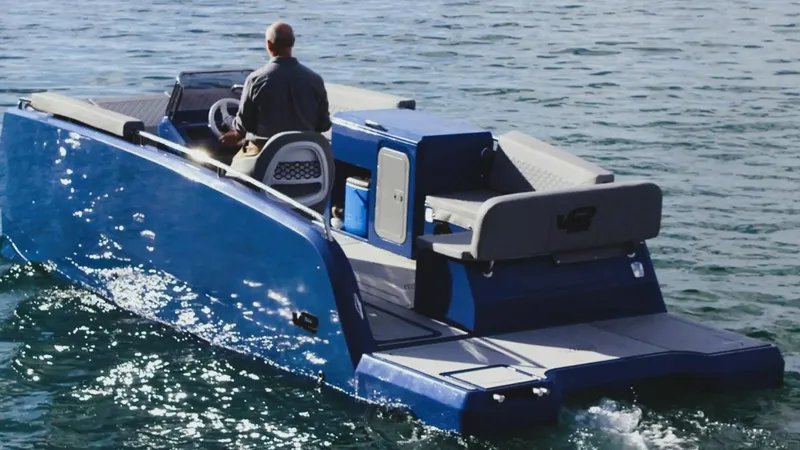
The latest milestone in marine additive manufacturing is a full-scale, six-meter catamaran, entirely 3D printed as a single, monolithic structure. The project represents a collaboration between the Spain-based V2 Group and the Italian Caracol AM, pioneers in large-format 3D printing for industrial applications.
In brief
The Spanish company V2 Group and the Italian firm Caracol AM have built a six-metre catamaran with a hull produced using 3D printing as a single, monolithic structure. The hull production process took around 160 hours and eliminated the need to make costly composite moulds. Additive printing reduces material waste and, according to the project team, can shorten the design-to-production cycle from months to weeks. The V2 Group and Caracol AM catamaran was tested for structural strength, buoyancy and finishing.
Unlike traditional boatbuilding, which relies on molds, hand-laid fiberglass, and labor-intensive layering, this catamaran’s hull was printed in one continuous operation, cutting down assembly steps and eliminating potential weak points. The printing process took approximately 160 hours, demonstrating that additive manufacturing can produce fully functional, open-water vessels at scale.
Monolithic hulls: strength through automation
Traditional composite boat construction requires multiple components joined together, often creating structural weak points. The 3D-printed hull, built layer by layer using robotic extrusion systems, integrates structural reinforcements directly into the geometry, reducing part counts and simplifying assembly.
The monolithic approach not only enhances structural integrity but also enables designers to embed reinforcements exactly where needed. By avoiding manual lamination and molds, the process is both more flexible and faster to implement.
Digital design, no molds required
One of the most significant advantages of large-format 3D printing in marine applications is design agility. Changes to the hull or deck layout can be implemented directly in the digital model, without the expense and lead time of producing new molds. For small- to medium-sized craft manufacturers, this can shorten design-to-production cycles from months to weeks.
Robotic production in action
The catamaran was printed using an industrial robotic arm, programmed to deposit composite material according to precise digital paths. Engineers monitor the process and manage parameters, while the robot handles the bulk of construction, building the hull layer by layer.
This method exemplifies robotic additive manufacturing, combining digital design, automation, and material science to deliver a fully functional vessel. It also reduces human error and ensures repeatable results—key factors for industrial adoption.
Preparing for serial production
Although the six-meter catamaran is currently a demonstrator, the project addresses full-scale production feasibility. The teams analyzed:
- material performance and structural strength
- buoyancy and hydrodynamics
- printing speed and efficiency
- post-processing workflows
The goal was to validate whether 3D printing could support repeatable, industrial-scale production of small to mid-sized marine vessels.
Sustainability and efficiency
Additive manufacturing reduces waste compared to conventional composites, since material is deposited only where required. Combined with robotic automation, the process can lower energy use, shorten production timelines, and simplify supply chains—making it an attractive option for eco-conscious and cost-sensitive shipyards.
The future of small craft manufacturing
While large commercial ships will remain largely traditional for the foreseeable future, small and medium-sized craft are an ideal proving ground for 3D printing. Fully automated, digital-first workflows could reshape recreational, workboat, and unmanned vessel production, delivering both flexibility and cost-efficiency.
The V2 Group–Caracol AM catamaran demonstrates that digital design and robotic manufacturing are ready to enter open water, and signals a potential shift toward industrial additive production for marine applications.
Source: Gazeta Morska · Compiled by: Kamil Kusier
Related articles
 Energy and offshore Equinor takes over Bałtyk 2 and 3 O&M base in Łeba. Port to serve 1.44 GW of offshore wind for 30 years
 Navy and defence Port Gdański Eksploatacja secures NATO NCAGE code. Gdańsk port company lines up for defence tenders
 Shipbuilding industry Ex-Enterprise towed to Mobile under $418.5m contract. Test case for Nimitz-class disposal begins
 Energy and offshore Energa renames Gdańsk gas plant company as foundations for 6,000-tonne turbine and boiler are laid
 Equipment and technology WB Group takes Polish drones from Tokyo to SOFEX in Jordan in a single week
 Ports and logistics PGE books Gdańsk’s T5 terminal for the long haul: Baltica 2 first, then more offshore wind farms
Comments (0)
The discussion is moderated by the editors: a comment appears after review. Your e-mail address is not published.
Nobody has commented on this article yet.