Winter navigation update: RZGW Szczecin closes Odra waterways and deploys icebreakers
The emerging ice cover on the Odra River, combined with sustained sub-zero temperatures and forecasts for further cold, has prompted the Regional Water Management Authority (RZGW) in Szczecin to prohibit navigation on all inland waterways under its administration. The ban will take effect on Friday, 9 January 2026, while a section of the eastern Odra from the Widuchowa weir to the Klucz–Ustowo Cut was already closed on Wednesday, 7 January.
security west pomerania news szczecin lagoon inland shipping07 january 2026 | 16:28 | Source: Gazeta Morska | Prepared by: Oskar Wojciechowski | Print
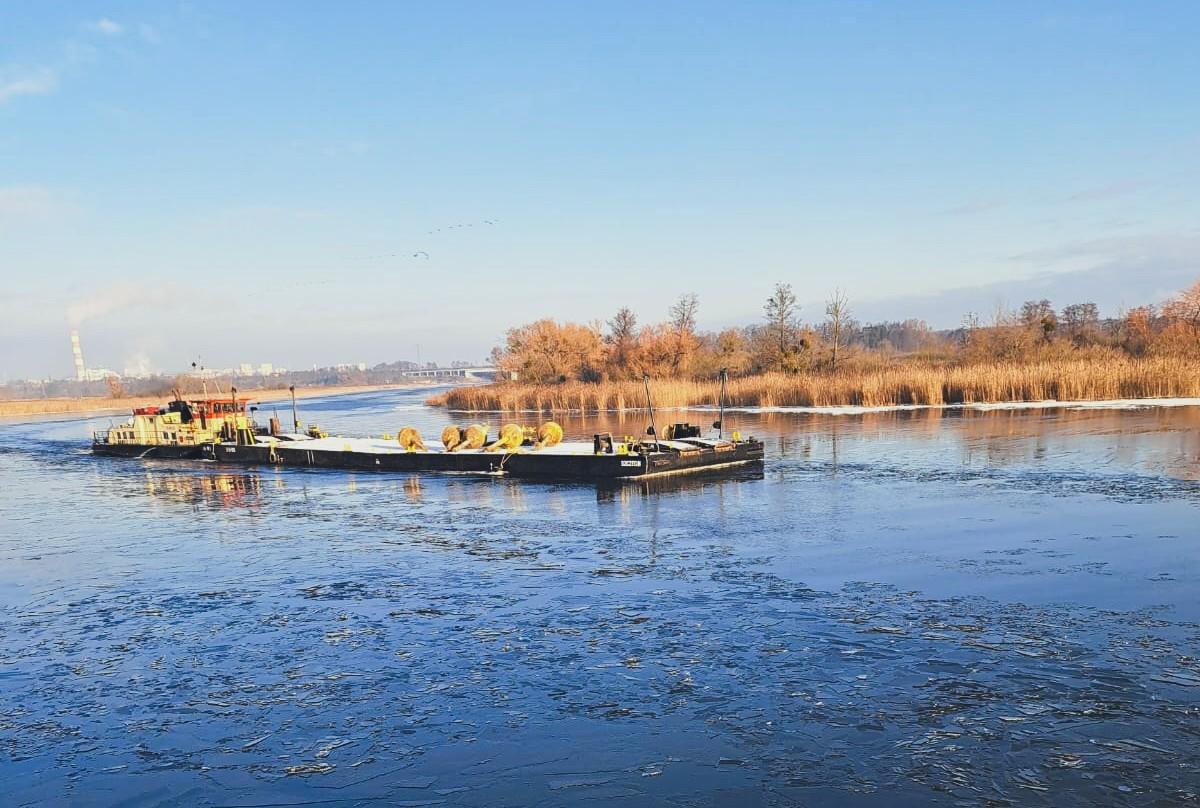
fot. Regionalny Zarząd Gospodarki Wodnej w Szczecinie
Simultaneously, RZGW Szczecin has initiated the technological start-up of its icebreaker fleet. On 7 January, the icebreaker Dzik undertook its first winter voyage, maintaining navigation conditions on the western Odra between the RZGW base in Podjuchy and the Widuchowa weir. The fleet’s start-up operations will continue until Thursday, 8 January. Depending on ice growth and weather conditions, vessels will be ready to clear critical sections of the Odra, Lake Dąbie, and the Szczecin water junction. Icebreaking operations are conducted primarily during periods of thaw.
Progressing Odra closures
Since 2 January 2026, the following sections of the Odra Waterway have been closed for navigation:
- Section I: km 542.4 – 586.0
- Section II: km 586.0 – 617.6
- Section III: km 617.6 – 667.2
On 5 January, further closures were implemented due to falling water temperatures:
- km 677.2 (Bielinek gravel pit) – km 704.1 (Widuchowa weir)
- eastern Odra: km 704.1 (Widuchowa weir) – km 706.0 (Marwice)
- eastern Odra: km 704.1 (Widuchowa weir) – km 730.5 (Klucz–Ustowo Cut)
From Friday, 9 January, the following remaining sections will also be closed:
- Regalica: km 730.5 – 741.6
- western Odra: km 0.0 – 36.6
- Klucz–Ustowo Cut, Parnica River, Parnicki Cut, Odyniec Canal
From that date, navigation on all inland waterways under RZGW Szczecin administration will be fully prohibited.
Icebreaker fleet in action
RZGW Szczecin operates a fleet of eight icebreakers, seven fully crewed and one in reserve. The German administration has contributed six vessels to joint winter icebreaking operations. Polish-German collaboration covers a 180 km stretch of the border Odra, from Widuchowa to the Lusatian Neisse River. Constant monitoring and icebreaking support are provided on Lake Dąbie, Regalica, eastern and western Odra sections, and the Szczecin water junction.
The fleet includes older vessels Odyniec and Dzik (1988, 1,060 HP, front-line icebreakers) and slightly smaller line icebreakers Lis and Żbik (1980s, 600 HP). Newer units Stanisław (2014, 1,599 HP) and Andrzej (2014, 1,066 HP) serve as line or front-line icebreakers depending on operational needs. The most recent icebreakers, Ocelot and Tarpan (2021, 862 HP each), enhance the fleet’s operational flexibility. Vessels can be deployed in teams, with the most powerful serving as the lead icebreaker.
Polish-German coordination
RZGW Szczecin works closely with the Polish Inland Navigation Authority and the German Waterways and Shipping Authority (Odra-Havel) in Eberswalde. The joint winter operation ensures safe navigation and maintains access to critical Odra sections during harsh winter conditions.
Continuous monitoring of ice development allows both administrations to respond to changing conditions. RZGW Szczecin provides ongoing updates on the Odra Waterway and the Szczecin water junction to enable operators and shipowners to plan operations safely during the winter season.
Buy us a coffee, and we’ll invest in great maritime journalism! Support Gazeta Morska and help us sail forward – click here!
Oskar Wojciechowski
redaktor
comments
Add the first comment
see also
Evening SAR operation in the Baltic. Two kitesurfers stranded offshore
Medical evacuation from sailing ship in Gdynia port. 17-year-old safely transported
Medical evacuation from Danish-flagged vessel Skoven off Łeba. Joint SAR operation in the Baltic Sea
Almost 2.5 million travellers cleared in 2025 by the Maritime Border Guard
Frontex officers train with Polish Maritime Border Guard
Damen Shipyards and Blue Water Autonomy announce license for Liberty-class autonomous vessel for the U.S. Navy
ITS Virginio Fasan and USS Bulkeley conduct PASSEX in eastern Mediterranean
NATO strengthens operations in the north: alliance boosts Arctic presence
SAR medevac operation in the Baltic Sea: m/v Lone crew member airlifted to Słupsk hospital
SAR operation near Mewia Łacha nature reserve. Lost man rescued from ice-covered beach
ADVERTISEMENT
ADVERTISEMENT