









Warsaw court to rule on environmental challenge to Świnoujście container terminal
On Monday, the Provincial Administrative Court (WSA) in Warsaw is expected to issue a ruling on the environmental permit for the planned deepwater container terminal in Świnoujście. The case stems from a joint legal challenge filed by German and Polish environmental organizations, raising concerns about the project’s ecological impact on the southern Baltic coast.
In brief
The Provincial Administrative Court in Warsaw is due to rule on Monday on the environmental permit for the deepwater container terminal in Świnoujście, issued in February 2025 by Poland's General Directorate for Environmental Protection. The challenge was filed by the German NGO Bürgerinitiative Lebensraum Vorpommern from the island of Usedom and the Polish group Zielone Wyspy Świnoujście, with the final hearing held on 21 July. The terminal, led by the Szczecin and Świnoujście Seaports Authority, is to handle two 400-meter vessels at once by 2029, with total costs of PLN 12.5 billion. Deputy Infrastructure Minister Arkadiusz Marchewka called the objections absurd.
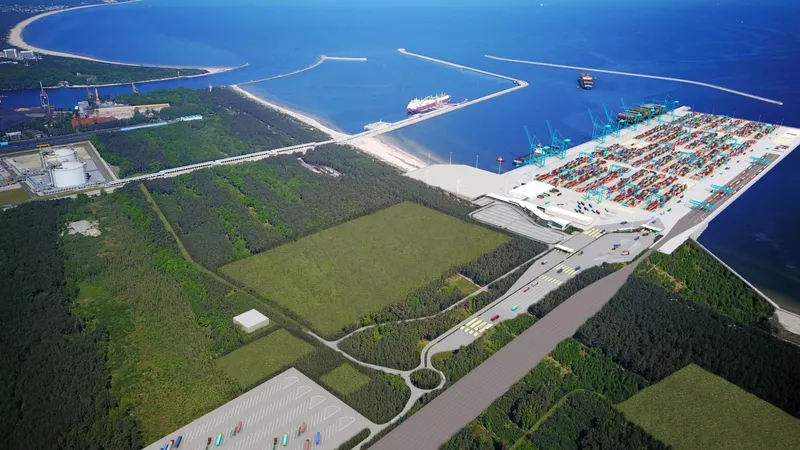
Wizualizacja terminala kontenerowego w Świnoujściu / fot. Ministerstwo Infrastruktury
The court had previously suspended the enforceability of the environmental decision issued in February 2025 by Poland’s General Directorate for Environmental Protection (GDOŚ), citing the complexity of the matter. The final hearing took place on July 21, with the court announcing that a verdict would be issued after further deliberation.
The investment—led by the Szczecin and Świnoujście Seaports Authority and coordinated by Poland’s Ministry of Infrastructure—is considered one of the country’s most ambitious maritime infrastructure projects. The terminal is designed to handle two 400-meter-long transoceanic vessels simultaneously and is scheduled for completion by 2029. The port infrastructure alone is expected to cost around PLN 10 billion (approx. €2.3 billion), with the overall project reaching PLN 12.5 billion.
The complaint was filed by the German NGO Bürgerinitiative Lebensraum Vorpommern (BLV), based on the island of Usedom, and the Polish group Zielone Wyspy Świnoujście. Both allege that the environmental impact assessment failed to fully account for cross-border risks, including to Natura 2000 areas and marine habitats. German media have highlighted support for the complaint from local authorities in nearby Heringsdorf, though the municipality is not a formal party to the proceedings.
Deputy Infrastructure Minister Arkadiusz Marchewka has dismissed the objections, describing them as “absurd” and politically motivated.
- We are aware that we are dealing with opponents of port development, he said, referencing German press coverage that frames Świnoujście as a competitive threat to ports on the German Baltic coast.
Marchewka emphasized that the court’s suspension affects only the enforceability of the environmental permit—not the investment itself. Preparatory works, including seabed magnetic surveys, soil investigations, and approach channel design, have already been completed. Groundbreaking for the terminal’s access infrastructure is scheduled for late 2025.
The government views the terminal as vital to its long-term goal of tripling national container throughput to 10 million TEU by 2030. In 2024, Polish ports handled 3.3 million TEU, generating PLN 56 billion in customs and tax revenue.
Should the court annul the permit, the decision can be appealed to the Supreme Administrative Court (NSA) within 30 days. A third possibility—requiring the investor to supplement documentation—has also been raised as a likely outcome.
Despite legal hurdles, the Ministry of Infrastructure remains firm: the Świnoujście container terminal is going ahead. A new 65-kilometer, 17-meter-deep fairway will link the terminal to international shipping routes. Construction will be carried out by a Qatari-Belgian consortium.
- This is a strategic project, said Marchewka. - It’s not a matter of if—it’s a matter of when.
Source: Gazeta Morska · Compiled by: Kamil Kusier
Related articles
 Shipbuilding industry Poland christens ro-pax ferry Bursztyn Unity in Szczecin on Independence Day. Ystad service starts 18 November
 Energy and offshore Orlen Neptun deploys V-LiDAR buoys at Baltic West ahead of Poland's 2027 offshore wind auction
 Energy and offshore Equinor takes over Bałtyk 2 and 3 O&M base in Łeba. Port to serve 1.44 GW of offshore wind for 30 years
 Navy and defence Port Gdański Eksploatacja secures NATO NCAGE code. Gdańsk port company lines up for defence tenders
 Shipbuilding industry Ex-Enterprise towed to Mobile under $418.5m contract. Test case for Nimitz-class disposal begins
 Energy and offshore Energa renames Gdańsk gas plant company as foundations for 6,000-tonne turbine and boiler are laid
Comments (0)
The discussion is moderated by the editors: a comment appears after review. Your e-mail address is not published.
Nobody has commented on this article yet.