









Port of Gdańsk strengthens its leading position - a robust first half of 2025
The Port of Gdańsk closed the first half of 2025 with strong operational and financial results, reinforcing its position as a key logistics hub in the Baltic Sea region. Cargo throughput exceeded 38.3 million tonnes, marking a 0.4% increase year-on-year. Financial performance was equally solid: net sales profitability reached 56%, while net profit rose by 40%, amounting to PLN 179.6 million.
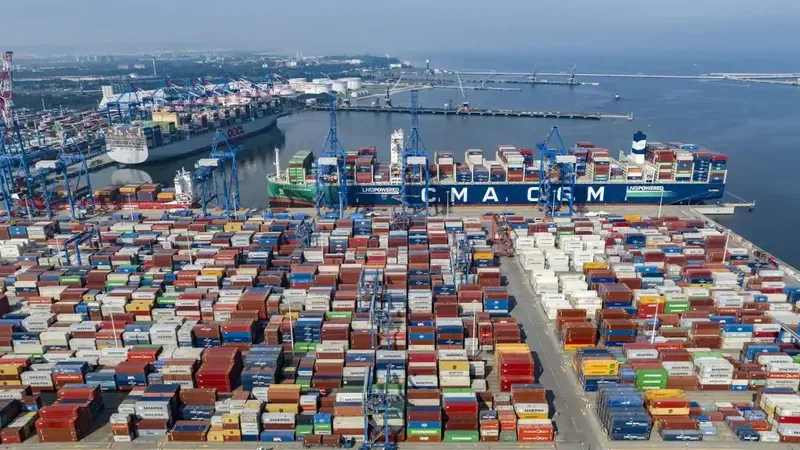
In brief
The Port of Gdańsk handled more than 38.3 million tonnes in the first half of 2025, 0.4 percent more year on year, while net profit rose 40 percent to PLN 179.6 million with a net sales margin of 56 percent. Liquid fuels accounted for 50 percent of cargo handling and fell to 19.2 million tonnes, whereas general cargo grew 12 percent to 13 million tonnes, including containerised cargo up 14 percent to 11.6 million tonnes. The launch of the T3 terminal at Baltic Hub Container Terminal raised handling capacity from 3 to 4.5 million TEU. Dorota Pyć, President of the Port of Gdańsk Authority, pointed to a flexible response to economic changes.
Liquid fuels remain dominant, container segment drives growth
Liquid fuels continued to dominate the cargo structure, accounting for 50% of total throughput. Although volumes fell slightly (down 4.7% year-on-year to 19.2 million tonnes) due to reduced domestic energy demand and lower strategic reserve activity, the segment remained stable. The majority of this traffic was handled by Naftoport.
The second-largest cargo category was general cargo, with volumes reaching 13 million tonnes, an increase of 12%. Within this segment, containerised cargo grew by 14% to 11.6 million tonnes. This boost is largely attributed to the launch of new maritime services by Mediterranean Shipping Company (MSC). With the introduction of its Britannia and Albatros services, Gdańsk has become a regular stop on MSC's Asia–Europe routes, connecting Poland directly to ports in China, South Korea, and Vietnam.
Baltic Hub expansion unlocks new container capacity
The container segment remains the port’s primary growth driver. The expansion of the Baltic Hub Container Terminal (BHCT) — the largest container terminal on the Baltic Sea — played a key role. The launch of the T3 terminal increased BHCT’s capacity by 1.5 million TEUs, from 3 to 4.5 million TEUs, reinforcing Gdańsk’s strategic position as a hub for Central and Eastern Europe.
Ore volumes surge, while coal and grain decline
The bulk cargo segment recorded mixed results. The "other bulk goods" category increased by 25%, reaching 1.9 million tonnes, with a particularly sharp rise in ore throughput, which jumped by 206%, the highest growth rate across all cargo types.
Conversely, coal volumes dropped by 12.4% to 2.9 million tonnes, reflecting lower national demand. Grain shipments were also down — falling 26% year-on-year to just over 1.1 million tonnes, in line with earlier forecasts.
Long-term resilience built on investment and global connectivity
– The Port of Gdańsk is steadily and pragmatically building its leadership in the Baltic Sea region, said Dorota Pyć, CEO of the Port of Gdańsk Authority. – The dynamic expansion of the container segment, stable performance in liquid fuels, and a rebound in bulk cargo show that we are responding flexibly to evolving economic, social, and geopolitical conditions.
The positive first-half results, supported by a diversified cargo structure and expanding infrastructure, confirm Gdańsk’s growing relevance in global maritime logistics. The port’s strong financial base and improved connectivity position it for continued growth in the second half of 2025 and beyond.
Source: Gazeta Morska · Compiled by: Kamil Kusier
Related articles
 Shipbuilding industry Poland christens ro-pax ferry Bursztyn Unity in Szczecin on Independence Day. Ystad service starts 18 November
 Energy and offshore Orlen Neptun deploys V-LiDAR buoys at Baltic West ahead of Poland's 2027 offshore wind auction
 Energy and offshore Equinor takes over Bałtyk 2 and 3 O&M base in Łeba. Port to serve 1.44 GW of offshore wind for 30 years
 Navy and defence Port Gdański Eksploatacja secures NATO NCAGE code. Gdańsk port company lines up for defence tenders
 Shipbuilding industry Ex-Enterprise towed to Mobile under $418.5m contract. Test case for Nimitz-class disposal begins
 Energy and offshore Energa renames Gdańsk gas plant company as foundations for 6,000-tonne turbine and boiler are laid
Comments (0)
The discussion is moderated by the editors: a comment appears after review. Your e-mail address is not published.
Nobody has commented on this article yet.