Polish counter-drone systems from Gdynia supporting air defense in the Middle East
In the Middle East — a region where effective air-defense technologies directly influence national security and military stability — advanced counter-UAS systems are becoming a key component of modern armed forces. Among the suppliers active in the region is Advanced Protection Systems S.A. (APS) from Gdynia, Poland, a company specializing in radar-based solutions designed to detect and neutralize unmanned aerial systems (UAS).
security business investments worldwide equipment and technology tricity news06 november 2025 | 14:17 | Source: Gazeta Morska | Prepared by: Kamil Kusier | Print
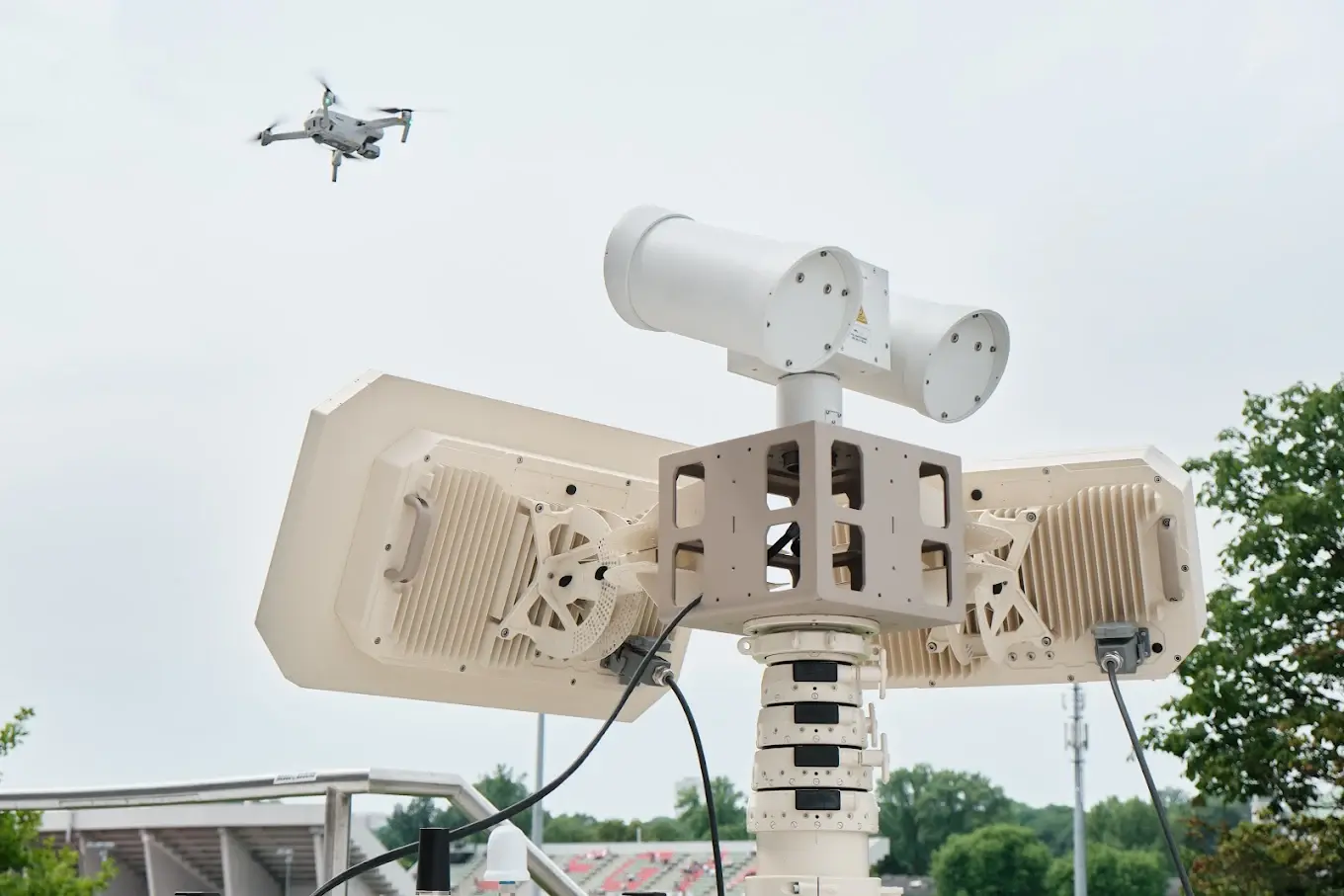
fot. Advanced Protection System
Integrated multi-sensor defense
APS has developed a family of systems combining several layers of sensors — radar, electro-optical and radio-frequency — with both soft-kill (jamming) and hard-kill (kinetic) effectors.
At the core of the architecture are FIELDctrl radars, designed in Poland to detect low-RCS aerial targets such as small drones. The systems are managed through the SKYctrl and CyView C2 command-and-control platforms, enabling operators to maintain situational awareness and coordinate countermeasures in real time.
– Our engineering teams support partners at every stage of deployment – from system integration to operational assistance. This allows us to continuously adapt our systems to the evolving battlespace in shorter technological cycles than before, Advanced Protection Systems underlined in a company statement.
Field testing under desert conditions
APS solutions were featured during the Air Defense Weapons Shooting Exercise (Sky Shield) held under the Arab Army Program, where scenarios included target detection, classification, command-and-control communication, and activation of electronic warfare and kinetic response measures.
According to Brig. Gen. Suleiman Al-Humaidach, Commander of the Air Defense Forces of the Jordanian Armed Forces:
- Air Defense Forces are a key indicator of the development and progress of an army, as is clearly visible in many of today’s conflicts.
These exercises provided validation for APS’s radar and C2 solutions under demanding desert conditions, confirming system resilience and integration flexibility.
Lessons for European airspace protection
Analysts emphasize that the growing use of drones — both commercial and military — requires layered defense systems that integrate sensors, effectors, and command networks. Real-time data processing, interoperability, and rapid software modernization have become central to maintaining effectiveness.
APS notes that experience gained in desert deployments is directly applicable to its European projects, including the protection of ports, airports, and other elements of critical infrastructure.
Founded in 2015 in Gdynia, APS employs specialists in radar engineering, signal processing, and defense integration. Its technologies are currently in service with both military and civilian operators responsible for securing national and strategic airspace.
Buy us a coffee, and we’ll invest in great maritime journalism! Support Gazeta Morska and help us sail forward – click here!
Kamil Kusier
redaktor naczelny
comments
Add the first comment
see also
"Let everyone know we will prevail". Poland’s armed forces set strategic course for 2026-2039
“Army 500” and strategic transformation: Poland sets the course for long-term deterrence and allied readiness
Medical evacuation from offshore vessel in the Baltic. Rescue 511 helicopter and m/s Huragan deployed
Karol Nawrocki: “The strength of the republic lies in its armed forces”. Security requires national unity
Human trafficking, money laundering, millions frozen. Successful operation by border guard and tax administration
Evening SAR operation in the Baltic. Two kitesurfers stranded offshore
Medical evacuation from sailing ship in Gdynia port. 17-year-old safely transported
Medical evacuation from Danish-flagged vessel Skoven off Łeba. Joint SAR operation in the Baltic Sea
Almost 2.5 million travellers cleared in 2025 by the Maritime Border Guard
Frontex officers train with Polish Maritime Border Guard
ADVERTISEMENT
ADVERTISEMENT