









Poland’s Miecznik programme enters critical phase as third frigate Huragan begins construction
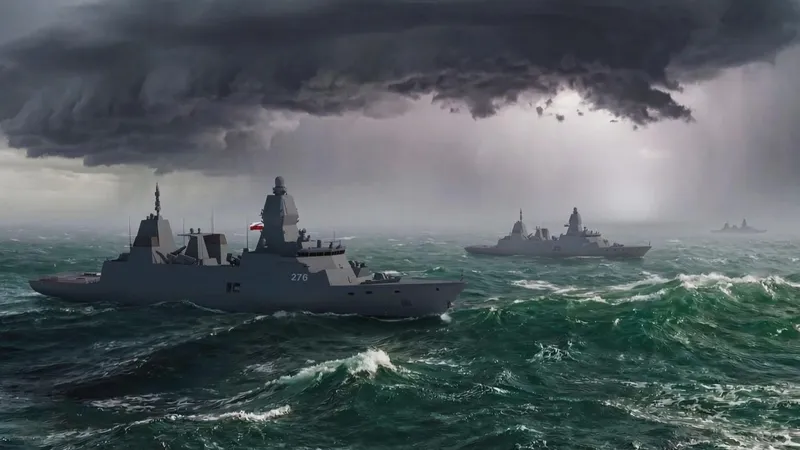
The Polish naval modernisation programme Miecznik is moving into its most industrially significant phase, as PGZ Stocznia Wojenna prepares to begin steel cutting for the third and final frigate in the series, ORP Huragan. The ceremony, scheduled for 28 April in Gdynia, marks the transition of the programme from sequential construction into a fully parallel production cycle involving all three vessels: Wicher, Burza, and now Huragan.
In brief
Steel cutting for the third frigate of the Miecznik programme, named Huragan, will begin on 28 April at PGZ Stocznia Wojenna in Gdynia. The Miecznik programme covers the construction of three multi-role frigates for the Polish Navy, and the start of work on Huragan means the parallel construction of the Wicher, Burza and Huragan. Wicher is at an advanced stage of hull construction and is heading towards launch, while Burza is taking shape as successive structural sections. All three frigates are to enter service in the first half of the next decade, with Huragan by the end of 2031.
For Poland’s defence sector, this step is more than a symbolic milestone. It represents the consolidation of large-scale warship production capability within the domestic shipbuilding base an ambition that has remained unrealised for decades.
From single builds to serial naval production
The Miecznik programme is structured around three multi-role frigates designed to significantly expand the combat capability of the Polish Navy. Their role encompasses air defence, surface warfare, and anti-submarine operations, positioning them as the most capable surface combatants in Polish service once delivered.
With the start of Huragan, the programme transitions into a true serial production model:
- ORP Wicher is currently in advanced hull construction and approaching launch preparations.
- ORP Burza is progressing through modular section fabrication.
- ORP Huragan now enters the steel-cutting phase, initiating its physical construction cycle.
This concurrency is a defining feature of modern naval industrial programmes, requiring stable supply chains, integrated engineering workflows, and sustained workforce capacity across multiple build stages.
Industrial significance for Poland’s shipbuilding sector
The programme is being executed by PGZ Stocznia Wojenna, which has undergone significant restructuring in recent years to restore complex naval construction capabilities.
From an industrial perspective, Miecznik is one of the most demanding defence manufacturing efforts ever undertaken in Poland. It functions simultaneously as:
- a naval capability programme for the Polish Armed Forces
- a technology integration project involving foreign and domestic systems
- a long-term industrial capacity-building initiative for the national shipbuilding sector
Unlike smaller patrol or auxiliary vessels, frigates of this class require full systems integration, covering combat management systems, radar and sensor suites, missile systems, propulsion architecture, and electronic warfare capabilities. This elevates the programme from conventional shipbuilding into high-end systems engineering.
Strategic context: modern frigate capability for the Baltic theatre
The vessels are designed primarily for operations in the Baltic Sea environment, which imposes distinct operational constraints: shallow waters, dense commercial traffic, and a high level of electronic surveillance and potential interference.
As a result, the Miecznik-class frigates are expected to emphasise:
- network-centric warfare integration within NATO frameworks
- advanced air and missile defence capability
- high situational awareness through multi-sensor fusion
- resilience in contested electronic environments
This reflects a broader NATO trend toward modular, multi-role surface combatants capable of operating as distributed nodes within allied maritime task groups.
Engineering and programme execution challenges
While steel cutting for Huragan signals progress, the programme now enters its most complex phase: parallel systems integration across multiple hulls.
Key industrial challenges include:
- synchronising hull construction across three vessels
- managing sequential system installation timelines
- integrating combat systems and weapon suites
- ensuring supplier continuity for high-tech components
- maintaining workforce continuity across long production cycles
Modern frigates are no longer defined primarily by hull design, but by the integration density of their combat systems. This shifts the critical path of the programme from traditional shipyard fabrication to advanced system engineering and certification.
A test of industrial maturity
The Miecznik programme is increasingly viewed not only as a naval procurement effort, but as a structural test of Poland’s defence industrial maturity. The ability to deliver three complex warships in sequence, within budgetary and scheduling constraints, will serve as a benchmark for future naval and defence programmes.
If successfully completed on schedule, with Huragan entering service by the early 2030s, Poland will have achieved something not seen in its modern naval history: sustained, domestically anchored production of frontline surface combatants.
Miecznik is a programme that tests the state’s capabilities
With all three frigates now in various stages of construction, Miecznik is transitioning from a procurement project into a long-term industrial ecosystem. The programme’s success will depend less on individual milestones and more on whether Poland can maintain production discipline, engineering coherence, and supply chain stability over a decade-long build cycle.
For the Polish Navy, the outcome is clear: a leap in surface warfare capability. For the shipbuilding sector, however, the stakes are broader—the establishment of a repeatable, sovereign warship production capability in the Baltic region.
Source: Gazeta Morska · Compiled by: Kamil Kusier
Related articles
 Shipbuilding industry Poland christens ro-pax ferry Bursztyn Unity in Szczecin on Independence Day. Ystad service starts 18 November
 Energy and offshore Orlen Neptun deploys V-LiDAR buoys at Baltic West ahead of Poland's 2027 offshore wind auction
 Energy and offshore Equinor takes over Bałtyk 2 and 3 O&M base in Łeba. Port to serve 1.44 GW of offshore wind for 30 years
 Navy and defence Port Gdański Eksploatacja secures NATO NCAGE code. Gdańsk port company lines up for defence tenders
 Shipbuilding industry Ex-Enterprise towed to Mobile under $418.5m contract. Test case for Nimitz-class disposal begins
 Energy and offshore Energa renames Gdańsk gas plant company as foundations for 6,000-tonne turbine and boiler are laid
Comments (0)
The discussion is moderated by the editors: a comment appears after review. Your e-mail address is not published.
Nobody has commented on this article yet.