









Poland strengthens its role in the Baltic-Black-Aegean corridor
Investment prospects within the Trans-European Transport Network (TEN-T) were at the center of discussions between Deputy Minister of Infrastructure Piotr Malepszak and Mario Mauro, the European Coordinator for the Baltic–Black–Aegean Sea Transport Corridor.

In brief
Deputy Minister of Infrastructure Piotr Malepszak met Mario Mauro, the European coordinator of the newly created Baltic Sea, Black Sea, Aegean Sea Transport Corridor, to discuss investments, interoperability and Poland's role in the TEN-T network. The corridor was established under Regulation 2024/1679 of the European Parliament and of the Council of the European Union of 13 June 2024, which entered into force on 18 July 2024. Piotr Malepszak pointed to the need for high interoperability of infrastructure on the eastern flank of the European Union and NATO and for dual-use investments. National priorities include the expansion of seaports, railways and the Centralny Port Komunikacyjny.
The corridor, formally established under the EU Regulation 2024/1679, came into force on 18 July 2024 as part of the renewed TEN-T framework. It connects northern, eastern, and southern Europe — from the Baltic Sea to the Black and Aegean Seas — strengthening links between ports, rail, and multimodal infrastructure across the continent.
The TEN-T policy aims to create a multimodal transport network integrating rail, road, inland waterways, and short-sea shipping, linking major urban nodes, seaports, inland ports, airports, and terminals within the EU and beyond.
— We see this corridor not only as an element that strengthens economic ties and prosperity within the EU. In the face of Russia’s aggression against Ukraine, we need a high level of interoperability on the eastern flank of the EU and NATO, along with dual-use investments in transport infrastructure. Poland is steadily modernizing its transport system, moving toward the new TEN-T parameters on schedule — said Deputy Minister Piotr Malepszak.
Malepszak underlined that the corridor’s development is fully aligned with Poland’s transport priorities — the growth of seaports, revitalization of the railway network, and the Central Communication Port (CPK) project, which will serve as a major hub for both Poland and Europe, enhancing connectivity across the TEN-T network.
The Baltic–Black–Aegean Sea Corridor is becoming not only a key economic axis, but also a strategic component of Europe’s transport security — a new infrastructure backbone of the continent’s eastern flank.
Source: Gazeta Morska · Compiled by: Kamil Kusier
Related articles
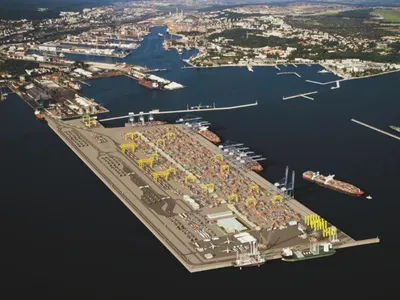 Ports and logistics One bid for Gdynia's Outer Port. MSC wants the 5-billion-zloty terminal, three rivals walked away
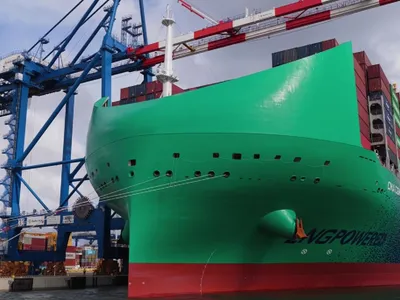 Ports and logistics CMA CGM Pantheon in Gdańsk. A success for the port and a bitter lesson about the absence of maritime policy
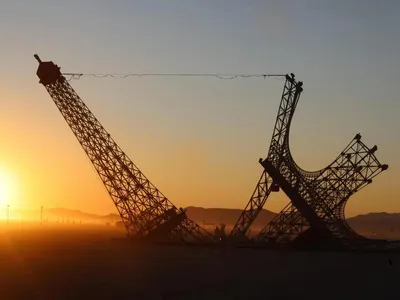 Ports and logistics CEVA ships a 29-tonne broken Eiffel Tower from Le Havre to Burning Man
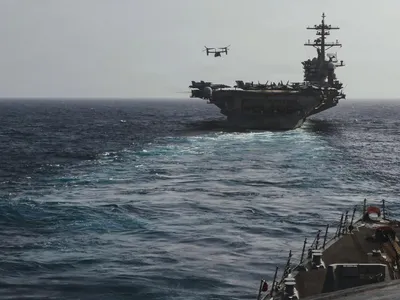 Ports and logistics US sinks Iranian tanker in the Gulf of Oman as Hormuz traffic stays at 7 percent
 Ports and logistics Maersk to fit a 35 m rotor sail on an 8,700 TEU Lima-class ship in 2027
 Ports and logistics Thirty years and 26 hectares. Baltic Hub leases Deepwater and plans a second rail siding
Comments (0)
The discussion is moderated by the editors: a comment appears after review. Your e-mail address is not published.
Nobody has commented on this article yet.