









Over 200-Ton HDPE Pipes Delivered to Poland for Baltic Offshore Wind Projects
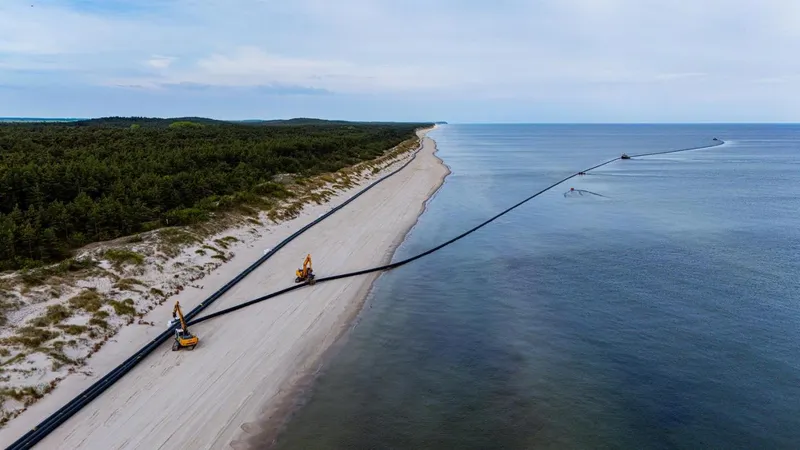
Four massive HDPE pipes—each 1.5 km long and weighing over 200 tons—have been successfully transported by sea from Norway to Poland to support the offshore wind projects Bałtyk 2 and Bałtyk 3, developed jointly by Equinor and Polenergia. The pipes were brought ashore near the coastal town of Mrzeżyno and will house export cables transmitting power generated offshore to the onshore grid.
In brief
Four HDPE pipes, each 1.5 km long and weighing over 200 tonnes, arrived from Norway and were pulled ashore near Mrzeżyno for HDD drilling for the Bałtyk 2 and Bałtyk 3 offshore wind farms. The transport set off from the town of Stathelle, and the three-day landing operation was supported by three tugboats, three cranes on the beach and WOPR lifeguard teams. The Equinor and Polenergia wind farms, with a combined capacity of 1,440 MW, will power over 2 million households, with first power in 2027 and the commercial phase from 2028.
The complex maritime transport operation began near Stathelle, Norway, where a primary tugboat towed two pipes at a time across the Baltic Sea. The final phase, involving beach landing, posed significant logistical challenges. It required three auxiliary tugboats for nearshore stabilization, three cranes operating from the beach to pull the pipes ashore, and coordinated safety and support teams from WOPR (Water Volunteer Rescue Service) both on land and at sea. These teams ensured controlled access, structural protection of the pipes, and environmental safety throughout the 3-day operation.
The entire logistics chain demanded close coordination between marine and onshore operational teams. From the outset, safety and environmental protection have been top priorities. Once onshore, the pipe ends were sealed, weighted, and stabilized with big bags and ballast. The area is continuously monitored by technical crews and security personnel.
The pipes will soon be relocated to the landfall zone, the designated starting point for horizontal directional drilling (HDD). This trenchless method enables the installation of power export cables beneath the shoreline without disturbing the environment.
The Bałtyk 2 and Bałtyk 3 offshore wind farms will have a combined capacity of 1.44 GW—enough to power over 2 million Polish households with clean, renewable energy. First power is expected in 2027, with commercial operations commencing in 2028.
Source: Gazeta Morska · Compiled by: Kamil Kusier
Related articles
 Shipbuilding industry Poland christens ro-pax ferry Bursztyn Unity in Szczecin on Independence Day. Ystad service starts 18 November
 Energy and offshore Orlen Neptun deploys V-LiDAR buoys at Baltic West ahead of Poland's 2027 offshore wind auction
 Energy and offshore Equinor takes over Bałtyk 2 and 3 O&M base in Łeba. Port to serve 1.44 GW of offshore wind for 30 years
 Navy and defence Port Gdański Eksploatacja secures NATO NCAGE code. Gdańsk port company lines up for defence tenders
 Shipbuilding industry Ex-Enterprise towed to Mobile under $418.5m contract. Test case for Nimitz-class disposal begins
 Energy and offshore Energa renames Gdańsk gas plant company as foundations for 6,000-tonne turbine and boiler are laid
Comments (0)
The discussion is moderated by the editors: a comment appears after review. Your e-mail address is not published.
Nobody has commented on this article yet.