









ORLEN expands LNG carrier fleet with two new vessels
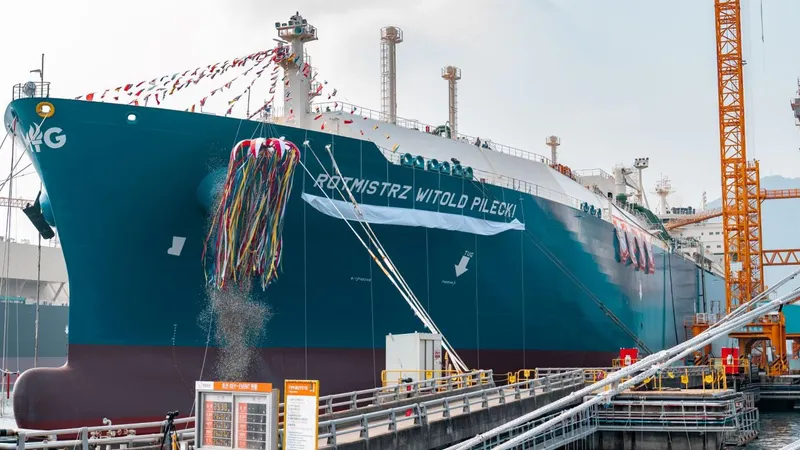
ORLEN Group is strengthening its LNG logistics capabilities by adding two modern LNG carriers to its fleet. The naming ceremony for the vessels took place at the Hanwha Ocean shipyard in South Korea. The ships will increase the company’s flexibility in transporting liquefied natural gas and support stable gas deliveries to Poland and other customers.
In brief
ORLEN Group took delivery at the Hanwha Ocean shipyard in South Korea of two LNG carriers named Danuta Siedzikówna-Inka and Rotmistrz Witold Pilecki. Each vessel has a capacity of 174 thousand cubic metres of LNG and will carry around 70 thousand tonnes of liquefied gas per voyage, which after regasification corresponds to around 100 million cubic metres of natural gas. The charter was concluded for 10 years with an option to extend, and the ORLEN Group LNG fleet now numbers eight carriers. In 2024 the LNG terminal in Świnoujście received 81 deliveries for ORLEN Group, almost 6 million tonnes of LNG.
- ORLEN continuously invests in the energy security and independence of Poland and the region. That is why we are developing not only our upstream activities, successfully exploring both domestically and on the Norwegian Continental Shelf. We are also expanding our trading capabilities. Increasing the number of vessels in our fleet strengthens the flexibility of LNG transportation to Poland and allows us to ensure stable supplies for customers in Poland and across our markets. At the same time, we are enhancing the energy security of the entire region, said Ireneusz Fąfara, President of the Management Board of ORLEN.
The new LNG carriers, “Danuta Siedzikówna-Inka” and “Rotmistrz Witold Pilecki”, are among the most advanced vessels of their type currently operating worldwide. Each ship has a capacity of 174,000 cubic metres of LNG and can transport around 70,000 tonnes of liquefied natural gas in a single voyage.
After regasification, this corresponds to approximately 100 million cubic metres of natural gas — roughly the amount consumed by all Polish households in a week. In energy terms, a single cargo equals close to 1 TWh, representing around 0.5–0.6% of Poland’s annual natural gas demand.
The vessels were designed to operate at most LNG terminals worldwide, providing significant operational flexibility. The charter period is set at 10 years with an option for extension. The ships’ godmothers are Renata Rosiak, Executive Director at ORLEN, and pianist Zuzanna Sejbuk.
Each LNG carrier of this class can complete around 8–9 voyages annually on the US–Europe route, providing a potential transport capacity of approximately 8–9 TWh of gas per year.
The vessels incorporate advanced technological solutions to improve efficiency and reduce operational losses. They are equipped with a reliquefaction system that allows boil-off gas generated during transport to be recovered and reused. An integrated energy management system has also been installed, while the engines can operate on both natural gas and marine diesel oil.
With the addition of the new vessels, ORLEN’s LNG fleet now consists of eight carriers, significantly increasing the company’s logistical capabilities in the global LNG market. Having its own fleet enables ORLEN to handle a substantial share of contracted LNG deliveries using its own vessels.
The development of LNG transport is a key element of ORLEN’s strategy. Natural gas is expected to play the role of a transition fuel in the energy transition, with consumption in Poland projected to rise to around 27 billion cubic metres annually within the next decade.
Last year, the LNG terminal in Świnoujście recorded a new milestone, with ORLEN receiving 81 LNG deliveries — 20 more than in the previous year. The total volume reached nearly 6 million tonnes, representing a 30% increase year-on-year.
ORLEN is also expanding its presence in the global LNG market, having already delivered cargoes to Japan, China, Thailand, Egypt and terminals in Western Europe.
The company is strengthening regional gas reception capabilities as well. ORLEN uses capacity at the FSRU terminal in Klaipėda, from which regasified gas is transported to Poland via the Poland–Lithuania pipeline. At the same time, domestic infrastructure is being developed. ORLEN has reserved the entire regasification capacity of the planned floating LNG terminal in the Gulf of Gdańsk, which will reach 6.1 bcm per year.
Once operational, the installation could increase the number of LNG cargoes received by the ORLEN Group by up to 58 shipments annually.
Source: Gazeta Morska · Compiled by: Kamil Kusier
Related articles
 Shipbuilding industry Poland christens ro-pax ferry Bursztyn Unity in Szczecin on Independence Day. Ystad service starts 18 November
 Energy and offshore Orlen Neptun deploys V-LiDAR buoys at Baltic West ahead of Poland's 2027 offshore wind auction
 Energy and offshore Equinor takes over Bałtyk 2 and 3 O&M base in Łeba. Port to serve 1.44 GW of offshore wind for 30 years
 Navy and defence Port Gdański Eksploatacja secures NATO NCAGE code. Gdańsk port company lines up for defence tenders
 Shipbuilding industry Ex-Enterprise towed to Mobile under $418.5m contract. Test case for Nimitz-class disposal begins
 Energy and offshore Energa renames Gdańsk gas plant company as foundations for 6,000-tonne turbine and boiler are laid
Comments (0)
The discussion is moderated by the editors: a comment appears after review. Your e-mail address is not published.
Nobody has commented on this article yet.