









Infinix unveils cutting-edge innovations: tri-fold smartphone and solar-powered charging
Infinix has set sail with its latest groundbreaking technologies, unveiling the Zero Series Mini Tri-Fold—a concept smartphone featuring a triple-fold mechanism with dual hinges. Alongside this, the company introduces solarEnergy-reserving technology for light-powered charging and e-color shift 2.0, which enables dynamic, AI-driven color transitions for the device’s exterior.
In brief
Infinix has unveiled the ZERO Series Mini Tri-Fold concept smartphone with a triple folding mechanism and dual hinges. Infinix's SolarEnergy-Reserving technology charges the device with sunlight and artificial light through a special case, with power reaching 2 W, and the Sunflower system tracks the light source from a distance of up to 3 metres. The E-Color Shift 2.0 solution allows the casing to dynamically change colour depending on weather conditions and the colours of the surroundings.
A new foldable experience: versatility beyond conventional design
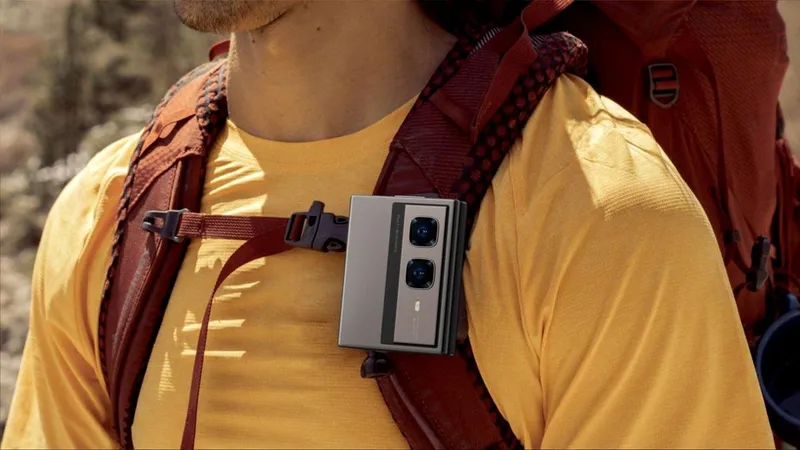
Unlike standard foldable smartphones that merely expand into a larger screen, the Zero Series Mini Tri-Fold offers unparalleled multi-mode usability. It can stand upright for hands-free operation, and thanks to an innovative strap design, it can be securely attached to gym equipment, a bike handlebar, a car dashboard, or even a bag strap—making it a perfect companion for on-the-go navigation or capturing moments on the move.
The dual-screen functionality allows users to conduct a video call on one screen while browsing content on the other or record videos simultaneously using both the main and selfie cameras—ideal for seamless multitasking and creative content production.
AI-assisted solar charging: harnessing light for continuous power
Infinix has also introduced solarEnergy-reserving, a pioneering technology that integrates advanced photovoltaic solutions with real-time AI optimization. A specialized phone case captures energy not only from sunlight but also from artificial lighting, intelligently regulating power intake for efficient energy storage of up to 2W, with potential for future expansion.
At the core of this innovation is sunflower, an AI-driven wireless charging system inspired by heliotropic plants that naturally orient themselves toward light sources. Utilizing intelligent positioning and energy transmission techniques, the system dynamically adjusts to lighting conditions, enabling efficient power absorption from distances of up to 3 meters. Future iterations aim to extend this range even further.
E-color shift 2.0: a dynamic, adaptive exterior
Expanding on the first-generation technology, e-color shift 2.0 offers users enhanced customization, allowing the device’s back panel to dynamically shift colors based on user preferences and environmental factors. With AI-driven adaptation, the smartphone's exterior responds intelligently to weather conditions and ambient hues, ensuring a seamless aesthetic integration with its surroundings.
With these innovative advancements, Infinix continues to push the boundaries of mobile technology, setting the course for a more versatile and energy-efficient future.
Source: Gazeta Morska · Compiled by: Kamil Kusier
Related articles
 Shipbuilding industry Poland christens ro-pax ferry Bursztyn Unity in Szczecin on Independence Day. Ystad service starts 18 November
 Energy and offshore Orlen Neptun deploys V-LiDAR buoys at Baltic West ahead of Poland's 2027 offshore wind auction
 Energy and offshore Equinor takes over Bałtyk 2 and 3 O&M base in Łeba. Port to serve 1.44 GW of offshore wind for 30 years
 Navy and defence Port Gdański Eksploatacja secures NATO NCAGE code. Gdańsk port company lines up for defence tenders
 Shipbuilding industry Ex-Enterprise towed to Mobile under $418.5m contract. Test case for Nimitz-class disposal begins
 Energy and offshore Energa renames Gdańsk gas plant company as foundations for 6,000-tonne turbine and boiler are laid
Comments (0)
The discussion is moderated by the editors: a comment appears after review. Your e-mail address is not published.
Nobody has commented on this article yet.