









Gdynia's PERUN rocket honoured in defence contest. 150 km apogee and ballistic missile simulation
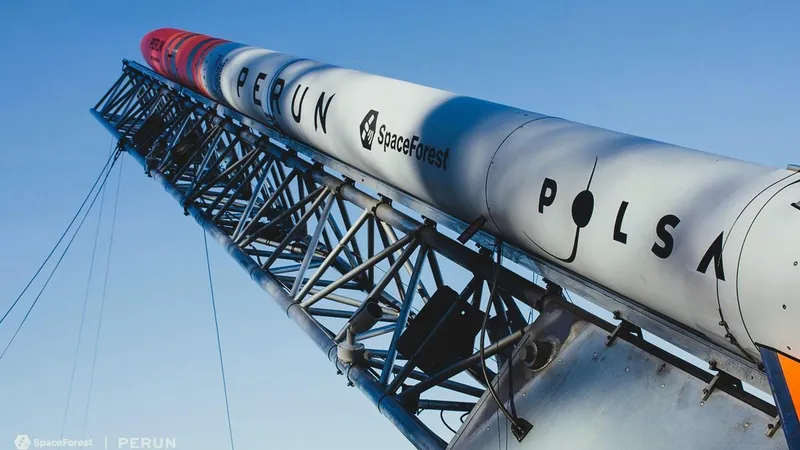
The PERUN suborbital rocket built by Gdynia-based SpaceForest has taken third place in the Innovations for Security and Defence 2026 competition organised by Portal-Mundurowy.pl. The winning projects were selected from 41 solutions featured in this year's catalogue, Innovations - Implementations - Security - Defence 2026. PERUN was recognised as a dual-use technology: a research platform for science and industry which, thanks to trajectory control, can also simulate ballistic missiles at ranges of up to 80 km.
In brief
SpaceForest of Gdynia took third place for its PERUN suborbital rocket in the Innowacje dla Bezpieczeństwa i Obronności 2026 competition, in which 41 solutions were assessed. PERUN is the largest hybrid suborbital rocket in Poland's history, weighs about 950 kg at launch, reaches an altitude of about 150 km and can simulate ballistic missiles over a distance of up to 80 km. The rocket's third flight took place on 22 November 2025 at the Central Air Force Training Ground in Ustka, and three test flights are planned for 2026 under a contract with the European Space Agency. The hybrid propulsion uses nitrous oxide and modified paraffin, and the rocket is reusable.
The competition forms part of an annual review of innovative projects related to security and defence. This year, for the first time since 2019, more than half of the entries came from private companies, alongside technologies from universities and research institutes. They included unmanned systems, military solutions and the Polish rocket, which stands out from the field for one simple reason: it already flies.
Three flights from Ustka, three more planned
PERUN is the largest hybrid-propelled suborbital rocket in Polish history. It has reached technology readiness level 7, and its third flight took place on 22 November 2025 at the Central Air Force Training Range in Ustka. It was a test flight, but with real research payloads on board, and the first in the commercialisation track under the European Space Agency's Boost! programme. Three test flights are scheduled for 2026 under the ESA contract, and the company is recruiting payloads for the coming missions.
During the November flight the team validated launch and safety procedures, the execution and recovery of experiments, payload integration, the thrust vector control system and the onboard safety system with immediate mission abort capability. The physical conditions of launch and flight, including vibration and g-forces, were also measured. With ESA funding SpaceForest has improved the combustion chamber, the key element of the engine.
950 kg, nitrous oxide and paraffin
At lift-off the rocket weighs around 950 kg, more than half of it fuel. Its hybrid propulsion uses nitrous oxide as oxidiser and modified paraffin wax as fuel, emitting no harmful substances into the atmosphere. The SF-1000 engine is SpaceForest's own design, ground-tested many times on a test bench. The airframe is built using filament-wound composite technology, making it lighter and more durable.
The mission profile is designed around experiments. After reaching an altitude of around 150 km the rocket enters a free-fall phase of several minutes, during which payloads experience microgravity comparable to conditions on the International Space Station, before returning under parachute for a soft landing. The rocket is reusable, launches from a mobile launcher anywhere in the world, and payload costs are estimated at a few thousand dollars per kilogram, many times cheaper than orbital launches.
RASEL, in-house tracking and communications
The latest flight also tested RASEL, an autonomous tracking and data transmission system developed by SpaceForest. It comprises two subsystems: a one-way link with an onboard beacon and a four-antenna ground tracking station, and a two-way link with an onboard transceiver, a directional ground antenna and software for data reception, archiving and visualisation. Together they allow continuous tracking of rocket parameters and transmission of control commands. The company has also developed an application to predict the landing site.
A Gdynia company from radars to rockets
SpaceForest is more than PERUN. The company, based on Bolesława Krzywoustego Street in Gdynia, has for years developed advanced electronics and microwave technologies, including space-grade components used in satellite systems and European orbital rockets. Its portfolio includes the HUSSAR family of synthetic aperture radars, with a version for drones, microwave filter tuning systems and the VIRA supersonic rocket. The first PERUN prototype was built with support from Poland's National Centre for Research and Development, and the current model was developed on that basis. The company also exhibited at this year's MSPO in Kielce as a supplier of dual-use technologies for defence, security and space.
For Pomerania the award is a signal that the region has not only shipyards, ports and offshore wind, but also space technologies moving from prototypes to services. A rocket launched from the range at Ustka, built in Gdynia and funded by ESA is one of the few Polish projects that combine all three.
Source: Gazeta Morska · Compiled by: Kamil Kusier
Related articles
 Shipbuilding industry Poland christens ro-pax ferry Bursztyn Unity in Szczecin on Independence Day. Ystad service starts 18 November
 Energy and offshore Orlen Neptun deploys V-LiDAR buoys at Baltic West ahead of Poland's 2027 offshore wind auction
 Energy and offshore Equinor takes over Bałtyk 2 and 3 O&M base in Łeba. Port to serve 1.44 GW of offshore wind for 30 years
 Navy and defence Port Gdański Eksploatacja secures NATO NCAGE code. Gdańsk port company lines up for defence tenders
 Shipbuilding industry Ex-Enterprise towed to Mobile under $418.5m contract. Test case for Nimitz-class disposal begins
 Energy and offshore Energa renames Gdańsk gas plant company as foundations for 6,000-tonne turbine and boiler are laid
Comments (0)
The discussion is moderated by the editors: a comment appears after review. Your e-mail address is not published.
Nobody has commented on this article yet.