Gdańsk’s Baltic Hub unveils T3. A new benchmark for Baltic container infrastructure
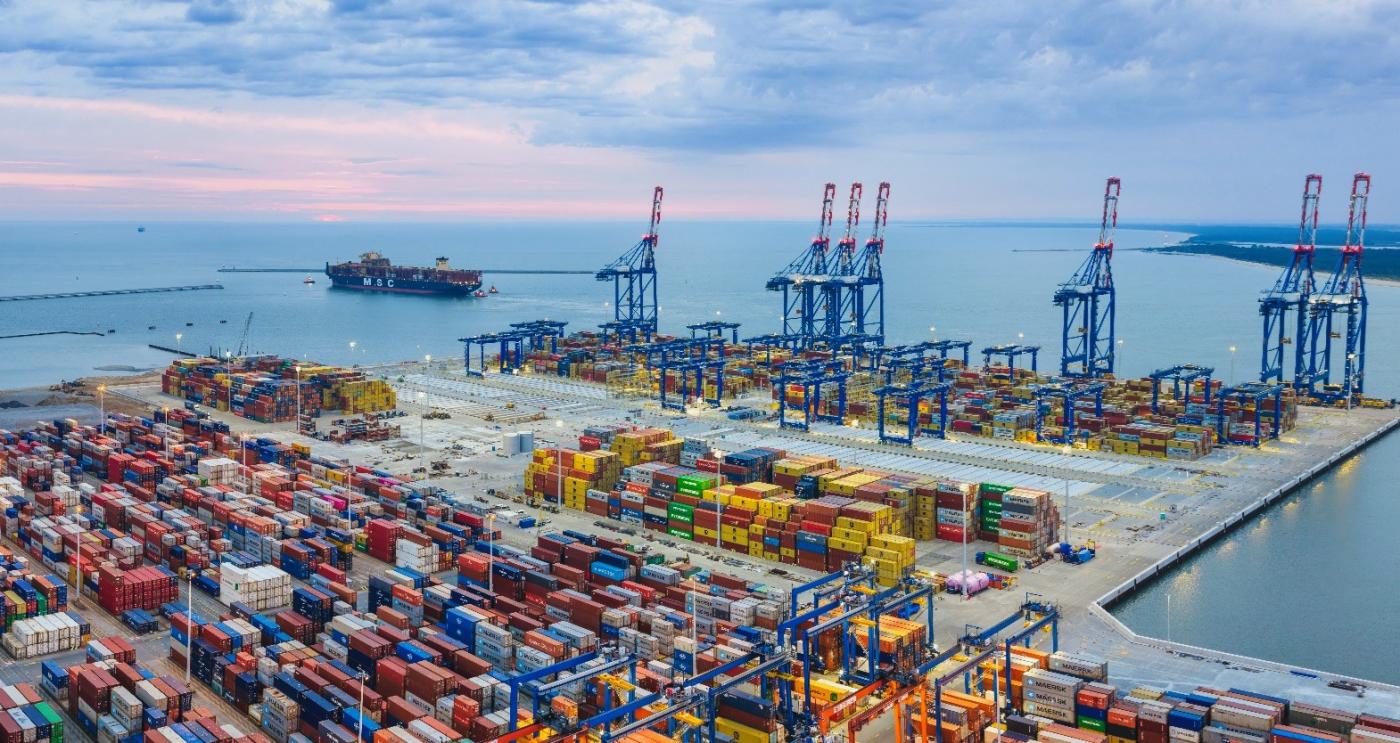
Baltic Hub has officially completed its state-of-the-art T3 terminal, marking the largest port development project in the Baltic Sea region and a defining moment for the container sector in Central and Eastern Europe. With T3 now in operation, the Gdańsk terminal boosts its annual handling capacity to 4.5 million TEU, reinforcing its status as one of Europe’s most strategically positioned logistics gateways.
business maritime economy investments logistics pomerania ports transport and forwarding tricity news19 november 2025 | 11:10 | Source: Gazeta Morska | Prepared by: Kamil Kusier | Print
fot. Baltic Hub
A three-year engineering effort that redefined regional ambition
Construction of T3 kicked off in September 2022, when Baltic Hub authorised its general contractor – a Budimex and DEME consortium – to begin work on what would become one of the region’s most complex hydrotechnical undertakings. Over 400 engineers, designers, operators and subcontractors were involved throughout the project, with nearly 600 people active on-site at peak.
The scale of infrastructure required was unprecedented:
- 4.37 million m³ of sand used to reclaim 36 hectares of new land, forming an artificial island.
- 17,500 tonnes of structural steel, comparable to 2.4 Eiffel Towers.
- 160,000 m³ of concrete, equivalent to filling 52 Olympic pools.
All work was completed on schedule, under the supervision of consulting firm Haskoning, and in line with stringent environmental commitments.
A next-generation terminal equipped for the world’s largest ships
T3 features 717 metres of deepwater quay with a draft of 17.5 metres, allowing it to service the world’s largest container vessels. The 36.4-hectare yard accommodates 7,608 container slots arranged across highly automated stacks.
The new equipment lineup includes:
- Seven ship-to-shore cranes (STS) — among the tallest and most advanced in Europe, reaching 96 metres in height (150 metres with booms raised).
- Twenty automated rail-mounted gantries (aRMGs) operated remotely from the terminal’s central control building.
The entire operation is powered by energy sourced from renewables, reflecting Baltic Hub’s commitment to reducing emissions by 50% by 2030 and achieving full climate neutrality by 2050.
The Baltic Sea’s largest and deepest container gateway
With T3 completed, Baltic Hub now spans over 124 hectares of operational area and boasts 2.1 kilometres of deepwater quays, making it the largest and deepest container terminal anywhere on the Baltic Sea.
Its strengthening role as a logistics nerve centre extends far beyond Poland. Gdańsk is increasingly serving as a primary entry point for cargo flows connecting Scandinavia, the Baltic States, and inland European markets such as the Czech Republic, Slovakia and Hungary. T3 enhances supply chain resilience and improves Europe’s access to global trade lanes, particularly on Asia–Europe routes.
As Baltic Hub CEO Jan Van Mossevelde notes, the combination of next-generation STS cranes, advanced automation and expanded yard capacity significantly elevates operational efficiency while reinforcing Poland’s position within the global logistics ecosystem.
A milestone for Poland’s maritime economy and the region’s future
T3 is more than a new terminal — it is a strategic investment shaping the future of maritime logistics in the Baltic. By merging cutting-edge technology, sustainable operations and strong intermodal connectivity, Baltic Hub is positioning itself as a long-term anchor point for global shipping lines and inland transport networks.
For the wider region, the completion of T3 marks a shift in the competitive landscape, establishing Gdańsk as a true deepwater hub capable of supporting Europe’s growing trade flows and accommodating the next generation of mega-vessels.
Buy us a coffee, and we’ll invest in great maritime journalism! Support Gazeta Morska and help us sail forward – click here!
Kamil Kusier
redaktor naczelny
comments
Add the first comment
see also
Radmor hosts delegation from the Republic of Turkey. Advancing maritime security cooperation
3D-printed catamaran: robotic manufacturing sets course for the future of small craft
Navantia and Fincantieri deepen cooperation on the european patrol corvette programme
Galeon Yachts and Meyer Shank Racing: merging luxury yachts with motorsport expertise
Unmanned systems and naval firepower modules. WB Group showcases integrated capabilities at Enforce Tac 2026
Swedish ports record lowest ship calls in 18 years. Implications for the maritime sector
February in Szczecin’s shiprepair sector. Ice, overhauls and North Sea expansion
Advanced ROV trials conducted at CTO to validate subsea technologies for offshore applications
University of Gdańsk and PGZ Naval Shipyard join forces for innovation and security
Stadt Naval to deliver electric propulsion system for Polish rescue vessel Ratownik
ADVERTISEMENT
ADVERTISEMENT