Elenger accelerates Baltic decarbonisation as bioLNG and emission pooling gain momentum
Elenger is expanding its footprint in the maritime energy market, supplying bioLNG to Tallink’s Baltic Sea ferries and supporting shipowners in meeting FuelEU Maritime requirements through the emission pooling mechanism. The model, already in use in Estonia and Finland, offers a cost-effective pathway for shipowners across the region — including those in Poland — to comply without expensive retrofits.
business power engineering maritime economy logistics transport and forwarding news02 december 2025 | 10:14 | Source: Gazeta Morska | Prepared by: Kamil Kusier | Print
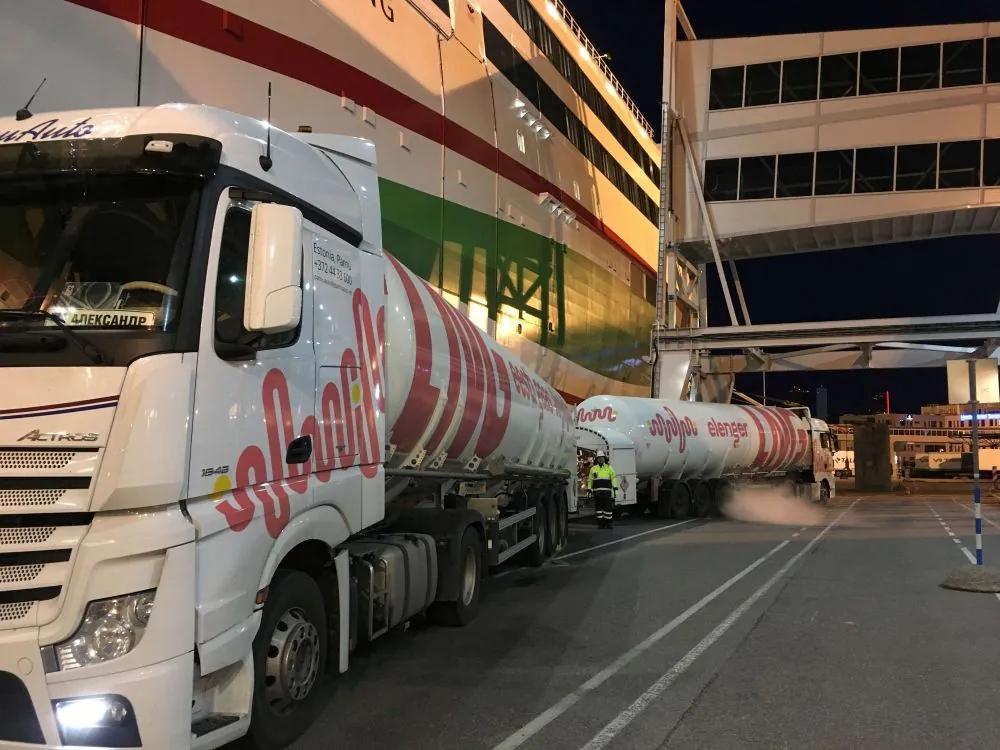
Bunkrowanie promu Tallink Megastar przez Elenger / fot. Elenger
Elenger boosts bio-driven transformation onshore and offshore
Elenger, the largest privately owned energy group in the Baltic–Finnish region, is intensifying its decarbonisation efforts across both land-based and maritime sectors. Alongside plans to launch Poland’s first high-pressure biomethane injection facilities and the expansion of bio-ready regasification infrastructure, the company is now bringing bioLNG solutions to the Baltic Sea. The delivery of bioLNG to Tallink ferries marks a major step, particularly as emission pooling under FuelEU Maritime becomes an increasingly important tool for shipowners.
BioLNG on the Baltic and new FuelEU Maritime rules
The FuelEU Maritime regulation, part of the EU’s Fit for 55 package, came into force on 1 January 2025, requiring large vessels calling at EU/EEA ports to reduce greenhouse gas intensity. A central element of the regulation is the pooling mechanism, which allows shipowners exceeding emission-reduction targets to share or sell surplus reductions to those falling short.
Demand for emission pooling has grown rapidly. Tallink’s entire surplus for 2025 has already been contracted by operators outside Poland. Elenger, as Tallink’s LNG and bioLNG supplier, ensures the certification and transparency of the process.
Tallink pushes forward with a full bioLNG transition
Tallink has been consistently investing in cleaner propulsion and energy-saving technologies. These measures have already cut CO₂ emissions by 62%. While LNG offers a 20–25% reduction versus HFO, switching to bioLNG — produced from renewable organic sources — allows for a much deeper carbon footprint reduction fully aligned with EU climate objectives.
Tallink aims to operate key vessels fully on bioLNG within the next year.
Pooling — a strategic opportunity for Polish and Baltic shipowners
The mechanics and benefits of pooling were presented during the IMO MEPC FuelEU Maritime Meeting held on 13 November 2025 in Gdynia by the Polish Shipowners’ Association. Tallink Grupp outlined a cooperation model that can help operators improve their emission performance without upgrading their fleets.
Tallink’s future surplus reductions will be available to shipowners across the region, including those in Poland, offering an effective compliance pathway.
Elenger strengthens its position on the Baltic and enters the Polish market
Elenger is among the pioneers of LNG bunkering in the Baltic Sea, having completed more than 7,000 truck-to-ship operations — including bioLNG — mainly in Estonian and Finnish ports. The company also owns the bunkering vessel Optimus, currently chartered to a Dutch operator.
In summer 2025, Elenger expanded into the Polish maritime market by supplying LNG to the new RO-PAX NB101 being built at Gdańsk Repair Shipyard. The vessel is currently undergoing sea trials powered by LNG delivered by Elenger’s Polish subsidiary via tank trucks.
Biomethane and bioLNG infrastructure development onshore
In parallel, Elenger has announced plans to commission Poland’s first high-pressure biomethane injection facilities in Gorzów Śląski and Rzepin. The group is also building additional regasification stations for industrial clients without access to the gas grid. All new LNG infrastructure is fully compatible with bioLNG, enabling a two-step transition: first to low-emission LNG, and later — without additional technological investment — to renewable bioLNG.
– Our goal is to deliver practical and effective energy solutions — LNG and bioLNG — for industry, agriculture, district heating and maritime transport. We offer companies a ready-to-use, efficient and economically viable pathway to decarbonisation on land and at sea, says Marcin Płocharski, managing director of Elenger sp. z o.o.
Buy us a coffee, and we’ll invest in great maritime journalism! Support Gazeta Morska and help us sail forward – click here!
Kamil Kusier
redaktor naczelny
comments
Add the first comment
see also
Radmor hosts delegation from the Republic of Turkey. Advancing maritime security cooperation
3D-printed catamaran: robotic manufacturing sets course for the future of small craft
Navantia and Fincantieri deepen cooperation on the european patrol corvette programme
Galeon Yachts and Meyer Shank Racing: merging luxury yachts with motorsport expertise
Unmanned systems and naval firepower modules. WB Group showcases integrated capabilities at Enforce Tac 2026
Swedish ports record lowest ship calls in 18 years. Implications for the maritime sector
February in Szczecin’s shiprepair sector. Ice, overhauls and North Sea expansion
Advanced ROV trials conducted at CTO to validate subsea technologies for offshore applications
University of Gdańsk and PGZ Naval Shipyard join forces for innovation and security
Stadt Naval to deliver electric propulsion system for Polish rescue vessel Ratownik
ADVERTISEMENT
ADVERTISEMENT