Capabilities that build security. A technological path to maritime sovereignty
The transformation undergone by PGZ Naval Shipyard in recent years goes far beyond the reorganisation of a production facility. It represents a deliberate and long-term strategy aimed at building industrial capabilities that will underpin Poland’s maritime security for decades to come. Rather than focusing solely on contract execution, the Shipyard is developing technological and human capital foundations that enable comprehensive support for the Polish Navy throughout the entire life cycle of naval vessels.
Content partner: PGZ Stocznia Wojenna business maritime economy pomerania shipbuilding industry defense industry tricity news13 december 2025 | 11:15 | Source: Gazeta Morska | Prepared by: Kamil Kusier | Print
fot. PGZ Stocznia Wojenna
From design and construction to in-service support and future strategic programmes such as submarine acquisition, this approach requires not only infrastructure investment but, above all, sustained development of highly specialised skills and expertise.
Building capabilities for maritime security
Maritime security cannot rely exclusively on the procurement of ready-made platforms. It requires a stable domestic industrial base capable of designing, building and maintaining naval assets over decades of service. PGZ Naval Shipyard has been systematically strengthening these capabilities — moving from sustaining the operational readiness of the existing fleet to delivering state-of-the-art vessels and providing full life-cycle support.
- Our responsibility extends far beyond meeting contractual milestones, says Marcin Ryngwelski, President of the Management Board of PGZ Naval Shipyard. - We are building a potential that will allow Poland to independently design, construct and sustain advanced naval platforms for decades. This elevates national maritime sovereignty to an entirely new level.
This philosophy is reflected in the organisational structure. An in-house design office employing nearly 100 engineers works in close cooperation with production departments, significantly shortening the path from concept to execution. At the same time, the Shipyard’s Armament and Electronics Centre is expanding competencies in combat system integration — a critical capability for modern naval platforms.
Organisational transformation: from repairs to new builds
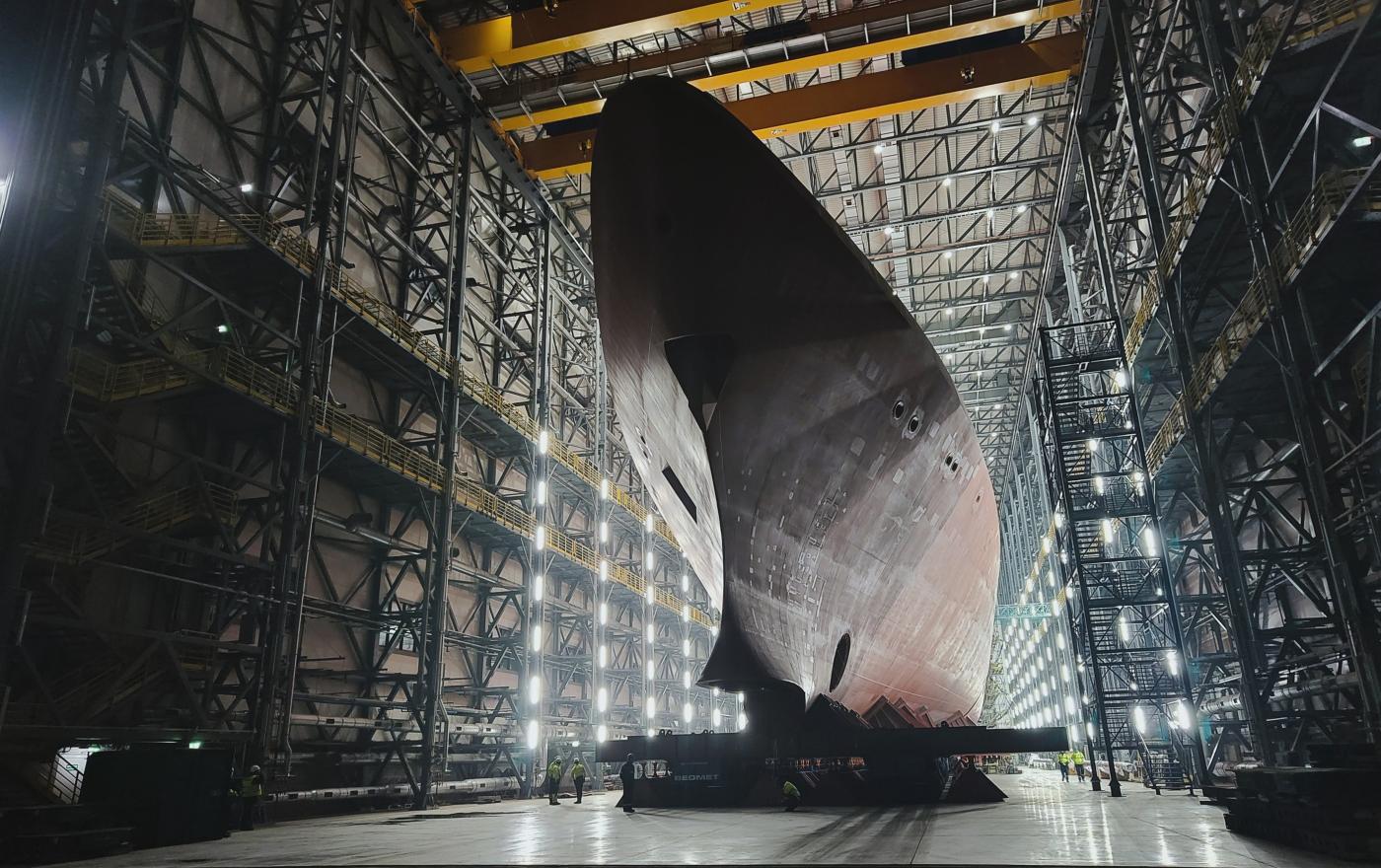
The year 2024 marked a new chapter for the Shipyard. Completion of a long-term investment programme resulted in the commissioning of a new hull construction hall and production facilities, while the start of construction of the first frigate Wicher confirmed readiness to execute large-scale new-build programmes.
For decades, the Shipyard focused primarily on repairs and modernisation of Polish Navy vessels. Today, supported by modern infrastructure and secured contracts, new construction has become a strategic priority — while legacy maintenance expertise remains an integral part of the portfolio.
This transition requires profound organisational change. Design and construction divisions have been reinforced, production processes adapted to multi-year naval programmes, and project management structures expanded. The upgraded infrastructure now enables parallel execution of several major programmes.
- Shifting from a repair-oriented profile to new warship construction is not only about facilities and machinery, explains Radosław Koc, Director of Production. - It is primarily a change in organisational mindset — from short-term execution to long-term planning, from reactive operations to strategic project management.
Strategic programmes as drivers of capability growth
The construction of three frigates under the Miecznik programme — Wicher, Burza and Huragan — provides a real-world test of the Shipyard’s expanded capabilities. As the largest naval procurement programme in the history of the Polish Navy, it requires coordination of dozens of suppliers, integration of advanced combat and electronic systems, and precise schedule control over many years.
The Ratownik programme, contracted in December 2024, further strengthens these competencies. The 6,500-ton displacement rescue vessel will be among the most advanced of its type in the Baltic Sea and is intended to support future submarine operations under the Orka programme.
Experience gained from both programmes directly translates into workforce development. Engineers acquire practical expertise in complex systems integration, production teams refine skills in advanced materials and technologies, and project managers build experience in overseeing long-term, high-complexity defence projects.
MRO: a new model of cooperation with the Polish Navy
Alongside new-build capabilities, the Shipyard is expanding its MRO (maintenance, repair and overhaul) offering — a comprehensive life-cycle support model covering the full spectrum of sustainment activities throughout a vessel’s service life. This represents an evolution from transactional repair contracts to long-term, integrated fleet support.
The MRO model encompasses three core areas: preventive maintenance, corrective repairs, and operational support including overhauls, modernisations and logistics management.
- The MRO model fundamentally changes fleet sustainment, notes President Marcin Ryngwelski. - Instead of reacting to failures, it enables proactive management of technical readiness, resulting in higher operational availability and better life-cycle cost control.
New platforms offer an ideal opportunity to implement this approach from day one. In the case of the Miecznik frigates and the Ratownik vessel, PGZ Naval Shipyard is a natural MRO provider, having been involved from the design and construction phases.
A licensed storage facility, expanded logistics infrastructure, decades of experience supporting the Polish Navy, and direct proximity to the Naval Port of Gdynia form a solid foundation for delivering comprehensive MRO packages — including for future submarines.
Preparing for the Orka submarine programme
Looking beyond current contracts, the Shipyard is actively preparing for participation in the Orka submarine programme. Engagements with all potential technology partners focus on building the competencies required to support submarines throughout their entire service life, including within an MRO framework.
Submarine platforms demand highly specialised expertise and infrastructure distinct from surface vessels. PGZ Naval Shipyard is systematically assessing technical and organisational requirements to meet these challenges.
Rebuilding the prestige of shipyard professions
Advanced facilities and technologies are insufficient without skilled personnel. Like the wider maritime industry, the Shipyard faces workforce shortages and declining interest in technical professions. In response, targeted initiatives aim to reshape perceptions of shipyard careers.
The #StoczniaJestCool programme targets vocational school pupils and university students, highlighting modern aspects of shipyard work — from advanced CAD-based design and complex system integration to strategic project management. The Shipyard participates in career fairs, organises study visits and open days, offering first-hand insight into the construction of modern naval vessels.
The #StoczniaJestKobietą initiative promotes women’s participation in technical and production roles. Women currently account for one-fifth of the workforce, including managers leading production teams.
- We are building a multi-generational shipyard community where experience meets new energy and ideas, says Beata Koniarska, Member of the Management Board. - The prestige of shipyard professions is rebuilt through tangible projects and real development prospects.
“Open shipyard”: local engagement as a strategic value
PGZ Naval Shipyard sees itself as an integral part of the Tricity community. The “open shipyard” concept emphasises active engagement in local social life.
Support for local sports is a key element, including sponsorship of top-tier teams such as AMW Arka Gdynia (basketball), Arka Gdynia (football and rugby), as well as youth clubs. Health initiatives and support for national charity programmes further reflect corporate social responsibility.
“Our responsibility does not end at the shipyard gate,” emphasises Koniarska. “By supporting sport, education and health, we invest in the future of both our company and the region.”
PGZ Naval Shipyard: where the future takes shape
Today, PGZ Naval Shipyard is more than a production facility. It is a strategic competence hub whose development directly strengthens Poland’s maritime defence capabilities. The shift towards new-build programmes, implementation of the MRO model and preparations for submarine support form a coherent strategy for long-term industrial sovereignty.
People remain the cornerstone of this vision. Only a holistic approach — combining technological investment, skills development and deep integration with the local community — can ensure genuine maritime sovereignty for Poland, not just for years, but for generations.
Buy us a coffee, and we’ll invest in great maritime journalism! Support Gazeta Morska and help us sail forward – click here!
Kamil Kusier
redaktor naczelny
comments
Add the first comment
see also
Radmor hosts delegation from the Republic of Turkey. Advancing maritime security cooperation
3D-printed catamaran: robotic manufacturing sets course for the future of small craft
Navantia and Fincantieri deepen cooperation on the european patrol corvette programme
Galeon Yachts and Meyer Shank Racing: merging luxury yachts with motorsport expertise
Unmanned systems and naval firepower modules. WB Group showcases integrated capabilities at Enforce Tac 2026
Swedish ports record lowest ship calls in 18 years. Implications for the maritime sector
February in Szczecin’s shiprepair sector. Ice, overhauls and North Sea expansion
Advanced ROV trials conducted at CTO to validate subsea technologies for offshore applications
University of Gdańsk and PGZ Naval Shipyard join forces for innovation and security
Stadt Naval to deliver electric propulsion system for Polish rescue vessel Ratownik
ADVERTISEMENT
ADVERTISEMENT