









Autonomy at sea. A new architecture of naval forces around the Saildrone Spectre program
The rapid evolution of unmanned maritime systems is beginning to reshape the structure and logic of naval power. One of the most prominent examples of this shift is the Saildrone Spectre program - a large autonomous surface platform developed by Saildrone in cooperation with Lockheed Martin.
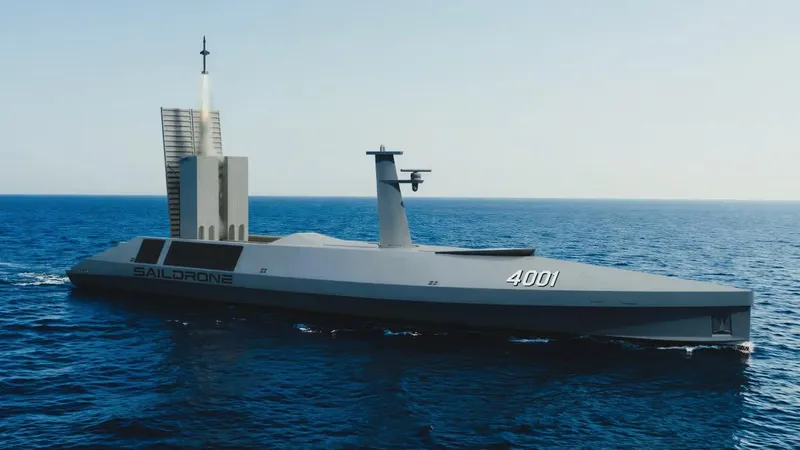
In brief
The American company Saildrone is developing the Spectre programme, a heavy autonomous surface platform for military applications, in which Lockheed Martin acts as the main mission systems integrator. Lockheed Martin is responsible for three areas: weapons integration, including light rocket launchers and modular vertical launch systems, command and control systems, and sensors and anti-submarine warfare with towed sonar arrays. Saildrone Spectre is capable of multi-week unmanned missions over long ocean distances, fitting into the distributed fleet concept.
Rather than representing a continuation of earlier unmanned surface vehicle concepts, Spectre signals a transition toward multi-mission autonomous surface combat systems designed to operate as integral components of distributed naval architectures.
From ISR platform to autonomous combat node
Saildrone has historically focused on long-endurance, wind-assisted unmanned systems for oceanographic and ISR applications. Spectre, however, represents a fundamental shift in both scale and intent.
At approximately 52 meters in length and displacing around 250 tonnes, the platform moves into a category that begins to overlap with light naval vessels. More importantly, it is designed from the outset not only as a sensor platform, but as a networked operational asset capable of integrating into combat systems.
This shift reflects a broader doctrinal evolution within naval forces - from platform-centric operations toward system-centric warfare.
Saildrone Spectre: platform specifications
In operational terms, Spectre occupies the emerging segment of large unmanned surface vessels (USVs) with extended endurance and modular mission capability:
- Length - approx. 52 m
- Displacement - approx. 250 tonnes
- Maximum speed - up to approx. 30 knots
- Endurance - multi-week to multi-month deployments
- Crew - none (fully autonomous operation)
- Range - several thousand nautical miles depending on mission profile
- Payload - modular, containerised mission systems
- Propulsion - hybrid diesel-electric architecture
The platform is designed to support a wide range of missions, including ISR, anti-submarine warfare (ASW), electronic warfare (EW), and potentially kinetic strike roles.
Lockheed Martin - mission systems integration
The role of Lockheed Martin in the Spectre program is centered on mission systems integration rather than platform construction.
This includes three primary areas:
- Weapons integration
Development and integration of modular weapon systems, including containerised launchers and potential compatibility with vertical launch systems.
- Command and control
Integration of command, control, and data fusion systems enabling Spectre to operate within broader naval networks and share real-time operational data.
- Sensor and ASW systems
Integration of advanced acoustic sensors, including towed arrays and signal processing systems, enabling submarine detection and tracking in contested environments.
This approach effectively transforms Spectre from a standalone unmanned platform into a networked combat node within a distributed force structure.
Operational and doctrinal impact
The significance of the Spectre program lies less in its individual specifications and more in its implications for naval doctrine and force structure.
Traditional naval power has relied on a limited number of highly capable, crewed surface combatants. In contrast, platforms such as Spectre enable:
- distributed force structures with a larger number of nodes
- reduced operational risk through removal of onboard personnel
- persistent maritime presence at lower cost
- enhanced sensor coverage and data collection
These developments align with concepts such as distributed maritime operations and distributed lethality, where combat effectiveness is derived from networked systems rather than individual platforms.
Strategic implications
The introduction of large autonomous surface systems suggests several long-term trends:
- increasing reliance on unmanned systems for persistent ISR and ASW
- growing importance of electronic warfare and counter-autonomy capabilities
- integration of surface, subsurface, and aerial unmanned systems into unified operational networks
- gradual redefinition of the role of traditional surface combatants
Spectre should therefore be understood not as an isolated platform, but as part of a broader transition toward hybrid naval forces combining manned and unmanned assets.
Is an autonomous fleet the future of naval warfare?
The Saildrone Spectre program, developed in cooperation with Lockheed Martin, represents a clear step toward the operationalization of large autonomous surface systems.
While such platforms are unlikely to replace crewed warships in the near term, they are already redefining how naval power is distributed, projected, and sustained.
In this emerging paradigm, maritime dominance will depend less on individual ships and more on the integration of autonomous systems into resilient, networked operational architectures.
Source: Gazeta Morska · Compiled by: Kamil Kusier
Related articles
 Shipbuilding industry Poland christens ro-pax ferry Bursztyn Unity in Szczecin on Independence Day. Ystad service starts 18 November
 Energy and offshore Orlen Neptun deploys V-LiDAR buoys at Baltic West ahead of Poland's 2027 offshore wind auction
 Energy and offshore Equinor takes over Bałtyk 2 and 3 O&M base in Łeba. Port to serve 1.44 GW of offshore wind for 30 years
 Navy and defence Port Gdański Eksploatacja secures NATO NCAGE code. Gdańsk port company lines up for defence tenders
 Shipbuilding industry Ex-Enterprise towed to Mobile under $418.5m contract. Test case for Nimitz-class disposal begins
 Energy and offshore Energa renames Gdańsk gas plant company as foundations for 6,000-tonne turbine and boiler are laid
Comments (0)
The discussion is moderated by the editors: a comment appears after review. Your e-mail address is not published.
Nobody has commented on this article yet.