Advanced search and rescue exercises by Canadian Air Force and Coast Guard in Malaspina Strait
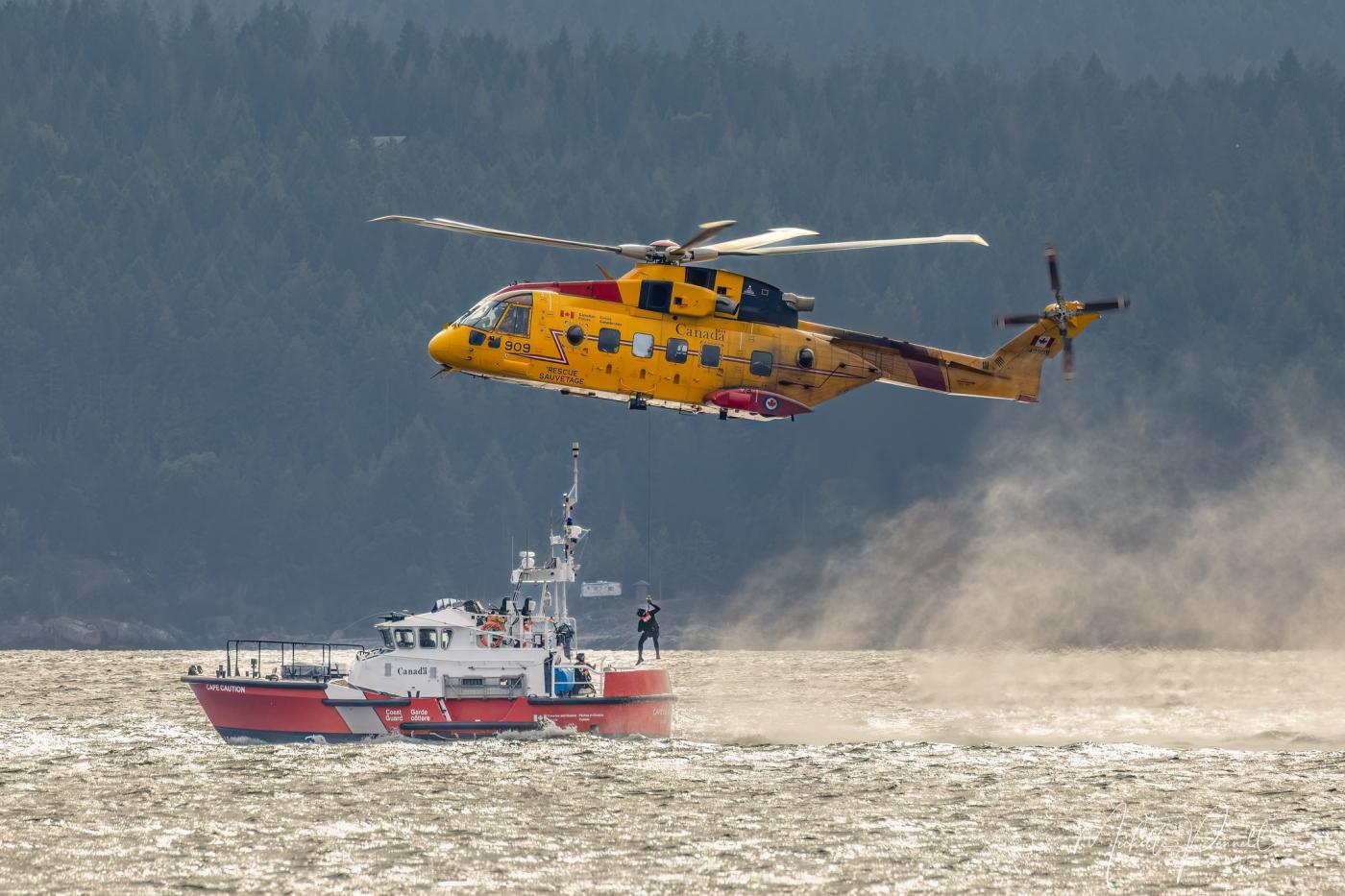
In the Malaspina Strait near Grief Point, British Columbia, Canadian Air Force and Canadian Coast Guard crews recently conducted advanced search and rescue exercises. The main goal of the drills was to test the new hoist system on the CH-149 Cormorant helicopter and to enhance coordination between air and sea crews in realistic operational scenarios.
security aviation worldwide maritime rescue coast guard news17 november 2025 | 14:58 | Source: Gazeta Morska | Prepared by: Kamil Kusier | Print
fot. Michelle Pennell / Canadian Coast Guard
The exercises involved the Cormorant helicopter from 19 Wing Comox and the CCGS Cape Caution, a highly resilient Cape-class lifeboat. Coast Guard personnel practiced recovering individuals from a moving vessel, stabilizing the boat in challenging sea conditions, and synchronizing actions with airborne rescue teams.
The CH-149 Cormorant is one of Canada’s most advanced search and rescue helicopters, equipped with radar and electro-optical sensors as well as a modern hoist system for safe and efficient recovery in demanding conditions. It can operate in night missions, strong winds, and high waves, while providing space for medics to administer care during flight.
The CCGS Cape Caution serves as a reliable coastal rescue platform. Its self-righting design and ability to operate in waves up to 6 meters make it a key asset in high-risk maritime rescues, fully coordinated with helicopter operations.
Malaspina Strait, with its narrow channels, variable winds, and limited maneuvering space, offered realistic training conditions. Crews practiced precise helicopter hovering over a moving vessel, hoist operations, emergency procedures for hoist failure, and full communication coordination between air and sea units.
These joint exercises highlight the high level of operational readiness and safety maintained along Canada’s Pacific coast. They also demonstrate the critical importance of seamless cooperation between air and maritime services, where seconds can be decisive, and every action must be carefully synchronized.
Buy us a coffee, and we’ll invest in great maritime journalism! Support Gazeta Morska and help us sail forward – click here!
Kamil Kusier
redaktor naczelny
comments
Add the first comment
see also
Defence.Hub strengthens capabilities in technologies supporting maritime infrastructure security
Damen to build 13 SAR units for Turkey. Strengthening search and rescue in the Aegean Sea
Sebastian Kluska, director of MSPiR SAR: No room for improvisation at sea. Skills and judgment matter
MS Kapitan Poinc to deploy FRB 850 in Baltic SAR upgrade
105th life-saving mission. Naval Aviators conduct double "Heart Action" transport
Another successful medical evacuation over the Baltic Sea. Yet another intervention at offshore wind farms
Fishing trip on Vistula Lagoon cut short due to missing certificates
Drifting tanker near Malta highlights risks linked to the global “shadow fleet”
Cross-border SAR operation on the ice of the Gulf of Bothnia
Body recovered from the waters of Puck Bay near Babie Doły in Gdynia
ADVERTISEMENT
ADVERTISEMENT