









128 missiles and radar with no blind zones. What Poland's first new-generation frigate will be capable of
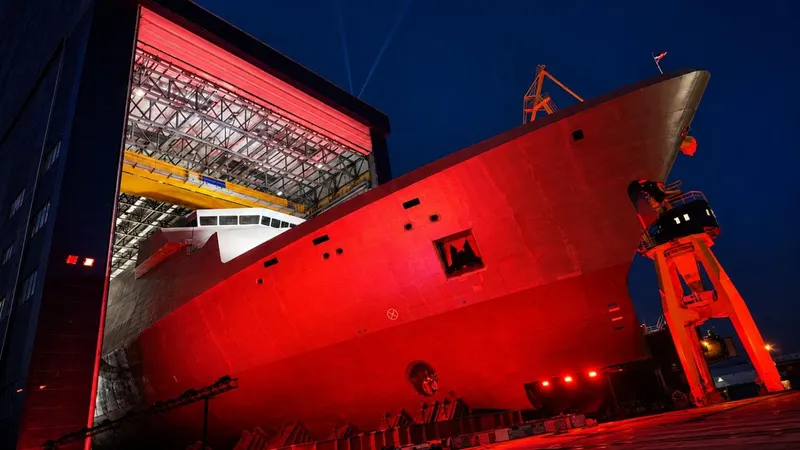
On Wednesday the frigate receives her name, on Thursday she touches water for the first time. But what makes Wicher a breakthrough will happen neither on the barge nor on Gdańsk Bay. It will happen when the ship starts doing what she was designed for: tracking the airspace, the sea surface and everything beneath it at the same time. No vessel in the history of the Polish Navy has carried such a set of capabilities.
In brief
The frigate Wicher will get four Lockheed Martin Mk 41 vertical launchers which, with ExLS modules, will hold up to 128 MBDA CAMM anti-aircraft missiles ranging from about 40 to a target 100 kilometres. Sensors include Thales SM400 series AESA and NS50 radars, two sonars and the TACTICOS combat management system integrated with OBR CTM. Weapons also include an OTO Melara 76 mm Super Rapid gun, two 35 mm OSU-35K guns, MU90 torpedo launchers and two quadruple NSM launchers with a range of up to 200 kilometres. Four MTU 20V8000 M71 engines of 8,400 kW each will power the 138.7-metre ship of about 7,000 tonnes maximum displacement.
An air-defence umbrella of 128 missiles
The heart of the frigate's defensive capability will be four Lockheed Martin Mk 41 universal vertical launchers, the most widespread launcher standard aboard NATO warships. Each has eight launch cells, and thanks to ExLS modules a single cell can hold four MBDA CAMM anti-aircraft missiles. In the maximum configuration that gives 128 rounds ready to fire, with no reloading and no need to train a launcher towards the target, straight up from beneath the deck.
The CAMM family is the same system the Polish armed forces know from the Narew and Pilica+ programmes, meaning unified logistics and training between the fleet and land-based air defence. In future the ships are also due to receive the medium-range CAMM-MR, developed jointly with the United Kingdom, which will take the place of two baseline rounds in each Mk 41 cell. The missiles' reach is to extend from around 40 kilometres to as much as 100 kilometres in the target configuration.
Eyes and ears: radars, sonars and TACTICOS
Situational awareness will come from Thales radars: a four-panel SM400-series AESA array whose fixed antennas on the superstructure watch the entire space around the ship simultaneously, with no blind zones and no waiting for an antenna to rotate, complemented by an NS50-series surveillance radar. Below the waterline, two sonars will be at work, one hull-mounted and one towed, with electronic warfare systems, reconnaissance equipment and identification friend-or-foe completing the picture.
All of this data will feed the TACTICOS combat management system, integrated with the involvement of Poland's OBR CTM. It is the ship's digital brain, fusing the sensor picture, classifying threats and assigning effectors to them, from missiles to guns. Aboard the two current Oliver Hazard Perry-class frigates, commissioned into the US Navy in the early 1980s, that level of automation was unthinkable.
Guns, torpedoes and anti-ship missiles
The gun armament will be led by an Italian OTO Melara 76 mm Super Rapid in the Strales version, capable of engaging cruise missiles as well. It will be joined by two Polish 35 mm OSU-35K guns from PIT-RADWAR, firing programmable ammunition, plus remotely controlled and manually operated heavy machine gun stations for close-in defence.
Anti-submarine work will fall to two twin B515/2V launchers for 324 mm MU90 lightweight torpedoes, working with the ship's sonars. Against surface targets the frigate will carry two quadruple launchers for Kongsberg NSM anti-ship missiles, a system already familiar to the Polish fleet from its land-based Naval Missile Units, with a reach of up to 200 kilometres. Aft, a flight deck and hangar for a shipboard helicopter will extend the ship's anti-submarine reach far beyond the horizon of her own sensors.
Propulsion and seakeeping
Wicher will be driven by four MTU 20V8000 M71 diesel engines of 8,400 kW each, working in a CODAD arrangement on two controllable-pitch propellers, with four 1,400 kW generator sets providing electrical power. At an overall length of 138.7 metres and a maximum displacement of around 7,000 tonnes, the frigate will be the largest combat ship ever built in Poland and one of the largest ever to fly the Polish flag.
The legacy of the Danish Iver Huitfeldt design, from which the Arrowhead 140 platform derives, is a spacious, stable hull with strong seakeeping and margin for future upgrades. In practice that means a ship capable of long patrols in the demanding conditions of the Baltic and North Sea, and of operating within NATO task groups on distant waters when required.
A leap of two generations
The scale of the change is clearest against the ships the Miecznik-class frigates will replace. ORP Gen. T. Kościuszko and ORP Gen. K. Pułaski were designed in the 1970s, with no vertical launchers, a single missile rail and largely analogue electronics. The Miecznik class brings the fleet capabilities it has never had: multi-channel air defence able to shield not just the ship herself but other vessels and convoys, radar coverage that never pauses in any direction, and full integration with allied systems.
Before that happens, a long road still lies ahead: outfitting at the quay, systems integration, harbour and sea trials, and finally qualification testing. But the course is set, and from Thursday the first Polish frigate of the new generation will be in the water.
Source: Gazeta Morska · Compiled by: Kamil Kusier
Related articles
 Shipbuilding industry Poland christens ro-pax ferry Bursztyn Unity in Szczecin on Independence Day. Ystad service starts 18 November
 Energy and offshore Orlen Neptun deploys V-LiDAR buoys at Baltic West ahead of Poland's 2027 offshore wind auction
 Energy and offshore Equinor takes over Bałtyk 2 and 3 O&M base in Łeba. Port to serve 1.44 GW of offshore wind for 30 years
 Navy and defence Port Gdański Eksploatacja secures NATO NCAGE code. Gdańsk port company lines up for defence tenders
 Shipbuilding industry Ex-Enterprise towed to Mobile under $418.5m contract. Test case for Nimitz-class disposal begins
 Energy and offshore Energa renames Gdańsk gas plant company as foundations for 6,000-tonne turbine and boiler are laid
Comments (0)
The discussion is moderated by the editors: a comment appears after review. Your e-mail address is not published.
Nobody has commented on this article yet.