







WB Group licenses Łukasiewicz base bleed technology to extend range of 155 mm artillery shells
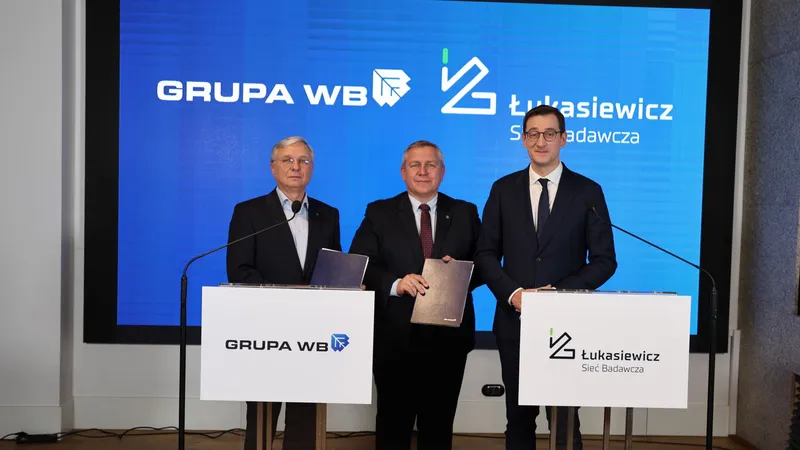
WB Group, Poland's largest privately owned defence company, has signed a licence agreement with the Łukasiewicz Research Network for gas generator technology that extends the range of 155 mm artillery shells. The deal could bring Łukasiewicz up to PLN 90 million in revenue and, according to the research network, is set to become Poland's largest commercialisation agreement in decades. It also puts Poland among the small group of countries able to produce extended-range 155 mm ammunition, a product currently offered by only a handful of European manufacturers amid rising demand from NATO and Ukraine.

In brief
WB Group has signed a licence agreement with the Łukasiewicz Research Network for gas generator (base bleed) technology that extends the range of 155 mm artillery shells. The deal could bring Łukasiewicz up to PLN 90 million and is described as Poland's largest commercialisation agreement in decades. Prototypes have passed ballistic tests and will now undergo range trials.
How a gas generator extends range
The core technology was developed by Łukasiewicz - Institute of Industrial Organic Chemistry (IPO). The gas generator, often referred to as base bleed, is fitted in the base of the projectile. During flight, it releases gas into the low-pressure area that forms behind the shell, reducing aerodynamic drag. As a result, the projectile travels further and artillery units can engage targets at greater distances.
For WB Group, the key advantage of the Łukasiewicz solution was that it increases range without rocket propulsion. That makes the shell simpler to manufacture and, according to the partners, better placed to compete in export markets.
The 155 mm calibre is the NATO standard for tube artillery. It is used by Poland's Krab and K9 self-propelled howitzers, as well as Germany's PzH 2000 and France's CAESAR, among others. Greater range translates directly into greater effectiveness and survivability for artillery crews, a lesson repeatedly underlined by the war in Ukraine.
A record deal between science and industry
Royalties will be paid to Łukasiewicz in instalments, with their value linked to the volume of sales. The licence was valued by an international consultancy.
– Analyses carried out by an international advisory firm to value the technology show that the Network will earn up to PLN 90 million from this licence. Everything indicates that this will be the largest Polish commercialisation agreement in recent decades – said Dr Hubert Cichocki, President of the Łukasiewicz Centre.
Engineers from Łukasiewicz and WB Group worked on the project from the early research stages. They were able to discuss the most sensitive technical details thanks to a strategic partnership agreement signed less than a year ago. Łukasiewicz introduced this model of cooperation with industry in 2025, drawing on practices from countries including Germany and Finland.
Under the model, research priorities are shaped by the needs of companies rather than by technologies already sitting on laboratory shelves. The approach is designed to shorten the path from research to production and to make public spending on science more visible in industrial orders.
– When we created the strategic partnership model, we assumed that scientists would respond to the needs of business, rather than try to persuade companies to buy technologies that already exist. Less than a year after signing the agreement with WB Group, we are showing that taxpayers' money invested in science can come back in the form of orders from industry – Dr Hubert Cichocki explained.
Technological sovereignty for Poland and Europe
WB Group stresses that the agreement allows it to base production on domestic, original solutions. That matters at a time when European demand for artillery ammunition still exceeds production capacity and supply chains remain vulnerable to disruption.
– The agreement underlines the close ties between WB Group and Polish science. It also shows how important technological sovereignty is for the security of Poland and Europe. The joint work of Łukasiewicz researchers and WB Group engineers is leading to our own original solutions, which can be manufactured without restriction using the domestic production base – said Piotr Wojciechowski, President of WB Group.
WB Group is best known for its unmanned aerial systems, loitering munitions and military communications. In December 2025, the company announced that it was entering the 155 mm artillery ammunition market. The Łukasiewicz licence is intended to allow it to offer an extended-range variant alongside standard shells.
From the laboratory to the firing range
Prototype shells fitted with the gas generator have already passed ballistic tests and have been confirmed to function at temperatures from -20 to +50°C. Using WB Group's resources, the projectiles will now move to range testing. These trials are required for certification by the armed forces, which in turn will open the way to mass production.
Moving from research to industrial scale requires a manufacturer. Range testing can only take place once production has been launched on industrial equipment rather than laboratory installations.
– Without cooperation with WB Group, further implementation of the technology would not have been possible. To carry out range tests, production has to be launched on industrial equipment – said Prof. Rafał Łukasik, Director of Łukasiewicz - Institute of Industrial Organic Chemistry.
Łukasiewicz turns towards defence
Łukasiewicz - IPO leads the Network's rocket and ammunition projects, which bring together the expertise of nine institutes. Defence has become one of the central priorities for the entire organisation. In 2026, 67% of new publicly funded Łukasiewicz projects concern defence, security or dual-use technologies.
The Łukasiewicz Research Network is a research and development organisation made up of 22 institutes. They employ around 7,000 people in 30 towns and cities across Poland. The Network focuses on four key areas: national defence and security, chemistry for industry, the energy transition and the circular economy.
A domestic answer to Europe's ammunition gap
Since the full-scale Russian invasion of Ukraine, 155 mm ammunition has become one of the most sought-after military products in Europe. Poland is expanding its production capacity on several fronts, with both state-owned and private companies investing in new lines and technologies.
The WB Group agreement shows that key components of modern artillery ammunition can be developed in Polish laboratories and taken into production without relying on foreign licensors. For Łukasiewicz, it is also proof that its strategic partnership model can turn publicly funded research into commercial revenue within a single year.
Source: Gazeta Morska
Comments (0)
The discussion is moderated by the editors: a comment appears after review. Your e-mail address is not published.
Nobody has commented on this article yet.