







Voyager 1 reaches one light-day from Earth, while the ocean floor remains a mystery
On 18 November 2026, Voyager 1 became the first human-made object to travel one light-day from Earth. Its signals now take a full day to reach us. The milestone is a reminder of how far we can reach into space, how little we still know about the seabed, and how quickly Poland is growing as a space nation, with companies from the Baltic coast among its leaders.

In brief
Voyager 1 is now one light-day from Earth. Read why the ocean floor is still a mystery and how Polish companies such as ICEYE, Eycore and SpaceForest are shaping Europe's space sector.
26 billion kilometres from home
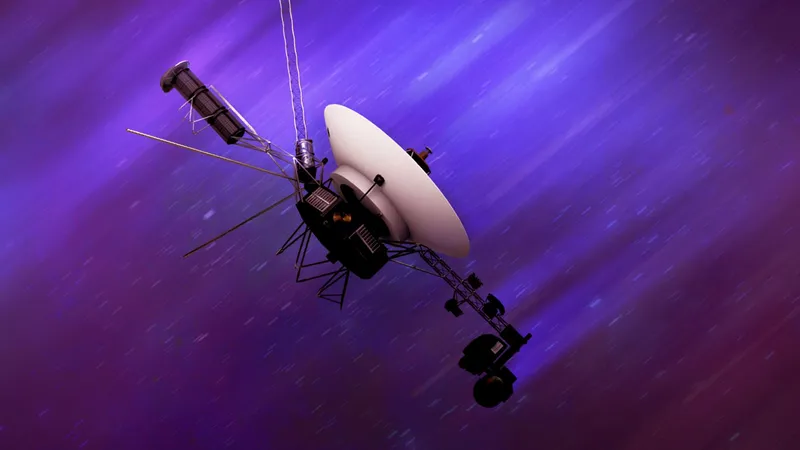
Voyager 1 crossed the one light-day mark at 10:16 UTC on 18 November, about 25.9 billion km from Earth, more than 173 times the Earth-Sun distance. Launched on 5 September 1977 and travelling at about 61,000 km/h, it took 49 years, 2 months and 11 days to get there. A command sent from Earth now needs 24 hours to arrive, and the reply another 24. Voyager 1 entered interstellar space in 2012 and will need roughly another 18,000 years to reach a full light-year. Its twin, Voyager 2, will not cross the light-day mark until November 2035.
The ageing spacecraft runs on a plutonium power source that weakens every year, so engineers at NASA's Jet Propulsion Laboratory keep switching off instruments. One was shut down in April 2026, and contact was briefly lost in October. Yet Voyager 1 still sends back data on magnetic fields, dust and cosmic rays almost every day.
– It's a national treasure – said Suzanne Dodd, Voyager project manager at JPL.
The sea on board
Both Voyagers carry the Golden Record, a message from humanity compiled by a team led by astronomer Carl Sagan. Alongside 116 images, music and greetings in 55 languages, it holds the sounds of Earth, including surf and the song of humpback whales recorded by biologist Roger Payne. In 1990, Voyager 1 turned its camera back and photographed Earth from about 6 billion km away as a pale blue dot, a colour that comes from the oceans covering about 71 percent of the planet.
Closer to the stars than to the seabed
We can stay in touch with a probe 26 billion km away, yet most of our own ocean floor remains unmapped. According to the Seabed 2030 project, only 28.7 percent of the seabed had been mapped in high resolution by April 2026. The deepest point, the Challenger Deep in the Mariana Trench, lies less than 11 km down, a distance Voyager covers in under a second, yet reaching it still takes specialised submersibles and research vessels.
Space also leads us back to water. Voyager images from 1979 revealed the cracked icy crust of Jupiter's moon Europa, one of the first hints of an ocean beneath. Today the European JUICE probe is heading to Jupiter's icy moons with a Polish contribution: the Space Research Centre of the Polish Academy of Sciences built the data processing unit and electronics of the RPWI instrument, and Polish company Astronika made its booms and antennas. The instrument will look for signals from tides and currents in the hidden oceans.
Poland's growing space role
Less than a year after Voyager 1 launched, Mirosław Hermaszewski became the first Pole in space in June 1978. The second, Sławosz Uznański-Wiśniewski, followed 47 years later, spending 18 days on the International Space Station in the IGNIS mission in 2025 and running 13 Polish experiments. In November 2025, Poland pledged a record contribution of about €550 million to ESA and signed a letter of intent to host an ESA centre focused on security and resilience.
– This is a positive step in Poland's involvement in ESA and will support Poland's growth as an emerging space power – said Josef Aschbacher, ESA Director General.
Watching the Baltic through the clouds
Poland's biggest successes are in radar (SAR) satellites, which see through cloud and darkness, a major advantage over the often overcast Baltic. They can track ships, including those that switch off AIS, and protect wind farms, pipelines, subsea cables and LNG terminals.
ICEYE, a company of Polish-Finnish origin co-founded and led by Rafał Modrzewski, operates the world's largest SAR constellation and was valued at over €10 billion in June 2026. Its Polish arm, together with Military Communication Works No. 1, delivered the MikroSAR system to the Polish Armed Forces in May 2026 under a contract worth about PLN 860 million.
– The private-state cooperation is a model for future strategic programs – said Cezary Tomczyk, Poland's Deputy Minister of National Defence.
Eycore, which grew out of Gdynia-based counter-drone and radar maker APS (Advanced Protection Systems), launched Eycore-1, the first satellite carrying a Polish-built SAR, on 3 May 2026. The company also plans a PLN 50 million investment in the Kashubia region, including a production hall and clean rooms.
– Space technologies, and satellite-based Earth observation in particular, are now critical to national security – said Tomasz Kusowski, co-founder and Vice President of Eycore.
Rockets from the Baltic coast
Gdynia's SpaceForest is developing Perun, a reusable suborbital rocket designed to carry up to 50 kg to about 150 km. It has flown three times from Ustka, and under a €2.4 million ESA contract it is due to make four flights up to 150 km, including one planned from a floating platform in the North Sea. SpaceForest also builds the flip control system for Europe's Themis reusable rocket demonstrator.
– We could really use a spaceport – said Robert Magiera, CEO of SpaceForest.
The ILR-33 Bursztyn rocket built by the Institute of Aviation in Warsaw, part of the Łukasiewicz Research Network, reached 101 km in July 2024, crossing the edge of space. On 12 November 2026, a week before Voyager's milestone, its Bursztyn 2K version flew at twice the speed of sound from Ustka, testing communications systems from Wrocław-based Thorium Space. Its mobile launcher was transported in a standard shipping container.
Voyager 1 shows that human curiosity has no limits. But the nearest great unknown is not 26 billion km away, but a few kilometres beneath the sea. Polish companies and institutes are increasingly working on both frontiers, building instruments that search for oceans on Jupiter's moons and satellites that watch over the Baltic from orbit.
Source: Gazeta Morska
Comments (0)
The discussion is moderated by the editors: a comment appears after review. Your e-mail address is not published.
Nobody has commented on this article yet.