







Sub-hunting in the Baltic as NATO drills off Sweden and Poland's first A26 submarine takes shape in Karlskrona
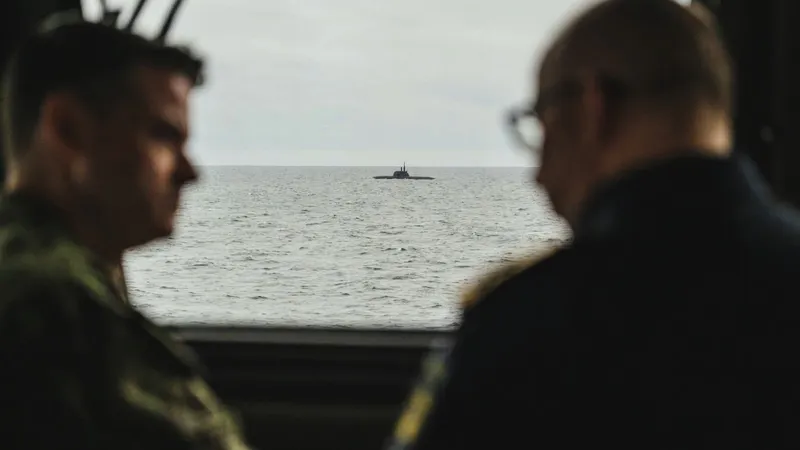
Submarines, warships, helicopters and maritime patrol aircraft from eight NATO Allies trained in anti-submarine warfare off the coast of Sweden during Exercise Dynamic Merlin 26. NATO has now released images from the drills, while another exercise involving Finland, Estonia and the US Marine Corps is under way in the northern Baltic. Meanwhile, at the Saab Kockums yard in Karlskrona, the hull of Poland's first A26 submarine is taking shape.

In brief
Eight NATO Allies trained in anti-submarine warfare off Sweden during Exercise Dynamic Merlin 26, while Exercise Narrow Waters 26.2 is under way in the northern Baltic. One year after the Polish-Swedish intergovernmental agreement, the hull of Poland's first A26 submarine under the Orka programme is being built in Karlskrona.
Dynamic Merlin 26 took place in the Baltic Sea off Sweden from 9 to 13 November 2026. Sweden hosted the exercise, with participation from the United Kingdom, Canada, Denmark, Finland, France, Germany and the Netherlands. NATO's Allied Maritime Command (MARCOM) describes it as one of the most demanding anti-submarine warfare exercises in the Baltic. It was the third time Sweden had hosted the drills, which are set to become a permanent fixture in the Alliance's maritime exercise calendar.
A game of hide and seek beneath the Baltic
The scenario focused on hunting submarines in the challenging conditions of a shallow and congested sea. A German and a Swedish submarine operated beneath the surface, while warships and patrol aircraft tried to detect and track them. Crews were also tested against anti-ship missile and drone threats, with commanders announcing beforehand that ships would face drone attacks they did not know were coming.
The Swedish Navy contributed five corvettes, a submarine, a Helicopter 14 and the support ship HMS Trossö. Standing NATO Maritime Group One (SNMG1) also took part, with the Dutch support ship HNLMS Den Helder as its flagship. Dynamic Merlin builds on earlier exercises such as Dynamic Manta, Dynamic Mongoose and Playbook Merlin, introducing new tactics and technologies to help Allied forces adapt to an increasingly complex undersea environment.
– Sweden is prepared to take on a large responsibility within the Alliance, and hosting this exercise is just one example of how we do that – said Rear Admiral Johan Norlén, Chief of the Swedish Navy, as the drills began.
The Baltic under constant watch
Dynamic Merlin is not the only Allied activity in the Baltic this month. From 26 November to 4 December, the Finnish Navy is leading Exercise Narrow Waters 26.2, its main autumn exercise, in the northern Baltic and the Gulf of Finland. Estonian forces and US Marines from a force reconnaissance company are taking part, with a focus on information sharing, strike coordination and the integration of air and missile defence.
The Marines previously operated off Finland as part of NATO's Baltic Sentry enhanced vigilance activity, which strengthens the monitoring of the Baltic and its critical undersea infrastructure. Allied maritime patrol aircraft, including British P-8A Poseidons, also fly regular surveillance missions over the sea. Finland's Navy chief Tuomas Tiilikainen recently described the security situation in the Baltic as tense but stable, adding that increased NATO patrols appear to be having a deterrent effect.
Poland's Orka is under construction
Poland was not among the participants in Dynamic Merlin. The Polish Navy currently operates just one submarine, ORP Orzeł, but that is set to change. This week marks one year since Poland and Sweden signed an intergovernmental agreement under the Orka programme, and since June a contract has been in force for three A26 submarines from Saab Kockums.
The contract was signed on 29 June 2026 in Gdynia, aboard the frigate ORP Gen. T. Kościuszko, and covers three submarines together with weapons, logistics and training packages. The first boat is due to join the Polish Navy at the start of the next decade. Construction began at the end of October: in Karlskrona, the hull is being built from a special patented steel alloy, and the boat's number has already been burned into the plates, although it has not yet been named.
– Today it can be announced to everyone that construction of the first submarine has begun – said Cezary Tomczyk, Poland's Deputy Minister of National Defence, during his visit to Karlskrona.
The programme is also moving forward in the supply chain. Saab has signed a contract with France's Jeumont Electric for the electric propulsion systems of the Polish submarines, the first publicly known equipment contract for the boats being built under Orka. The A26 is designed for covert operations in shallow and challenging waters such as the Baltic and features air-independent propulsion.
Bridging capability and benefits for industry
Until the first A26 is delivered, Poland will operate a bridging submarine: a modernised A17 Södermanland-class boat that Sweden intends to make available to Poland until 2032. Polish sailors are already training in Karlskrona, including in damage control, medical care and escape from a damaged submarine. This will allow the Polish Navy to maintain submarine crew skills until the new boats enter service.
Orka also has an industrial dimension. Saab has committed to transferring technology and know-how for submarine maintenance, repair and overhaul, and Polska Grupa Zbrojeniowa has signed an agreement with the company that paves the way for building submarine support capabilities in Poland. WB Group has also signed an agreement with Saab. In addition, Sweden has committed to buying a Ratownik rescue ship built by PGZ Stocznia Wojenna in Gdynia.
The images from Dynamic Merlin show what Allied naval cooperation in the Baltic looks like today. Anti-submarine warfare requires close coordination between surface ships, aircraft and submarines, and once the new A26 boats enter service Poland will be able to bring modern capabilities of its own to such exercises. Polish-Swedish cooperation under Orka is creating one of the strongest submarine partnerships in the region.
Source: Gazeta Morska
Comments (0)
The discussion is moderated by the editors: a comment appears after review. Your e-mail address is not published.
Nobody has commented on this article yet.