







Russian cargo ship ablaze in the Gulf of Finland after drone strike as war edges into Baltic shipping lanes
The Russian cargo ship Sparta II caught fire in the eastern Gulf of Finland on Saturday morning after what Russian officials describe as a strike by two drones. The Finnish Defence Forces and Finland's prime minister have confirmed the attack. The damaged vessel has drifted from international waters into Finnish territorial waters, where the Finnish Border Guard is leading the response. It is the second attack on a Russian vessel in the Baltic in ten days.

In brief
The Russian cargo ship Sparta II caught fire in the Gulf of Finland after a drone strike and drifted into Finnish waters. The Finnish Border Guard is leading the response. Here is what we know.
Explosions at 9:35, then a drift into NATO waters
The incident took place on 21 November. Estonia's Police and Border Guard Board received reports of a fire and explosions on board at 9:35 a.m. local time. The ship was then in an international shipping lane about 11 nautical miles north of the Estonian island of Vaindloo. The Finnish Defence Forces said they had detected a drone attack on a Russian merchant vessel in international waters west of the island of Gogland.
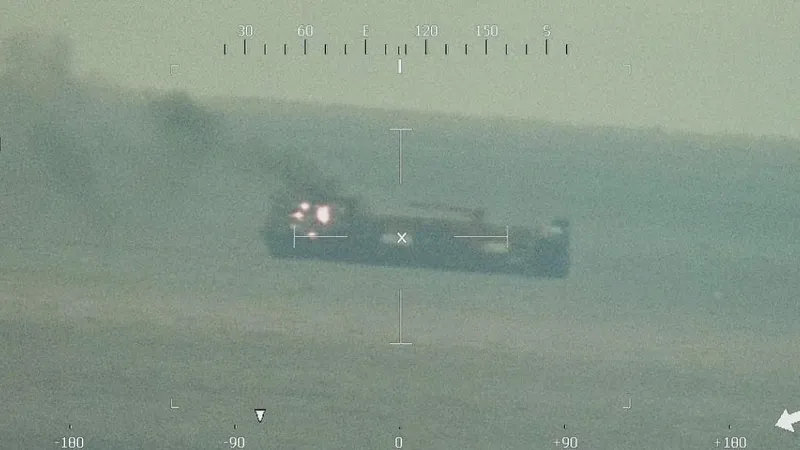
According to Estonian police, the ship was within the area of responsibility of the St Petersburg maritime rescue coordination centre. At around 10 a.m. local time it left Estonia's exclusive economic zone, and it then drifted into Finnish territorial waters in the eastern Gulf of Finland. A photograph released by the Finnish Border Guard shows smoke rising from the vessel's bow. The Finnish Defence Forces confirm that the ship has been damaged.
“The war is spilling over”: Finland steps in to help a Russian ship
The Finnish Border Guard, which is responsible for maritime search and rescue and for responding to environmental damage at sea in the Finnish area of responsibility, said in a statement issued shortly before 1 p.m. local time that it was leading the rescue operation and preparing for possible pollution response.
– The situation poses no danger to other maritime traffic – said the Finnish Border Guard.
The agency added that it was preparing for possible rescue measures together with other authorities in Finland and internationally, and that it would provide further information as the operation progressed. Finland's Ministry of Defence said the attack had occurred in international waters and that Finland had informed its allies.
Prime Minister Petteri Orpo commented on X.
– The war is spilling over into our immediate vicinity. Ukraine has the right to fight back against the aggressor – wrote Petteri Orpo, Prime Minister of Finland.
The Finnish Defence Forces had been imposing temporary restrictions on air and sea traffic in the eastern Gulf of Finland since the early hours of Saturday. The first took effect at around 4 a.m. local time, the restrictions were reinstated at 9:33 a.m., just before the fire was reported, and all were lifted at 2 p.m. The General Staff described them as a routine precaution linked to the ongoing situation in neighbouring areas rather than a response to a specific threat. A drone warning was also issued for north-eastern Estonia.
In Estonia, the Police and Border Guard Board said it was following the situation together with its Finnish counterparts.
– We will respond if Russia requests international assistance – said Andres Tiik, duty officer at the Estonian Police and Border Guard Board, according to public broadcaster ERR.
Two drones, three miles from Russia's border
The attack was first reported by Alexander Drozdenko, governor of Russia's Leningrad region. He said two unmanned aerial vehicles had struck the ship, which was sailing from St Petersburg to Kaliningrad, in neutral waters about three nautical miles from the Russian border, and that the crew was being evacuated.
The governor also claimed that Russian air defences had shot down 80 drones over the region overnight. That figure has not been independently verified. The authorities in Kaliningrad said supplies to the exclave were not at risk.
Sparta II: a sanctioned ship with weapons in its past
Sparta II sails under the Russian flag and is on the United States sanctions list. According to the Open Sanctions database, cited by Finnish public broadcaster Yle, the vessel operates under Russia's Ministry of Defence and has been used to transport weapons. Ukrainian military intelligence makes the same claim, saying the ship carried military equipment from Syria to Russia in 2022. Its cargo on Saturday is not known.
The route matters to Moscow. Kaliningrad is separated from the rest of Russia by Lithuania and Poland, and the sea link with St Petersburg and Ust-Luga is the only supply route that does not cross NATO territory.
All signs point to Kyiv, but Kyiv stays silent
Finnish public broadcaster Yle reported on Saturday afternoon that the Finnish Defence Forces had confirmed that Ukraine struck the vessel. In their official statements, the Defence Forces refer to having detected a drone attack, and as of Saturday afternoon Kyiv had made no statement and had not claimed responsibility.
The circumstances support that account. The strike coincided with another wave of Ukrainian drones over the Leningrad region, and it came just ten days after Ukraine's Security Service (SBU) said its unmanned systems had hit the Russian missile corvette Naro-Fominsk near Gogland on 11 November. The Finnish Defence Forces confirmed at the time that they had detected a strike on a Russian warship in the Gulf of Finland. Analysts described it as the first Ukrainian strike on a Russian vessel in a part of the Baltic used by civilian traffic. On the same day, drones set fire to facilities at the port of Ust-Luga, and some strayed into the airspace of Estonia, Latvia and Lithuania, prompting NATO to scramble aircraft.
After that earlier attack, Finnish Defence Minister Antti Häkkänen said Helsinki had raised the matter with Kyiv, stressing the sensitivity of the narrow Gulf of Finland for civilian shipping and the environment.
The strikes come at a delicate moment. Russia, Ukraine and the United States held talks in Abu Dhabi earlier this month, the first in that format since February, which ended without a breakthrough beyond an agreement on a large prisoner exchange.
A burning ship in one of the Baltic's busiest lanes
The Gulf of Finland is one of the busiest stretches of water in the region and Russia's main maritime gateway to the west. According to Poland's Centre for Eastern Studies (OSW), about half of Russia's seaborne exports of crude oil and petroleum products pass through its Baltic ports. The same waters carry ferries between Helsinki and Tallinn and merchant ships bound for Finnish and Estonian ports.
A burning ship in such waters creates three kinds of risk. The first is navigational safety, although Finnish authorities say there is currently no danger to other vessels. The second is environmental: the gulf is shallow and narrow, so any fuel spill would reach the coast quickly. As of Saturday afternoon, no pollution had been reported. The third is political. A damaged Russian vessel is now in the territorial waters of a NATO member, which is obliged to conduct rescue operations regardless of the ship's flag.
For the wider Baltic, the incident raises a question that shipowners, insurers and port authorities will be watching closely: whether attacks on Russian vessels become a regular feature of a sea that NATO already patrols under its Baltic Sentry mission, launched in January 2025 to protect undersea cables and pipelines. OSW has documented ten incidents involving shadow fleet tankers in the Baltic between January 2023 and May 2026, and about 700 tankers are under EU, UK and US sanctions. Drone strikes on ships add a new layer of risk to waters that were already among the most closely monitored in Europe.
Crew, cargo, damage: the questions still open
It is not yet known how many crew members were on board, whether anyone was injured, how badly the ship is damaged or what it was carrying. The Finnish Border Guard has said it will issue further updates as the operation continues.
Source: Gazeta Morska
Comments (0)
The discussion is moderated by the editors: a comment appears after review. Your e-mail address is not published.
Nobody has commented on this article yet.