







Possible beluga off Gdynia joins long list of unusual visitors to Poland's Baltic coast
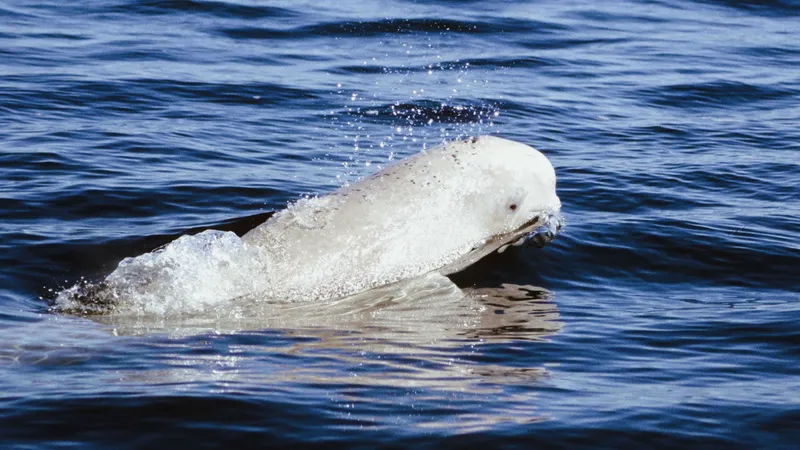
A pure white animal with no dorsal fin was filmed swimming in the Gulf of Gdańsk on Saturday, 21 November 2026, around 100 to 200 metres off the Orłowo cliff in Gdynia. Walkers who recorded it on a phone believe it may have been a beluga whale. The species has not yet been confirmed by specialists, but if it was a beluga, it would be the latest in a series of unexpected visitors to Poland's Baltic coast, from Świnoujście in the west to Krynica Morska in the east.

In brief
A white whale filmed off Gdynia may have been a beluga. Humpbacks, dolphins, sunfish and sharks have also visited Poland's Baltic coast.
A white whale far from the Arctic
Belugas are medium-sized toothed whales of the narwhal family, growing to about 5 metres long. Calves are born grey and turn white as they age. They have no dorsal fin, a feature that sets them apart from dolphins and porpoises and that is visible in the Gdynia footage.
Belugas normally live in Arctic and sub-Arctic waters. Water temperature in the Gulf of Gdańsk, around 8.5°C in recent days, is not a problem for them. The low salinity of the Baltic is a bigger challenge, and long periods in brackish water can cause skin damage. Known as sea canaries for their wide range of whistles, calls and clicks, belugas use sound both to communicate and to echolocate, which helps them hunt and find their way in dark or murky water.
Sightings across northern Europe in 2026
A confirmed beluga in Gdynia would add to an unusual run of sightings this year. On 17 January 2026 a beluga was seen in the North Sea off the Netherlands, the first there since 1966. In mid-April one was reported in the Flensburg Fjord on the German-Danish border, and another was later observed off Ostrobothnia in Finland, where researchers noted skin problems linked to low-salinity water.
At the end of August a beluga was seen near Porvoo in southern Finland, the first record in Finnish waters since 1986. In October one was filmed in Donegal Bay in Ireland. Arctic whale specialists have suggested that a single lone animal may have been seen in Norway, Denmark and Finland during the summer, though no photographic match has confirmed this. Whether the Gdynia animal is linked to any of these sightings is unknown.
Humpbacks from Międzyzdroje to the Vistula
Humpback whales are the largest visitors to the Polish Baltic. In February 2015 fishermen from Kuźnica filmed a humpback in the Bay of Puck. The same animal had earlier been seen in the port of Gdynia and off Westerplatte, before heading west towards the Bay of Greifswald and the island of Rügen.
On 26 February 2025 a humpback became entangled in fishing nets about 80 metres off the beach at Międzyzdroje and was freed after a rescue operation lasting several hours. It was seen near Świnoujście a few days later. On 3 April 2025 passengers on a sightseeing cruise from Świbno watched a feeding humpback about 17 km north of the mouth of the Śmiała Wisła, diving for six to eight minutes at a time.
In 2026 a female humpback nicknamed Timmy drew attention in Germany after repeatedly stranding on the German Baltic coast. She was moved by barge and released into the North Sea on 2 May, but died later that month in the Kattegat.
Dolphins, sunfish and sharks
In August 2015 a pair of bottlenose dolphins was seen in the Gulf of Gdańsk, first near Hel and then by anglers off the eastern shore of the gulf, before appearing near Klaipėda in Lithuania. The species had last been recorded off the Polish coast at the end of the 19th century. A bottlenose dolphin was later seen by anglers in open water off Dębki, with photos confirmed by the University of Gdańsk's Marine Station in Hel.
The ocean sunfish, a warm-water fish that looks as if it is all head, has been caught in Polish waters several times. The first was recorded on 27 October 2000, and others followed off Łeba in 2010 and off the Hel Peninsula in 2014. On 4 November 2019 the fishing vessel SZT-1 caught one north-west of Krynica Morska, the furthest east the species has been recorded off Poland. It measured 57 cm, weighed 12.4 kg and was handed to the National Marine Fisheries Research Institute in Gdynia.
Sharks occasionally enter the Baltic too, mostly in its western part. The porbeagle, which can reach about 3.5 metres and more than 150 kg, poses no threat to people. In 2018 scientists reported the first record from the southern Baltic of the deep-water velvet belly lanternshark, Etmopterus spinax, found in the Pomeranian Bay.
The Baltic's own rare residents
Four marine mammal species live permanently in the Baltic: the grey seal, the harbour seal, the ringed seal and the harbour porpoise. The porpoise is the only resident cetacean. According to the international SAMBAH research project, the population in the central and eastern Baltic numbers only around 500 animals and is classed as critically endangered, with bycatch in fishing nets the main threat.
The ringed seal, the smallest Baltic seal, lives mainly in the north of the sea and is rarely seen on Polish beaches. In early October 2026 one rested for several days on the beach at Osetnik near the Stilo lighthouse, watched over by volunteers from WWF's Blue Patrol.
Specialists advise people not to approach marine mammals on the beach or in the water, including by boat or drone, and to report sightings, ideally with photos or video, to the Marine Station in Hel or the WWF Blue Patrol.
Source: Gazeta Morska
Comments (0)
The discussion is moderated by the editors: a comment appears after review. Your e-mail address is not published.
Nobody has commented on this article yet.