




Polish port safety experts share know-how with Asian ports at EU Global Ports Safety seminar in Yokohama
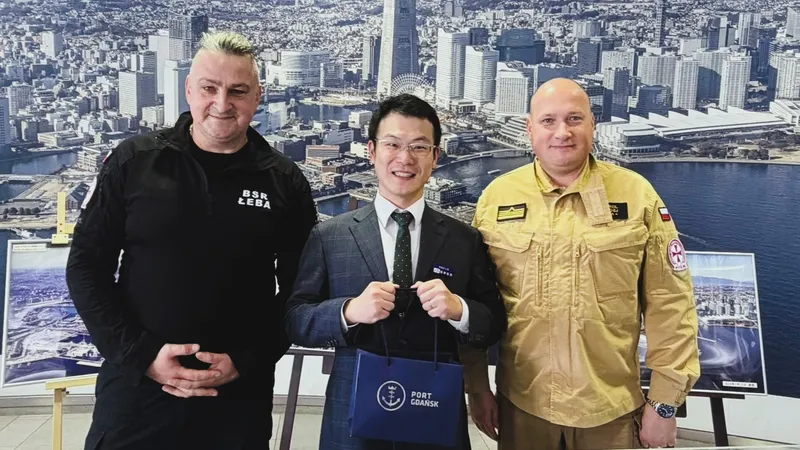
Karol Madej, Management Board Director of the Florian Port Fire Brigade in Gdańsk, and Sebastian Kluska, Director of Poland's Maritime Search and Rescue Service (MSPiR SAR), represented Poland at the Global Ports Safety international seminar in Yokohama, Japan. Poland is one of only two EU member states, alongside France, involved in the EU-funded project, which aims to improve safety at strategic ports across South and Southeast Asia.

In brief
Karol Madej of the Florian Port Fire Brigade and Sebastian Kluska of Poland's MSPiR SAR represented Poland at the Global Ports Safety seminar in Yokohama. The EU-funded project, implemented by Expertise France with France and Poland as participating member states, aims to improve safety at Asian ports handling dangerous goods and alternative fuels.
The seminar took place on 25 and 26 November 2026 at Pacifico Yokohama, alongside OXExpo, an exhibition dedicated to ocean transformation. It brought together experts from Europe and Asia, maritime administrations and emergency services to discuss port infrastructure safety, the response to risks linked to alternative fuels, and the handling of dangerous goods.
Polish experts in the spotlight
Karol Madej and Sebastian Kluska took part as experts from Poland, sharing their experience with representatives of maritime administrations from across Asia. Karol Madej also moderated one of the international working groups. A key part of the programme was a visit to the Japan Coast Guard, where participants were introduced to Japanese rescue capabilities and procedures for responding to emergencies at sea.
– Together with Karol Madej of the Florian Port Fire Brigade, we are here in the port of Yokohama as experts from Poland, sharing our safety know-how with representatives of maritime administrations from across Asia. We are discussing how to prevent incidents in ports and how to respond effectively when they do happen. This is knowledge we use every day in the Baltic – said Sebastian Kluska, Director of the Polish Maritime Search and Rescue Service.
For the head of MSPiR SAR, the project also has a personal dimension. Sebastian Kluska has been with the service since the start of his professional career and worked his way up to the position of director.
– When I started my career at the Maritime Search and Rescue Service, I never dreamed that I would one day join the international pool of Global Ports Safety experts. It shows how much the standing of Polish maritime services has grown in recent years and how seriously our foreign partners take us today – says Sebastian Kluska.
What Global Ports Safety is about
Global Ports Safety (GPS) is co-funded by the European Union and France and implemented by Expertise France, the French public agency for international technical cooperation. Its specific objectives are to improve safety management in beneficiary ports in South and Southeast Asia and to strengthen their capacity to manage incidents, especially those involving dangerous goods. The project also promotes European best practice and international standards in incident prevention and response at strategic industrial ports.
The EU is contributing EUR 6 million to the project and France a further EUR 720,000. France and Poland are the EU member states involved, while the Czech Republic, Singapore and the Republic of Korea also take part. GPS forms part of the EU's Global Gateway strategy, which seeks to build resilient and sustainable connectivity between Europe and Asia.
Running from 2024 to 2028, the project covers eight countries: Bangladesh, Cambodia, Indonesia, Malaysia, the Philippines, Sri Lanka, Thailand and Vietnam. Its activities include training-of-trainers programmes for emergency responders, marine firefighting courses and exchanges of experience between maritime administrations.
– On the international stage, we have shown that Poland's maritime economy, and its safety in particular, is at a high level. Our expertise has been recognised by partners from France, Australia and Singapore, countries with highly developed maritime safety systems of their own. It is an honour and a source of pride for us – stressed Sebastian Kluska.
Yokohama's bet on safe, clean ports
This year's seminar was hosted by the City of Yokohama, which signed a memorandum of understanding with Expertise France on the joint implementation of the project in the spring. The cooperation was referenced in a joint statement by the leaders of Japan and France. Yokohama, one of Japan's leading ports, sees the project as a way to raise its international profile and advance its ambition to become a carbon-neutral port.
The focus on new fuels is central for the city. The seminar was aimed primarily at port and energy stakeholders from ASEAN countries and dealt with the decarbonisation of maritime fuels in ports. As LNG, methanol and ammonia enter shipping, ports must prepare for new types of hazards, which calls for both specialised equipment and well-trained people.
Experience from Gdańsk and Gdynia
The Florian Port Fire Brigade is responsible for fire protection at the Port of Gdańsk, one of the largest ports on the Baltic, which handles crude oil, fuels and chemicals among other cargoes. The company also runs a professional training centre with an indoor fire simulator that is used by units of Poland's State Fire Service as well. This hands-on base underpins the experience that Gdańsk's port firefighters now share with foreign partners.
– We are pleased that, as the Florian Port Fire Brigade, we can share our experience internationally and actively help to develop port safety standards in the face of the new challenges facing the global maritime economy – the Florian Port Fire Brigade said on social media.
Headquartered in Gdynia, the Maritime Search and Rescue Service is responsible for search and rescue operations in Polish maritime areas. Its rescue crews and coordination centres operate around the clock, and the experience gained in the Baltic, including in waters with a growing number of offshore projects, is now becoming part of international knowledge exchange. The participation of Polish experts in the project is supported by Poland's Ministry of Foreign Affairs.
– I would like to thank the Ministry of Foreign Affairs for its support. Thanks to it, Polish experts can showcase their skills where international safety standards are being shaped, and Poland's maritime economy can build its reputation far beyond the Baltic – said Sebastian Kluska.
The presence of Polish experts in Yokohama shows that Poland is not only a participant in Global Ports Safety, but also a provider of expertise. Polish ports and maritime services, which have developed rapidly alongside investment in fuel, gas and container terminals, have gained experience that can benefit Asian ports preparing for similar challenges.
Source: Gazeta Morska
Comments (0)
The discussion is moderated by the editors: a comment appears after review. Your e-mail address is not published.
Nobody has commented on this article yet.