Poland's first quantum connection - a breakthrough in digital security
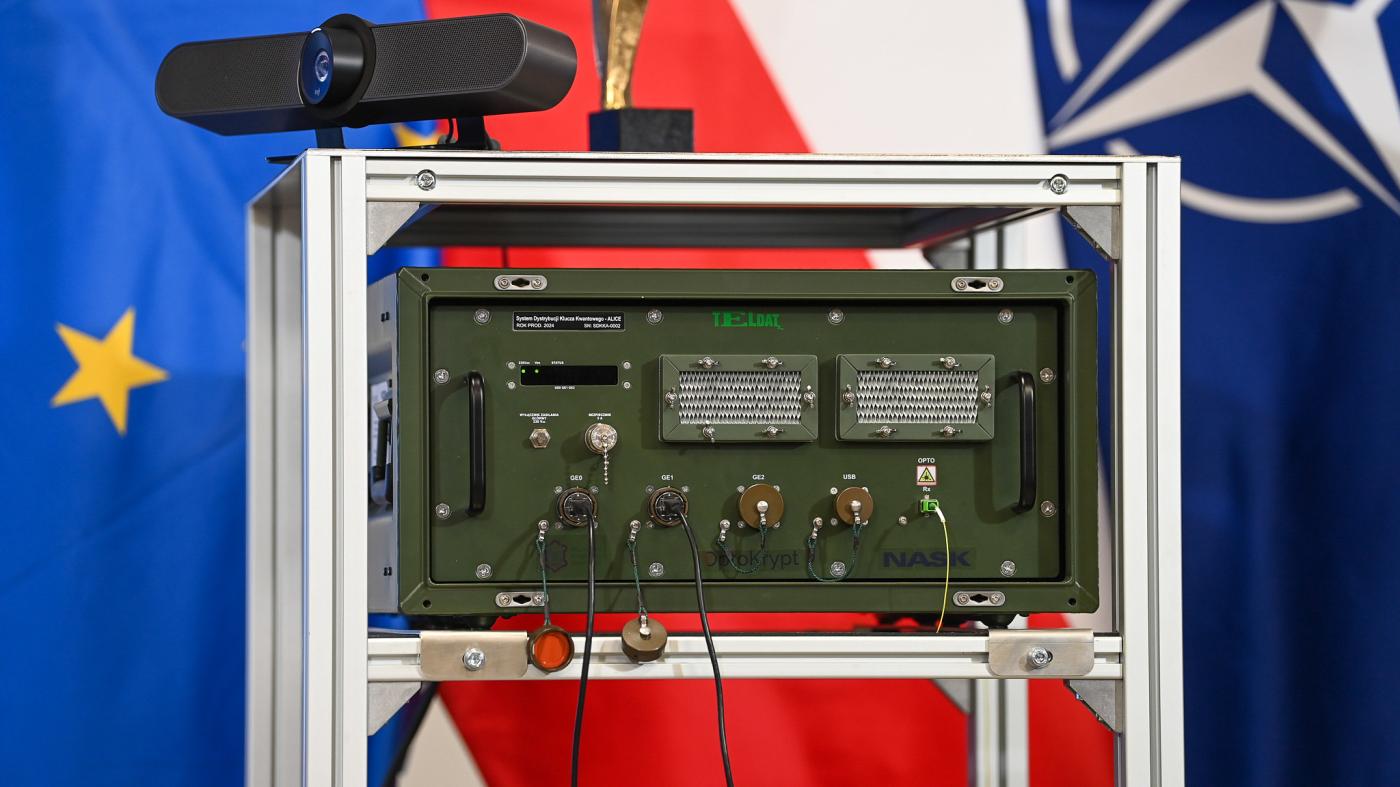
Digital security has become one of the key challenges for modern states. Poland, with its innovative solutions in the field of quantum key distribution (QKD), is joining the ranks of technological leaders in data protection. The system, developed by the Military University of Technology in cooperation with TELDAT Sp. z o.o. and NASK National Research Institute, with the support of the Ministry of Digital Affairs and the Armed Forces of the Republic of Poland, is an example of domestic innovation that could revolutionize the country’s cybersecurity.
business education politics equipment and technology news19 march 2025 | 10:37 | Source: Gazeta Morska | Prepared by: Kamil Kusier | Print
fot. st. kpr. Wojciech Król / MON
How does quantum key distribution work?
Quantum key distribution is a technology that enables the transmission of cryptographic keys in a way that is entirely resistant to interception. The use of quantum channels, both fiber-optic and satellite-based, ensures the highest level of information security. This is crucial for government institutions, the military, special services, and strategic economic sectors such as banking, energy, and critical infrastructure.
Deputy prime minister and minister of national defense Władysław Kosiniak-Kamysz emphasized that Poland has developed one of the best quantum communication systems, marking a significant step toward digital sovereignty.
- Data has become the new global currency, and we must protect it absolutely, the defense minister stated during a meeting at the Military University of Technology.
Polish technology ready for deployment
The QKD project has reached the ninth level of technological readiness (TRL 9), meaning it has been fully tested under operational conditions. The Polish armed forces plan to complete the formal evaluation of the project by the end of Q1 2025. Polish quantum communication technology not only ensures security for strategic state institutions but also opens new opportunities for the private sector. The Ministry of Finance, banks, and medical institutions—where secure patient data exchange is a priority—have already expressed interest in the solution.
A new era of digital security
As noted by deputy prime minister and minister of digital affairs Krzysztof Gawkowski, quantum technologies will be applied across multiple sectors, from public administration and transport to healthcare. Poland is also actively developing other innovative projects, such as the artificial intelligence implementation center and the artificial intelligence factory in Krakow.
The development of quantum technologies aligns with the global trend of increasing resilience to cyber threats. The cyber defense forces, which supervised the QKD project, are setting new standards in data protection, ensuring that Poland remains at the forefront of technological progress. Quantum technologies represent not only the future of defense but also an opportunity to strengthen the country's economic position through the transfer of advanced solutions to the civilian sector.
By investing in groundbreaking technologies, Poland is laying the foundation for a secure digital future. The first Polish quantum connection marks a milestone in ensuring reliable and attack-resistant communication, which is of particular significance in the current geopolitical landscape.
see also
Buy us a coffee, and we’ll invest in great maritime journalism! Support Gazeta Morska and help us sail forward – click here!
Kamil Kusier
redaktor naczelny
comments
Add the first comment
see also
A 1,112-metre pier into the sea at Lubiatowo has its environmental decision. Reactor vessels will arrive by sea
A third companion for Leviathan. Indratus, the former Game Changer, leaves Oceanco after a refit
Italy uses its 95-year-old tall ship to promote the nation. Poland has Dar Młodzieży and a quarrel over a quay
President signs the fuel windfall tax and demands cuts now. What it means for fishermen and ports
One bid for Gdynia's Outer Port. MSC wants the 5-billion-zloty terminal, three rivals walked away
Batavia goes ashore. The Dutch show what to do with a ship no longer worth keeping afloat
Gdańsk and New York sign a letter of intent. US trade is growing, a direct service is missing
A 240 million zloty dock and a new chief executive. Gryfia begins its modernisation programme
From one million to 38.6 million tonnes. Naftoport turns 35 and builds a berth for the largest tankers
Fake invoices worth 16 million zloty and 284 foreign workers. Suspect brought from Spain to Gdańsk
ADVERTISEMENT
ADVERTISEMENT